JEE Advanced 2021 Physics question — Fluid pressure, Pascal's law and accelerated/rotating liquids
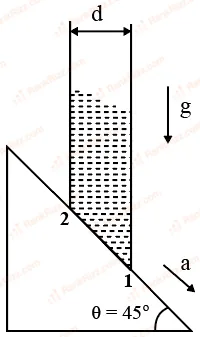
A cylindrical tube, with its base as shown in the figure, is filled with water. It is moving down with a constant acceleration 𝑎 along a fixed inclined plane with angle and are pressures at points 1 and 2, respectively, located at the base of the tube. Let , where is density of water, 𝑑 is the inner diameter of the tube and 𝑔 is the acceleration due to gravity. Which of the following statement(s) is(are) correct?
SOLUTION
In the frame of the tube the water is at rest under the effective gravity , so the pressure increases along : the pressure difference between two points equals times the component of along the line joining them, times their separation.
The tube is vertical and its base lies along the incline, so point 1 lies down the slope from point 2 at a distance .
Along the slope (downwards), has component and has component , so
For : , so (A) is correct and (B) is wrong.
For : , so (C) is correct and (D) is wrong.
Hence, the correct options are (A) and (C).
Tagged Fluid pressure, Pascal's law and accelerated/rotating liquids. Machine-assigned, so read it as a strong shortlist rather than a verdict.