JEE Advanced 2020 Physics question — Fluid pressure, Pascal's law and accelerated/rotating liquids
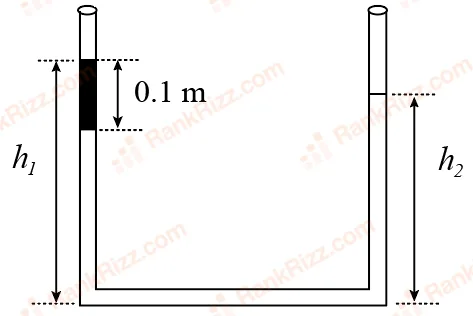
An open-ended U-tube of uniform cross-sectional area contains water (density ). Initially the water level stands at 0.29 m from the bottom in each arm. Kerosene oil (a water-immiscible liquid) of density 800 kg is added to the left arm until its length is 0.1 m, as shown in the schematic figure below. The ratio of the heights of the liquid in the two arms is
SOLUTION
Initially both arms contain only water of density up to a height from the bottom.
When kerosene (density ) of length is gently poured into the left arm, it floats on water. Let the water-kerosene interface in the left arm fall by . Because the tube has uniform cross-section, the water level in the right arm rises by the same .
Therefore, after pouring kerosene:
Left arm: height of water column = , height of kerosene column = .
Right arm: height of water column = .
Pressures at the common bottom level in the two arms must be equal (both tops are open to atmosphere). Equating hydrostatic pressures:
Cancel on both sides and substitute the densities:
Total height of liquid in each arm:
Left arm: .
Right arm: .
Required ratio:
Option B which is:
Tagged Fluid pressure, Pascal's law and accelerated/rotating liquids. Machine-assigned, so read it as a strong shortlist rather than a verdict.