RankRizz
JEE ADVANCED 2026 · PAPER 2+2MEDIUMTRANSCRIBED

JEE Advanced 2026 Physics question — Equation of continuity and Bernoulli's theorem

Question Stem for Question Nos. 15 and 16

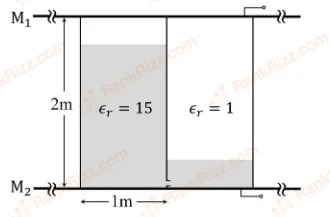
A container of height 2 m2\,\mathrm{m}, length 2 m2\,\mathrm{m} and breadth 1 m1\,\mathrm{m} is made of insulating vertical walls and two large area horizontal metal plates (M1M_1 and M2M_2) which extend far beyond the vertical walls in all directions. The container is partitioned into two equal chambers with a thin insulating vertical wall. The partition wall contains a small hole of cross-sectional area 10 cm2\sqrt{10}\,\mathrm{cm^2} near its bottom edge. Initially the hole is closed and the left chamber of the container is completely filled with a liquid of dielectric constant ϵr=15\epsilon_r=15 and the right chamber is empty (ϵr=1\epsilon_r=1). At time t=0t=0, the hole is opened and the liquid flows from the left chamber to the right chamber. In both the chambers, the space above the liquid has ϵr=1\epsilon_r=1 and is maintained at atmospheric pressure. The schematic of the container at a time t>0t>0 is shown in the figure.

[Given: acceleration due to gravity is 10 ms−210\,\mathrm{ms^{-2}}.]

Figure for JEE Advanced 2026 Physics question on Equation of continuity and Bernoulli's theorem

The height (in m) of the liquid in left chamber at t=500 st=500\,\mathrm{s} is:

SOLUTION

Torricelli's law gives the efflux velocity as v=2gΔhv = \sqrt{2g\Delta h}, and the rate of drainage is determined by the equation of continuity along with conservation of volume.

Given: H=2 mH = 2\text{ m}, A0=1 m×1 m=1 m2A_0 = 1\text{ m} \times 1\text{ m} = 1\text{ m}^2, a=10×10−4 m2a = \sqrt{10} \times 10^{-4}\text{ m}^2, g=10 ms−2g = 10\text{ ms}^{-2}

From conservation of volume: h1+h2=2  ⟹  h2=2−h1h_1 + h_2 = 2 \implies h_2 = 2 - h_1

Applying continuity equation:

−dh1dt=aA02g(h1−h2)-\frac{dh_1}{dt} = \frac{a}{A_0}\sqrt{2g(h_1 - h_2)}

−dh1dt=aA02g(2h1−2)=2agA0h1−1-\frac{dh_1}{dt} = \frac{a}{A_0}\sqrt{2g(2h_1 - 2)} = \frac{2a\sqrt{g}}{A_0}\sqrt{h_1 - 1}

∫2h1dh1h1−1=−2agA0∫0500dt\int_{2}^{h_1} \frac{dh_1}{\sqrt{h_1 - 1}} = -\frac{2a\sqrt{g}}{A_0}\int_{0}^{500} dt

[2h1−1]2h1=−2agA0(500)\left[2\sqrt{h_1 - 1}\right]_2^{h_1} = -\frac{2a\sqrt{g}}{A_0}(500)

2h1−1−2=−2⋅10×10−4⋅101⋅5002\sqrt{h_1 - 1} - 2 = -2 \cdot \frac{\sqrt{10} \times 10^{-4} \cdot \sqrt{10}}{1} \cdot 500

2h1−1−2=−12\sqrt{h_1 - 1} - 2 = -1

2h1−1=1  ⟹  h1−1=0.52\sqrt{h_1 - 1} = 1 \implies \sqrt{h_1 - 1} = 0.5

h1−1=0.25  ⟹  h1=1.25 mh_1 - 1 = 0.25 \implies h_1 = 1.25\text{ m}

Tagged Equation of continuity and Bernoulli's theorem. Machine-assigned, so read it as a strong shortlist rather than a verdict.

SubjectPhysics
TopicEquation of continuity and Bernoulli's theorem
TypeNumerical answer