RankRizz

Electrochemistry — JEE Advanced Previous Year Questions

Every Electrochemistry question JEE Advanced has set from 2007–2026, grouped by the idea it tests rather than the order of the syllabus. 32 questions across 3 distinct ideas. Free to read, answer key on every one.

Questions

32

Distinct ideas

3

Share of marks

4.3%

Difficulty

MEDIUM

The ideas inside Electrochemistry

A chapter is not one subject — it is a handful of procedures the examiner reuses. These are the ones Electrochemistry questions actually test.

01Electrode potentials, electrochemical series and cell EMFset 15×
02Galvanic cells, cell notation and salt bridgeNot set in Advanced
03Nernst equation and concentration cellsNot set in Advanced
04Relation of EMF with Gibbs energy and equilibrium constantNot set in Advanced
05Electrolysis and Faraday's lawsNot set in Advanced
06Conductance, conductivity and molar conductivityset 14×
07Kohlrausch's law and its applicationsNot set in Advanced
08Batteries, fuel cells and corrosionset 3×

Electrochemistry weightage, year by year

The share of each year’s Chemistry questions that came from Electrochemistry, counted from the 19 papers we hold for the last 10 years, and paper by paper inside a year.

Rising: 5.0% of Chemistry questions in 2024–2026, up from 3.8% in 2017–2023. Its heaviest year was 2025, at 6.3%.

20261 / 342.9%PAPER 1 0.0%PAPER 2 5.6%
20252 / 326.3%PAPER 1 6.3%PAPER 2 6.3%
20242 / 345.9%PAPER 1 5.9%PAPER 2 5.9%
20231 / 342.9%PAPER 1 5.9%PAPER 2 0.0%
20222 / 365.6%PAPER 1 5.6%PAPER 2 5.6%
20211 / 382.6%PAPER 1 0.0%PAPER 2 5.3%
20201 / 362.8%PAPER 1 5.6%PAPER 2 0.0%
20191 / 362.8%PAPER 1 5.6%PAPER 2 0.0%
20181 / 185.6%1 PAPER
20172 / 365.6%PAPER 1 5.6%PAPER 2 5.6%

“QS” is Electrochemistry questions out of all Chemistry questions that year. A year with more sittings asks more questions, which is why the share, not the count, is the number to compare.

Electrochemistry: quick answers

How many Electrochemistry questions has JEE Advanced asked?

32 questions from 2007–2026. Over the last 20 papers, Electrochemistry carried about 4.3% of Chemistry marks.

Which Electrochemistry topics come up most?

Electrode potentials, electrochemical series and cell EMF (15 questions), Conductance, conductivity and molar conductivity (14 questions), Batteries, fuel cells and corrosion (3 questions). Start with these, they are what the examiner keeps coming back to.

Is Electrochemistry important for JEE Advanced?

Rising: 5.0% of Chemistry questions in 2024–2026, up from 3.8% in 2017–2023. Its heaviest year was 2025, at 6.3%. It has carried about 4.3% of Chemistry marks in recent papers, rated medium on our difficulty scale. The year-by-year table above shows how that has moved.

Do these Electrochemistry PYQs have answers and solutions?

Yes. Every question shows its official answer key, and a worked solution opens on the question’s own page wherever we have one. Reading and checking answers is free, no sign-up needed.

What’s the fastest way to revise Electrochemistry?

Do one past question per idea first: Electrochemistry has 3 distinct ideas, listed above. Then practise the topics you get wrong, or build a timed test from this chapter.

Every Electrochemistry question

1–20 OF 32 · NEWEST FIRST

JEE ADVANCED 2026 · PAPER 2Conductance, conductivity and molar conductivityTRANSCRIBED

At 300 K, the molar conductivities of the aqueous solutions of three salts at two different concentrations are given below:
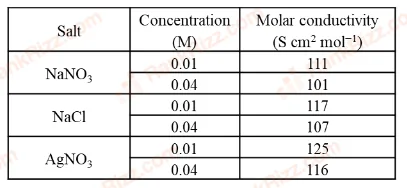
Figure for JEE Advanced 2026 Chemistry question on Conductance, conductivity and molar conductivity

The conductivity of a saturated aqueous solution of AgCl is 1.40×10−61.40\times 10^{-6} S cm−1^{-1} at 300 K. If the solubility of AgCl in water at 300 K is XX mol L−1^{-1}, then log⁡10(X−1)\log_{10}(X^{-1}) is

(Assume that AgCl dissolved in water ionizes completely and that the molar conductivity of saturated AgCl solution is equal to its limiting molar conductivity.)

  1. A

    33

  2. B

    44

  3. C

    55

  4. D

    66

JEE ADVANCED 2025 · PAPER 1Conductance, conductivity and molar conductivityTRANSCRIBED

In an electrochemical cell, dichromate ions in aqueous acidic medium are reduced to Cr3+^{3+}. The current (in amperes) that flows through the cell for 48.25 minutes to produce 1 mole of Cr3+^{3+} is ________.

Use: 1 Faraday = 96500 C mol−1^{-1}

JEE ADVANCED 2025 · PAPER 2Batteries, fuel cells and corrosionTRANSCRIBED

An electrochemical cell is fueled by the combustion of butane at 1 bar and 298 K. Its cell potential is XF×103\frac{X}{F} \times 10^3 volts, where FF is the Faraday constant. The value of XX is ______.

Use: Standard Gibbs energies of formation at 298 K are: ΔfGCO2o=−394\Delta_f G^o_{CO_2} = -394 kJ mol−1^{-1}; ΔfGwatero=−237\Delta_f G^o_{water} = -237 kJ mol−1^{-1}; ΔfGbutaneo=−18\Delta_f G^o_{butane} = -18 kJ mol−1^{-1}

JEE ADVANCED 2024 · PAPER 2Batteries, fuel cells and corrosionTRANSCRIBED

An aqueous solution of hydrazine (N2H4N_2H_4) is electrochemically oxidized by O2O_2, thereby releasing chemical energy in the form of electrical energy. One of the products generated from the electrochemical reaction is N2(g)N_2(g).

Choose the correct statement(s) about the above process

  1. A

    OH−OH^- ions react with N2H4N_2H_4 at the anode to form N2(g)N_2(g) and water, releasing 4 electrons to the anode.

  2. B

    At the cathode, N2H4N_2H_4 breaks to N2(g)N_2(g) and nascent hydrogen released at the electrode reacts with oxygen to form water.

  3. C

    At the cathode, molecular oxygen gets converted to OH−OH^-.

  4. D

    Oxides of nitrogen are major by-products of the electrochemical process.

JEE ADVANCED 2024 · PAPER 1Conductance, conductivity and molar conductivityTRANSCRIBED

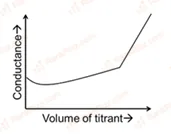
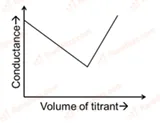
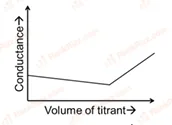
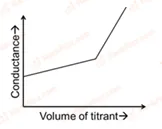
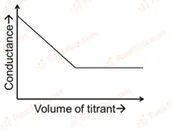
In a conductometric titration, small volume of titrant of higher concentration is added stepwise to a larger volume of titrate of much lower concentration, and the conductance is measured after each addition.

The limiting ionic conductivity (Λ0\Lambda_0) values (in mS m2m^2 mol−1mol^{-1}) for different ions in aqueous solutions are given below:

IonsAg+Ag^+K+K^+Na+Na^+H+H^+NO3−NO_3^-Cl−Cl^-SO42−SO_4^{2-}OH−OH^-CH3COO−CH_3COO^-
Λ0\Lambda_06.27.45.035.07.27.616.019.94.1

For different combinations of titrates and titrants given in List-I, the graphs of 'conductance' versus 'volume of titrant' are given in List-II.

Match each entry in List-I with the appropriate entry in List-II and choose the correct option.

List-IList-II
(P)Titrate: KCl
Titrant: AgNO3AgNO_3
(1)
Figure for JEE Advanced 2024 Chemistry question on Conductance, conductivity and molar conductivity
(Q)Titrate: AgNO3AgNO_3
Titrant: KCl
(2)
Figure for JEE Advanced 2024 Chemistry question on Conductance, conductivity and molar conductivity
(R)Titrate: NaOH
Titrant: HCl
(3)
Figure for JEE Advanced 2024 Chemistry question on Conductance, conductivity and molar conductivity
(S)Titrate: NaOH
Titrant: CH3COOHCH_3COOH
(4)
Figure for JEE Advanced 2024 Chemistry question on Conductance, conductivity and molar conductivity
(5)
Figure for JEE Advanced 2024 Chemistry question on Conductance, conductivity and molar conductivity
  1. A

    P-4, Q-3, R-2, S-5

  2. B

    P-2, Q-4, R-3, S-1

  3. C

    P-3, Q-4, R-2, S-5

  4. D

    P-4, Q-3, R-2, S-1

JEE ADVANCED 2023 · PAPER 1Conductance, conductivity and molar conductivityTRANSCRIBED

Plotting 1/Λm1/\Lambda_m against cΛmc\Lambda_m for aqueous solutions of a monobasic weak acid (HX) resulted in a straight line with y-axis intercept of P and slope of S. The ratio P/S is

[Λm\Lambda_m = molar conductivity, Λm∘\Lambda_m^\circ = limiting molar conductivity, c = molar concentration, KaK_a = dissociation constant of HX]

  1. A

    KaΛm∘K_a \Lambda_m^\circ

  2. B

    KaΛm∘/2K_a \Lambda_m^\circ / 2

  3. C

    2KaΛm∘2 K_a \Lambda_m^\circ

  4. D

    1/(KaΛm∘)1 / (K_a \Lambda_m^\circ)

JEE ADVANCED 2022 · PAPER 1Electrode potentials, electrochemical series and cell EMFTRANSCRIBED

The reduction potential (E0E^0, in V) of MnO4−MnO_4^-(aq)/Mn(s) is ______.

[Given : EMnO4−(aq)/MnO2(s)0=1.68E^0_{MnO_4^-(aq)/MnO_2(s)} = 1.68 V ; EMnO2(s)/Mn2+(aq)0=1.21E^0_{MnO_2(s)/Mn^{2+}(aq)} = 1.21 V ; EMn2+(aq)/Mn(s)0=−1.03E^0_{Mn^{2+}(aq)/Mn(s)} = -1.03 V]

JEE ADVANCED 2022 · PAPER 2Conductance, conductivity and molar conductivityTRANSCRIBED

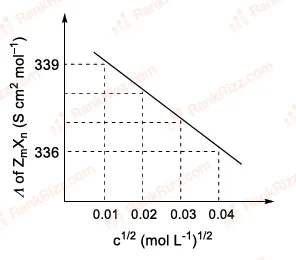
Consider the strong electrolytes Zm_mXn_n, Um_mYp_p and Vm_mXn_n. Limiting molar conductivity (Λ0\Lambda^0) of Um_mYp_p and Vm_mXn_n are 250 and 440 S cm2^2 mol−1^{-1}, respectively. The value of (m + n + p) is _______.

Given:

IonZn+^{n+}Up+^{p+}Vn+^{n+}Xm−^{m-}Ym−^{m-}
λ0\lambda^0 (S cm2^2 mol−1^{-1})50.025.0100.080.0100.0

λ0\lambda^0 is the limiting molar conductivity of ions

The plot of molar conductivity (Λ\Lambda) of Zm_mXn_n vs c1/2^{1/2} is given below.

Figure for JEE Advanced 2022 Chemistry question on Conductance, conductivity and molar conductivity
JEE ADVANCED 2021 · PAPER 2Electrode potentials, electrochemical series and cell EMFTRANSCRIBED

Some standard electrode potentials at 298 K are given below:
Pb2+^{2+}/Pb -0.13 V
Ni2+^{2+}/Ni -0.24 V
Cd2+^{2+}/Cd -0.40 V
Fe2+^{2+}/Fe -0.44 V
To a solution containing 0.001 M of X2+^{2+} and 0.1 M of Y2+^{2+}, the metal rods X and Y are inserted (at 298 K) and connected by a conducting wire. This resulted in dissolution of X. The correct combination(s) of X and Y, respectively, is(are)
(Given: Gas constant, R = 8.314 J K−1^{-1} mol−1^{-1}, Faraday constant, F = 96500 C mol−1^{-1})

  1. A

    Cd and Ni

  2. B

    Cd and Fe

  3. C

    Ni and Pb

  4. D

    Ni and Fe

JEE ADVANCED 2020 · PAPER 1Batteries, fuel cells and corrosionTRANSCRIBED

Consider a 70% efficient hydrogen-oxygen fuel cell working under standard conditions at 1 bar and
298 K. Its cell reaction is
H2(g)+12O2(g)→H2O(l)H_{2} (g) + \frac{1}{2}O_{2}(g) \rightarrow H_{2}O (l)

The work derived from the cell on the consumption of 1.0×10−31.0 \times 10^{−3} mol of H2H_{2}(g) is used to compress
1.00 mol of a monoatomic ideal gas in a thermally insulated container. What is the change in the
temperature (in K) of the ideal gas?

The standard reduction potentials for the two half-cells are given below.
O2(g)+4H+(aq)+4e−→2H2O(l),E0=1.23VO_{2}(g) + 4H^{+} (aq) + 4e^{-} \rightarrow 2 H_{2}O (l), E^{0} = 1.23 V,

2H+(aq)+2e−→H2(g),E0=0.00V2H^{+} (aq) + 2e^{-} \rightarrow H_{2} (g), E^{0} = 0.00 V.

Use 𝐹=96500Cmol−1,𝑅=8.314Jmol−1K−1𝐹 = 96500 C mol^{−1},𝑅 = 8.314 J mol^{−1} K^{−1}.

JEE ADVANCED 2019 · PAPER 1Conductance, conductivity and molar conductivityTRANSCRIBED

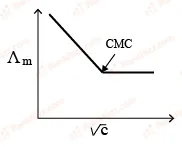
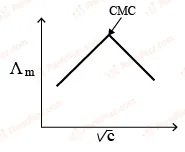
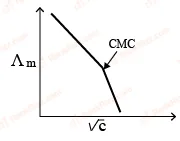
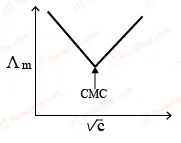
Molar conductivity (∧m)(\wedge_m) of aqueous solution of sodium stearate, which behaves as a strong electrolyte, is recorded at varying concentrations (c) of sodium stearate. Which oneofthe following plots provides the correct representation of micelle formation in the solution?
(critical micelle concentration (CMC) is marked with an arrow in the figures

  1. A
    Figure for JEE Advanced 2019 Chemistry question on Conductance, conductivity and molar conductivity
  2. B
    Figure for JEE Advanced 2019 Chemistry question on Conductance, conductivity and molar conductivity
  3. C
    Figure for JEE Advanced 2019 Chemistry question on Conductance, conductivity and molar conductivity
  4. D
    Figure for JEE Advanced 2019 Chemistry question on Conductance, conductivity and molar conductivity
JEE ADVANCED 2018 · PAPER 1Electrode potentials, electrochemical series and cell EMFTRANSCRIBED

For the electrochemical cell,
Mg(s)∣Mg2+Mg(s) \mid Mg^{2+} (aq,1M) ∥Cu2+\parallel Cu^{2+} (aq,1M) ∣Cu(s)\mid Cu(s) the standard emf of the cell is 2.70 V at 300 K. When the concentration of Mg2+Mg^{2+} is changed to 𝒙 M, the cell potential changes to 2.67 V at 300 K. The value of 𝒙 is ____.
(given FR=11500KV−1\frac{F}{R} = 11500 KV^{-1}, where F is the Faraday constant and 𝑅 is the gas constant, ln⁡(10)=2.30)\ln(10) = 2.30)

JEE ADVANCED 2017 · PAPER 2Electrode potentials, electrochemical series and cell EMFTRANSCRIBED

For the following cell, Zn(s)∣ZnSO4(aq)∥CuSO4(aq)∣Cu(s)Zn(s)\mid ZnSO_{4}(aq)\parallel CuSO_{4}(aq)\mid Cu(s) when the concentration of Zn2+Zn^{2+} is 10 times the concentration of Cu2+Cu^{2+}, the expression for △G\triangle G ((in J mol−1mol^{-1}) is [F is Faraday constant; R is gas constant; T is temperature; E0(cell)=1.1VE^{0}(cell)=1.1V]

  1. A

    1.1F

  2. B

    2.303RT-2.2F

  3. C

    2.303RT+1.1F

  4. D

    -2.2F

JEE ADVANCED 2017 · PAPER 1Conductance, conductivity and molar conductivityTRANSCRIBED

The conductance of a 0.0015 M aqueous solution of a weak monobasic acid was determined by using a conductivity cell consisting of platinized Pt electrodes. The distance between the electrodes is 120 cm with an area of cross section of 1cm21 cm^2. The conductance of this solution was found to be 5×10⁻⁷S5 \times 10^{-7} S. The pH of the solution is 4. The value of limiting molar conductivity (⋀m0)\left(\bigwedge_m^0\right) of this weak monobasic acid in aqueous solution is Z×102Scm−1mol−1Z \times 10^2 S cm^{-1} mol^{-1}. The value of Z is

JEE ADVANCED 2016 · PAPER 2Electrode potentials, electrochemical series and cell EMFTRANSCRIBED

For the following electrochemical cell at 298 K,
Pt(s)∣H2(g,1bar)∣H+(aq,1M)∥M4+(aq),M2+(aq)∣Pt(s)Pt(s) \mid H_2(g, 1 bar) \mid H^+(aq, 1M) \parallel M^{4+}(aq), M^{2+}(aq) \mid Pt(s)
Ecell=0.092VE_{cell} = 0.092 V and when [M2+(aq)][M4+(aq)]=10x\frac{[M^{2+}(aq)]}{[M^{4+}(aq)]} = 10^x.
Given : EM4+M2+0=0.15V;2.303RTF=0.059VE_{\frac{M^{4+}}{M^{2+}}}^{0} = 0.15 V; 2.303 \frac{RT}{F} = 0.059 V
The value of x is

  1. A

    -2

  2. B

    -1

  3. C

    1

  4. D

    2

JEE ADVANCED 2015 · PAPER 2Conductance, conductivity and molar conductivityTRANSCRIBED

The molar conductivity of a solution of a weak acid HX (0.01 M) is 10 times smaller than the molar conductivity of a solution of a weak acid HY (0.10 M). If λX0≈λY0\lambda_X^0 \approx \lambda_Y^0, the difference in their pKapK_a values, pKa(HX)−pKa(HY)pK_a (HX) - pK_a (HY), is (consider degree of ionization of both acids to be ≪1\ll 1

JEE ADVANCED 2015 · PAPER 1Electrode potentials, electrochemical series and cell EMFTRANSCRIBED

All the energy released from the reaction X→Y,△rG0=−193kJmol−1X \rightarrow Y, \triangle_r G^0 = - 193 kJ mol^{-1} is used for oxidizing M+M^+ as M+→M3++2e−,E0=−0.25VM^+ \rightarrow M^{3+} + 2e^-, E^0 = -0.25 V Under standard conditions, the number of moles of M+M^+ oxidized when one mole of X is converted to Y is [F = 96500 C mol−1mol^{-1}]

JEE ADVANCED 2014 · PAPER 1Electrode potentials, electrochemical series and cell EMFTRANSCRIBED

In a galvanic cell, the salt bridge

  1. A

    does not participate chemically in the cell reaction.

  2. B

    stops the diffusion of ions from one electrode to another.

  3. C

    is necessary for the occurrence of the cell reaction.

  4. D

    ensures mixing of the two electrolytic solutions.

JEE ADVANCED 2013 · PAPER 2Electrode potentials, electrochemical series and cell EMFTRANSCRIBED

The standard reduction potential data at 25∘C25^\circ C is given below.
E∘(Fe3+,Fe2+)=+0.77VE^\circ(Fe^{3+}, Fe^{2+}) = + 0.77 V;

E∘(Fe2+,Fe)=−0.44VE^\circ(Fe^{2+}, Fe) = - 0.44 V;

E∘(Cu2+,Cu)=+0.34VE^\circ(Cu^{2+}, Cu) = + 0.34 V;

E∘(Cu+,Cu)=+0.52VE^\circ(Cu^{+}, Cu) = + 0.52 V;

E∘[O2(g)+4H++4e−→2H2O]=+1.23VE^\circ[O_2(g) + 4H^+ + 4e^{-} \rightarrow 2H_2O] = + 1.23 V;

E∘[O2(g)+2H2O+4e−→4OH−]=+0.40VE^\circ[O_2(g) + 2H_2O + 4e^{-} \rightarrow 4OH^{-}] = + 0.40 V;

E∘(Cr3+,Cr)=−0.74VE^\circ(Cr^{3+}, Cr) = - 0.74 V;

E∘(Cr2+,Cr)=−0.91VE^\circ(Cr^{2+}, Cr) = - 0.91 V

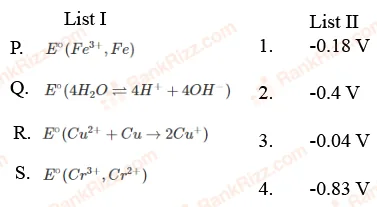
Match E∘E^\circ of the redox pair in List I with the values given in List II and select the correct answer using the code given below the lists:

Figure for JEE Advanced 2013 Chemistry question on Electrode potentials, electrochemical series and cell EMF
  1. A

    P-4, Q-1, R-2, S-3

  2. B

    P-2, Q-3, R-4, S-1

  3. C

    P-1, Q-2, R-3, S-4

  4. D

    P-3, Q-4, R-1, S-2

JEE ADVANCED 2013 · PAPER 2Conductance, conductivity and molar conductivityTRANSCRIBED

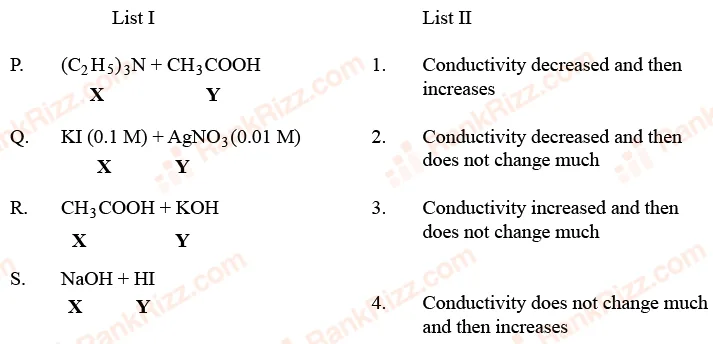
An aqueous solution of X is added slowly to an aqueous solution of Y as shown in List J. The variation in conductivity of these reactions is given in List II. Match List I with List II and select the correct answer using the code given below the lists:

Figure for JEE Advanced 2013 Chemistry question on Conductance, conductivity and molar conductivity
  1. A

    P-3, Q-4, R-2, S-1

  2. B

    P-4, Q-3, R-2, S-1

  3. C

    P-2, Q-3, R-4, S-1

  4. D

    P-1, Q-4, R-3, S-2