RankRizz
JEE ADVANCED 2022 · PAPER 2+3 / −1HARDTRANSCRIBED

JEE Advanced 2022 Chemistry question — Conductance, conductivity and molar conductivity

Consider the strong electrolytes Zm_mXn_n, Um_mYp_p and Vm_mXn_n. Limiting molar conductivity (Λ0\Lambda^0) of Um_mYp_p and Vm_mXn_n are 250 and 440 S cm2^2 mol−1^{-1}, respectively. The value of (m + n + p) is _______.

Given:

IonZn+^{n+}Up+^{p+}Vn+^{n+}Xm−^{m-}Ym−^{m-}
λ0\lambda^0 (S cm2^2 mol−1^{-1})50.025.0100.080.0100.0

λ0\lambda^0 is the limiting molar conductivity of ions

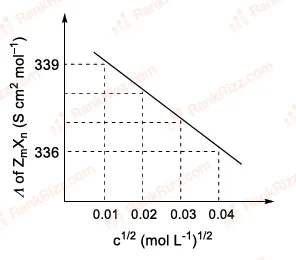
The plot of molar conductivity (Λ\Lambda) of Zm_mXn_n vs c1/2^{1/2} is given below.

Figure for JEE Advanced 2022 Chemistry question on Conductance, conductivity and molar conductivity
SOLUTION

For a strong electrolyte, Kohlrausch’s law of independent ionic migration states that its limiting molar conductivity is the sum of the ionic conductivities multiplied by their stoichiometric coefficients:
Λ0=∑νi λi0−(1)\Lambda^0=\sum \nu_i\,\lambda_i^0 \qquad -(1)

Let the stoichiometric coefficients in the three electrolytes be:

ZmXn    ⟶\longrightarrow    m Zn++n Xm−m\,\text{Z}^{n+}+n\,\text{X}^{m-}
UmYp    ⟶\longrightarrow    m Up++p Ym−m\,\text{U}^{p+}+p\,\text{Y}^{m-}
VmXn    ⟶\longrightarrow    m Vn++n Xm−m\,\text{V}^{n+}+n\,\text{X}^{m-}

The given ionic conductivities are:

λZn+0=50.0,  λUp+0=25.0,  λVn+0=100.0,  λXm−0=80.0,  λYm−0=100.0    (all in S cm2 mol−1).\lambda^0_{\text{Z}^{n+}}=50.0,\; \lambda^0_{\text{U}^{p+}}=25.0,\; \lambda^0_{\text{V}^{n+}}=100.0,\; \lambda^0_{\text{X}^{m-}}=80.0,\; \lambda^0_{\text{Y}^{m-}}=100.0\;\;(\text{all in S cm}^2\text{ mol}^{-1}).

Electrolyte UmYp
Applying (1):
ΛUmYp0=m λUp+0+p λYm−0\Lambda^0_{U_mY_p}=m\,\lambda^0_{\text{U}^{p+}}+p\,\lambda^0_{\text{Y}^{m-}} 250=25 m+100 p250 = 25\,m + 100\,p Divide by 25:
m+4p=10−(2)m + 4p = 10 \qquad -(2)

Electrolyte VmXn
Similarly:
ΛVmXn0=m λVn+0+n λXm−0\Lambda^0_{V_mX_n}=m\,\lambda^0_{\text{V}^{n+}}+n\,\lambda^0_{\text{X}^{m-}} 440=100 m+80 n440 = 100\,m + 80\,n Divide by 20:
5m+4n=22−(3)5m + 4n = 22 \qquad -(3)

Equations (2) and (3) must be satisfied by positive integers m, n, p.

From (3):
5m=22−4n5m = 22 - 4n The right-hand side must be a multiple of 5. Testing integer values of nn:

n = 1 →\rightarrow 22 − 4 = 18 (not multiple of 5)
n = 2 →\rightarrow 22 − 8 = 14 (not multiple of 5)
n = 3 →\rightarrow 22 − 12 = 10 (multiple of 5) ⇒\Rightarrow m=105=2m = \frac{10}{5}=2

No larger positive value of nn keeps the right side positive, so the unique solution is
m=2,  n=3m = 2,\; n = 3

Substitute m=2m = 2 into (2):
2+4p=10    ⇒    4p=8    ⇒    p=22 + 4p = 10 \;\;\Rightarrow\;\; 4p = 8 \;\;\Rightarrow\;\; p = 2

Thus
m=2,  n=3,  p=2m = 2,\; n = 3,\; p = 2

The required sum is
(m+n+p)=2+3+2=7(m+n+p) = 2 + 3 + 2 = 7

Hence, the value of (m + n + p) is 7.

Tagged Conductance, conductivity and molar conductivity. Machine-assigned, so read it as a strong shortlist rather than a verdict.

SubjectChemistry
TopicConductance, conductivity and molar conductivity
TypeNumerical answer