JEE ADVANCED 2026 · PAPER 1Geometrical and optical isomerism in complexesTRANSCRIBED
The total number of all possible isomers for the square planar complex with formula is ___.
(M = metal ion and gly = )
Every Coordination Compounds question JEE Advanced has set from 2007–2026, grouped by the idea it tests rather than the order of the syllabus. 46 questions across 9 distinct ideas. Free to read, answer key on every one.
Questions
46
Distinct ideas
9
Share of marks
5.7%
Difficulty
MEDIUM
A chapter is not one subject — it is a handful of procedures the examiner reuses. These are the ones Coordination Compounds questions actually test.
The share of each year’s Chemistry questions that came from Coordination Compounds, counted from the 19 papers we hold for the last 10 years, and paper by paper inside a year.
Rising: 8.0% of Chemistry questions in 2024–2026, up from 5.1% in 2017–2023. Its heaviest year was 2024, at 11.8%.
“QS” is Coordination Compounds questions out of all Chemistry questions that year. A year with more sittings asks more questions, which is why the share, not the count, is the number to compare.
46 questions from 2007–2026. Over the last 20 papers, Coordination Compounds carried about 5.7% of Chemistry marks.
Colour and magnetic behaviour of complexes from CFT (18 questions), Geometrical and optical isomerism in complexes (13 questions), Valence bond theory of complexes (5 questions). Start with these, they are what the examiner keeps coming back to.
Rising: 8.0% of Chemistry questions in 2024–2026, up from 5.1% in 2017–2023. Its heaviest year was 2024, at 11.8%. It has carried about 5.7% of Chemistry marks in recent papers, rated medium on our difficulty scale. The year-by-year table above shows how that has moved.
Yes. Every question shows its official answer key, and a worked solution opens on the question’s own page wherever we have one. Reading and checking answers is free, no sign-up needed.
Do one past question per idea first: Coordination Compounds has 9 distinct ideas, listed above. Then practise the topics you get wrong, or build a timed test from this chapter.
1–20 OF 46 · NEWEST FIRST
The total number of all possible isomers for the square planar complex with formula is ___.
(M = metal ion and gly = )
Consider that the coordinating atoms of the ligands in cis-[Co(NH)Cl]Cl and mer-[Co(NH)Cl] octahedral complexes are at the vertices of an octahedron. The sum of total number of the triangular faces in both the complexes having one N atom and two Cl atoms at their corners is ___.
The correct order of the wavelength maxima of the absorption band in the ultraviolet-visible region for the given complexes is
[Co(CN)] < [Co(NH)] < [Co(NH)(HO)] < [Co(NH)(Cl)]
[Co(NH)(Cl)] < [Co(NH)(HO)] < [Co(NH)] < [Co(CN)]
[Co(CN)] < [Co(NH)(Cl)] < [Co(NH)(HO)] < [Co(NH)]
[Co(NH)] < [Co(CN)] < [Co(NH)(Cl)] < [Co(NH)(HO)]
The sum of the spin only magnetic moment values (in B.M.) of [Mn(Br)] and [Mn(CN)] is ______.
Among the following options, select the option in which each complex in Set-I shows geometrical isomerism and the two complexes in Set-II are ionization isomers of each other.
[en = ]
Set-I: and
Set-II: and
Set-I: and
Set-II: and
Set-I: and
Set-II: and
Set-I: and
Set-II: and
Among , , , , , , , and , the total number of species isoelectronic with is ______.
[Given atomic number : V = 23, Cr = 24, Mn = 25, Fe = 26, Co = 27, Ni = 28, Cu = 29, Ir = 77]
Among , , , , , , and the total number of species with tetrahedral geometry is ______.
Among the following complexes, the total number of diamagnetic species is ______.
, , , , and
[Given, atomic number: Mn = 25, Fe = 26, Co = 27; en = ]
The complex(es), which can exhibit the type of isomerism shown by [Pt(NH)Br], is(are)
[en = HNCHCHNH]
[Pt(en)(SCN)]
[Zn(NH)Cl]
[Pt(NH)Cl]
[Cr(en)(HO)(SO)]
Match the electronic configurations in List-I with appropriate metal complex ions in List-II and choose the correct option.
[Atomic Number: Fe = 26, Mn = 25, Co = 27]
| List-I | List-II | ||
|---|---|---|---|
| (P) | (1) | ||
| (Q) | (2) | ||
| (R) | (3) | ||
| (S) | (4) | ||
| (5) | |||
P 1; Q 4; R 2; S 3
P 1; Q 2; R 4; S 5
P 3; Q 2; R 5; S 1
P 3; Q 2; R 4; S 1
LIST-I contains metal species and LIST-II contains their properties.
| LIST-I | LIST-II |
|---|---|
| (I) | (P) orbitals contain 4 electrons |
| (II) | (Q) (spin-only) = 4.9 BM |
| (III) | (R) low spin complex ion |
| (IV) | (S) metal ion in 4+ oxidation state |
| (T) species |
[Given : Atomic number of Cr = 24, Ru = 44, Fe = 26]
Match each metal species in LIST-I with their properties in LIST-II, and choose the correct option
I R, T; II P, S; III Q, T; IV P, Q
I R, S; II P, T; III P, Q; IV Q, T
I P, R; II R, S; III R, T; IV P, T
I Q, T; II S, T; III P, T; IV Q, R
The calculated spin only magnetic moments of and in BM, respectively, are (Atomic numbers of Cr and Cu are 24 and 29, respectively)
3.87 and 2.84
4.90 and 1.73
3.87 and 1.73
4.90 and 2.84
The pair(s) of complexes wherein both exhibit tetrahedral geometry is(are)
(Note: py = pyridine
Given: Atomic numbers of Fe, Co, Ni and Cu are 26, 27, 28 and 29, respectively)
and
and
and
and
The total number of possible isomers for is ___.
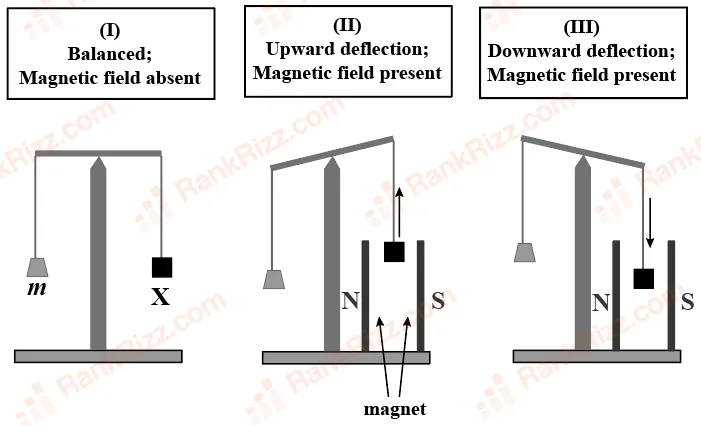
In an experiment, 𝑚 grams of a compound X (gas/liquid/solid) taken in a container is loaded in a balance as shown in figure I below. In the presence of a magnetic field, the pan with X is either deflected upwards (figure II), or deflected downwards (figure III), depending on the compound X. Identify the correct statement(s).
If X is , deflection of the pan is upwards.
If X is , deflection of the pan is upwards.
If X is , deflection of the pan is downwards.
If X is , deflection of the pan is downwards.
Choose the correct statement(s) among the following:
has tetrahedral geometry.
has 2 geometrical isomers.
(C) $$\left[FeCl_{4}]^{−} has higher spin-only magnetic moment than [Co(en)(NH3)2Cl2]+.
(D) The cobalt ion in has hybridization.
Total number of c is N-Mn-Cl bond angles (that is, Mn-N and Mn-Cl bonds in c is positions) present in a molecule of c is- complex is (en =
The correct statement(s) regarding the binary transition metal carbonyl compounds is (are) (Atomic numbers: Fe = 26, Ni = 28)
Total number of valence shell electrons at metal centre in is 16
These are predominantly low spin in nature
Metal-carbon bond strengthens when the oxidation state of the metal is lowered
The carbonyl C−O bond weakens when the oxidation state of the metal is increased
The ammonia prepared by treating ammonium sulphate with calcium hydroxide is completely used by tp form a stable coordination compound. Assume that both the reactions are 100% complete. If 1584 g of ammonium sulphate and 952 g of are used in the preparation, the combined weight (in grams) of gypsum and the nickel-ammonia coordination compound thus produced is ____
(Atomic weights in g )
Addition of excess aqueous ammonia to a pink coloured aqueous solution of and gives an octahedral complex Y in the presence of air. In aqueous solution, complex Y behaves as 1:3 electrolyte. The reaction of X with excess HCl at room temperature results in the formation of a blue coloured complex Z. The calculated spin only magnetic moment of X and Z is 3.87 B.M., whereas it is zero for complex Y. Among the following options, which statement(s) is(are) correct?
Addition of silver nitrate to Y gives only two equivalents of silver chloride
The hybridization of the central metal ion in Y is
Z is a tetrahedral complex
When X and Z are in equilibrium at , the colour of the solution is pink
JEE Main has set 373 Coordination Compounds questions too. Coordination Compounds JEE Main PYQs →
OTHER CHEMISTRY CHAPTERS