RankRizz

Polymers — JEE Advanced Previous Year Questions

Every Polymers question JEE Advanced has set from 2007–2026, grouped by the idea it tests rather than the order of the syllabus. 10 questions across 2 distinct ideas. Free to read, answer key on every one.

Questions

10

Distinct ideas

2

Share of marks

1.1%

Difficulty

EASY

The ideas inside Polymers

A chapter is not one subject — it is a handful of procedures the examiner reuses. These are the ones Polymers questions actually test.

01Classification of polymers and types of polymerisationset 7×
02Important polymers and their monomersset 3×
03Rubber and biodegradable polymersNot set in Advanced

Polymers weightage, year by year

The share of each year’s Chemistry questions that came from Polymers, counted from the 19 papers we hold for the last 10 years, and paper by paper inside a year.

Rising: 2.0% of Chemistry questions in 2024–2026, up from 0.9% in 2017–2023. Its heaviest year was 2025, at 3.1%. Not asked at all in 2017, 2018, 2020, 2021, 2023, 2024.

20261 / 342.9%PAPER 1 0.0%PAPER 2 5.6%
20251 / 323.1%PAPER 1 6.3%PAPER 2 0.0%
20240 / 340.0%PAPER 1 0.0%PAPER 2 0.0%
20230 / 340.0%PAPER 1 0.0%PAPER 2 0.0%
20221 / 362.8%PAPER 1 0.0%PAPER 2 5.6%
20210 / 380.0%PAPER 1 0.0%PAPER 2 0.0%
20200 / 360.0%PAPER 1 0.0%PAPER 2 0.0%
20191 / 362.8%PAPER 1 0.0%PAPER 2 5.6%
20180 / 180.0%1 PAPER
20170 / 360.0%PAPER 1 0.0%PAPER 2 0.0%

“QS” is Polymers questions out of all Chemistry questions that year. A year with more sittings asks more questions, which is why the share, not the count, is the number to compare.

Polymers: quick answers

How many Polymers questions has JEE Advanced asked?

10 questions from 2007–2026. Over the last 20 papers, Polymers carried about 1.1% of Chemistry marks.

Which Polymers topics come up most?

Classification of polymers and types of polymerisation (7 questions), Important polymers and their monomers (3 questions). Start with these, they are what the examiner keeps coming back to.

Is Polymers important for JEE Advanced?

Rising: 2.0% of Chemistry questions in 2024–2026, up from 0.9% in 2017–2023. Its heaviest year was 2025, at 3.1%. Not asked at all in 2017, 2018, 2020, 2021, 2023, 2024. It has carried about 1.1% of Chemistry marks in recent papers, rated easy on our difficulty scale. The year-by-year table above shows how that has moved.

Do these Polymers PYQs have answers and solutions?

Yes. Every question shows its official answer key, and a worked solution opens on the question’s own page wherever we have one. Reading and checking answers is free, no sign-up needed.

What’s the fastest way to revise Polymers?

Do one past question per idea first: Polymers has 2 distinct ideas, listed above. Then practise the topics you get wrong, or build a timed test from this chapter.

Every Polymers question

1–10 OF 10 · NEWEST FIRST

JEE ADVANCED 2026 · PAPER 2Important polymers and their monomersTRANSCRIBED

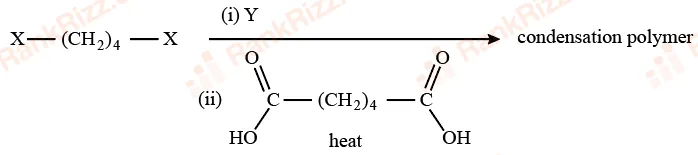
In the following reaction sequence, major products X and Y are acyclic monomers.
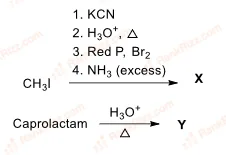
Figure for JEE Advanced 2026 Chemistry question on Important polymers and their monomers

500 mol of X completely reacts with 500 mol of Y to give 1 mol of a single biodegradable acyclic copolymer Z as the only product. The amount of Z formed in grams is ___.

Given: Atomic mass (in amu): H : 1, C : 12, N : 14, O : 16, Br : 80
JEE ADVANCED 2025 · PAPER 1Important polymers and their monomersTRANSCRIBED

The monomer (X) involved in the synthesis of Nylon 6,6 gives positive carbylamine test. If 10 moles of X are analyzed using Dumas method, the amount (in grams) of nitrogen gas evolved is ________.

Use: Atomic mass of N (in amu) = 14

JEE ADVANCED 2022 · PAPER 2Important polymers and their monomersTRANSCRIBED

Among the following, the correct statement(s) about polymers is(are)

  1. A

    The polymerization of chloroprene gives natural rubber.

  2. B

    Teflon is prepared from tetrafluoroethene by heating it with persulphate catalyst at high pressures.

  3. C

    PVC are thermoplastic polymers.

  4. D

    Ethene at 350-570 K temperature and 1000-2000 atm pressure in the presence of a peroxide initiator yields high density polythene.

JEE ADVANCED 2019 · PAPER 2Classification of polymers and types of polymerisationTRANSCRIBED

Choose the correct option(s) from the following

  1. A

    Natural rubber is polyisoprene containing trans alkene units

  2. B

    Nylon-6 has amide linkages

  3. C

    Teflon is prepared by heating tetrafluoroethene in presence of a persulphate catalyst at high pressure

  4. D

    Cellulose has only α\alpha-D-glucose units that are joined by glycosidic linkages

JEE ADVANCED 2016 · PAPER 1Classification of polymers and types of polymerisationTRANSCRIBED

On complete hydrogenation, natural rubber produces

  1. A

    ethylene-propylene copolymer

  2. B

    vulcanised rubber

  3. C

    polypropylene

  4. D

    polybutylene

JEE ADVANCED 2015 · PAPER 2Classification of polymers and types of polymerisationTRANSCRIBED

Under hydrolytic conditions, the compounds used for preparation of linear polymer and for chain termination, respectively, are

  1. A

    CH3SiCl3CH_3SiCl_3 and Si(CH3)4Si(CH_3)_4

  2. B

    (CH3)2SiCl2(CH_3)_2 SiCl_2 and $$(CH_3)_3SiCl

  3. C

    (CH3)2SiCl2(CH_3)_2 SiCl_2 and CH3SiCl3CH_3 SiCl_3

  4. D

    SiCl4SiCl_4 and (CH3)3SiCl(CH_3)_3 SiCl

JEE ADVANCED 2013 · PAPER 1Classification of polymers and types of polymerisationTRANSCRIBED

The total numberof lone-pairs of electrons in melamine is

JEE ADVANCED 2011 · PAPER 2Classification of polymers and types of polymerisationTRANSCRIBED

The correct functional group X and the reagent/reaction conditions Y in the following scheme are

Figure for JEE Advanced 2011 Chemistry question on Classification of polymers and types of polymerisation
  1. A

    X=COOCH3,Y=H2/Ni/heatX = COOCH_3, Y = H_2/Ni/heat

  2. B

    X=CONH2,Y=H2/Ni/heatX = CONH_2, Y = H_2/Ni/heat

  3. C

    X=CONH2,Y=Br2/NaOHX = CONH_2, Y = Br_2/NaOH

  4. D

    X=CN,Y=H2/Ni/heatX = CN, Y = H_2/Ni/heat

JEE ADVANCED 2009 · PAPER 1Classification of polymers and types of polymerisationTRANSCRIBED

Among cellulose, poly(vinyl chloride), nylon and natural rubber, the polymer in which the intermolecular force of attraction is weakest is -

  1. A

    Nylon

  2. B

    Poly(vinyl chloride)

  3. C

    Cellulose

  4. D

    Natural Rubber

JEE ADVANCED 2007 · PAPER 1Classification of polymers and types of polymerisationTRANSCRIBED

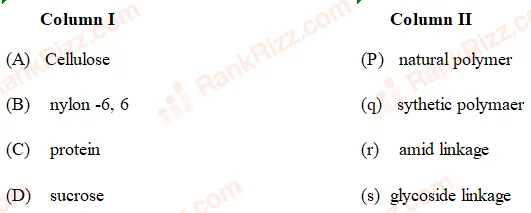
Match the chemical substances in Column I with type of polymers/type of bonds in Column II. Indicate your answer by darkening the appropriate bubbles of the 4×44 \times 4 matrix given in the ORS.

Figure for JEE Advanced 2007 Chemistry question on Classification of polymers and types of polymerisation