JEE ADVANCED 2013 · PAPER 2+3 / −1MEDIUMTRANSCRIBED
JEE Advanced 2013 Chemistry question — Conductance, conductivity and molar conductivity
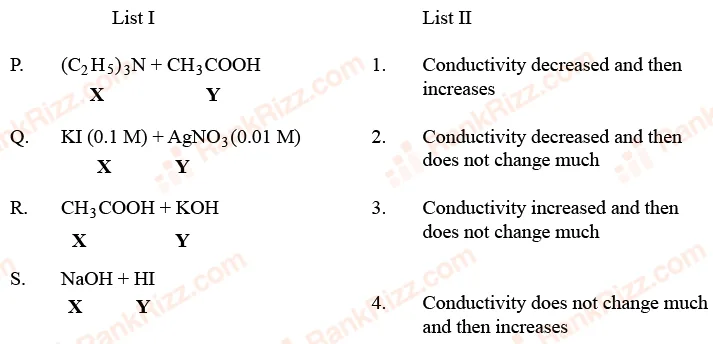
An aqueous solution of X is added slowly to an aqueous solution of Y as shown in List J. The variation in conductivity of these reactions is given in List II. Match List I with List II and select the correct answer using the code given below the lists:
SOLUTION
Key idea: Conductivity depends on how many ions are present and how mobile they are. Follow what replaces what as X is added to Y.
- P into : weak acid and weak base give the salt , so ions form and conductivity increases. After the end point, excess weak base adds few ions, so it doesn't change much. That is 3.
- Q KI into : is removed as AgI and replaced by of similar mobility, so conductivity doesn't change much. After the end point, extra and make it increase. That is 4.
- R into KOH: fast is replaced by slow , so conductivity decreases. Excess weak acid is barely ionised, so it then doesn't change much. That is 2.
- S NaOH into HI: fast is replaced by , so conductivity decreases. Excess then makes it increase. That is 1.
So P-3, Q-4, R-2, S-1.
Answer: (A)
Tagged Conductance, conductivity and molar conductivity. Machine-assigned, so read it as a strong shortlist rather than a verdict.