RankRizz

Biomolecules — JEE Advanced Previous Year Questions

Every Biomolecules question JEE Advanced has set from 2007–2026, grouped by the idea it tests rather than the order of the syllabus. 22 questions across 3 distinct ideas. Free to read, answer key on every one.

Questions

22

Distinct ideas

3

Share of marks

3.1%

Difficulty

EASY

The ideas inside Biomolecules

A chapter is not one subject — it is a handful of procedures the examiner reuses. These are the ones Biomolecules questions actually test.

01Carbohydrates: classification and monosaccharidesset 14×
02Disaccharides, polysaccharides and anomersNot set in Advanced
03Amino acids and peptidesNot set in Advanced
04Proteins and enzymesset 7×
05Nucleic acidsNot set in Advanced
06Vitamins and hormonesset 1×

Biomolecules weightage, year by year

The share of each year’s Chemistry questions that came from Biomolecules, counted from the 19 papers we hold for the last 10 years, and paper by paper inside a year.

Rising: 5.0% of Chemistry questions in 2024–2026, up from 2.1% in 2017–2023. Its heaviest year was 2024, at 5.9%. Not asked at all in 2017, 2018.

20262 / 345.9%PAPER 1 0.0%PAPER 2 11.1%
20251 / 323.1%PAPER 1 0.0%PAPER 2 6.3%
20242 / 345.9%PAPER 1 5.9%PAPER 2 5.9%
20231 / 342.9%PAPER 1 0.0%PAPER 2 5.9%
20221 / 362.8%PAPER 1 0.0%PAPER 2 5.6%
20211 / 382.6%PAPER 1 5.3%PAPER 2 0.0%
20201 / 362.8%PAPER 1 0.0%PAPER 2 5.6%
20191 / 362.8%PAPER 1 5.6%PAPER 2 0.0%
20180 / 180.0%1 PAPER
20170 / 360.0%PAPER 1 0.0%PAPER 2 0.0%

“QS” is Biomolecules questions out of all Chemistry questions that year. A year with more sittings asks more questions, which is why the share, not the count, is the number to compare.

Biomolecules: quick answers

How many Biomolecules questions has JEE Advanced asked?

22 questions from 2007–2026. Over the last 20 papers, Biomolecules carried about 3.1% of Chemistry marks.

Which Biomolecules topics come up most?

Carbohydrates: classification and monosaccharides (14 questions), Proteins and enzymes (7 questions), Vitamins and hormones (1 questions). Start with these, they are what the examiner keeps coming back to.

Is Biomolecules important for JEE Advanced?

Rising: 5.0% of Chemistry questions in 2024–2026, up from 2.1% in 2017–2023. Its heaviest year was 2024, at 5.9%. Not asked at all in 2017, 2018. It has carried about 3.1% of Chemistry marks in recent papers, rated easy on our difficulty scale. The year-by-year table above shows how that has moved.

Do these Biomolecules PYQs have answers and solutions?

Yes. Every question shows its official answer key, and a worked solution opens on the question’s own page wherever we have one. Reading and checking answers is free, no sign-up needed.

What’s the fastest way to revise Biomolecules?

Do one past question per idea first: Biomolecules has 3 distinct ideas, listed above. Then practise the topics you get wrong, or build a timed test from this chapter.

Every Biomolecules question

1–20 OF 22 · NEWEST FIRST

JEE ADVANCED 2026 · PAPER 2Carbohydrates: classification and monosaccharidesTRANSCRIBED

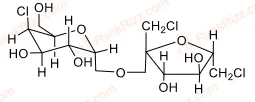
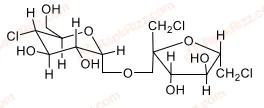
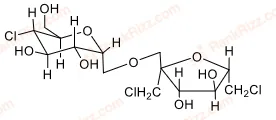
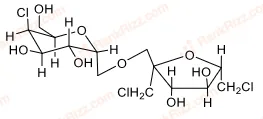
A known artificial sweetener X is composed of 4-chloro-4-deoxy-α\alpha-D-galactose and 1,6-dichloro-1,6-dideoxy-β\beta-D-fructose joined by a glycosidic linkage. Structure of D-galactose is given below (Fischer projection):
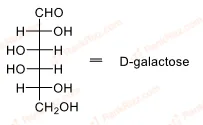
Figure for JEE Advanced 2026 Chemistry question on Carbohydrates: classification and monosaccharides

The correct structure of X is

  1. A
    Figure for JEE Advanced 2026 Chemistry question on Carbohydrates: classification and monosaccharides
  2. B
    Figure for JEE Advanced 2026 Chemistry question on Carbohydrates: classification and monosaccharides
  3. C
    Figure for JEE Advanced 2026 Chemistry question on Carbohydrates: classification and monosaccharides
  4. D
    Figure for JEE Advanced 2026 Chemistry question on Carbohydrates: classification and monosaccharides
JEE ADVANCED 2026 · PAPER 2Carbohydrates: classification and monosaccharidesTRANSCRIBED

The correct statement(s) regarding sugars is(are)

Given: Specific rotations of L-(−-)-glucose and L-(+)-fructose are −52.5∘-52.5^\circ and +92.5∘+92.5^\circ, respectively.

  1. A

    On treatment with HNO3\mathrm{HNO_3}, gluconic acid is oxidized to saccharic acid, whereas glucose is not oxidized to saccharic acid.

  2. B

    Fructose gives a positive Fehling's test because it isomerises to glucose and another aldohexose in the presence of Fehling's reagent.

  3. C

    Invert sugar is an equimolar mixture of D-glucose and D-fructose formed after hydrolysis of the corresponding disaccharide.

  4. D

    Specific rotation of invert sugar is −40∘-40^\circ.

JEE ADVANCED 2025 · PAPER 2Carbohydrates: classification and monosaccharidesTRANSCRIBED

A linear octasaccharide (molar mass = 1024 g mol−1^{-1}) on complete hydrolysis produces three monosaccharides: ribose, 2-deoxyribose and glucose. The amount of 2-deoxyribose formed is 58.26% (w/w) of the total amount of the monosaccharides produced in the hydrolyzed products. The number of ribose unit(s) present in one molecule of octasaccharide is ______.

Use: Molar mass (in g mol−1^{-1}): ribose = 150, 2-deoxyribose = 134, glucose = 180; Atomic mass (in amu): H = 1, O = 16

JEE ADVANCED 2024 · PAPER 1Proteins and enzymesTRANSCRIBED

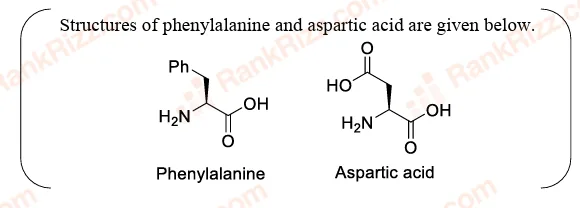
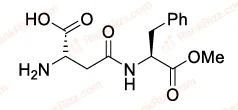
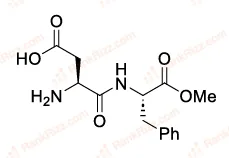
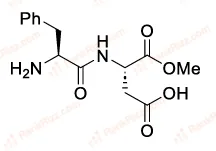
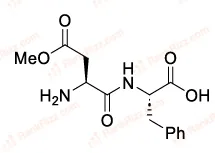
Aspartame, an artificial sweetener, is a dipeptide aspartyl phenylalanine methyl ester. The structure of aspartame is

Figure for JEE Advanced 2024 Chemistry question on Proteins and enzymes
  1. A
    Figure for JEE Advanced 2024 Chemistry question on Proteins and enzymes
  2. B
    Figure for JEE Advanced 2024 Chemistry question on Proteins and enzymes
  3. C
    Figure for JEE Advanced 2024 Chemistry question on Proteins and enzymes
  4. D
    Figure for JEE Advanced 2024 Chemistry question on Proteins and enzymes
JEE ADVANCED 2024 · PAPER 2Vitamins and hormonesTRANSCRIBED

For a double strand DNA, one strand is given below:

Figure for JEE Advanced 2024 Chemistry question on Vitamins and hormones

The amount of energy required to split the double strand DNA into two single strands is ______ kcal mol−1mol^{-1}.

[Given: Average energy per H-bond for A-T base pair = 1.0 kcal mol−1mol^{-1}, G-C base pair = 1.5 kcal mol−1mol^{-1}, and A-U base pair = 1.25 kcal mol−1mol^{-1}. Ignore electrostatic repulsion between the phosphate groups.]

JEE ADVANCED 2023 · PAPER 2Carbohydrates: classification and monosaccharidesTRANSCRIBED

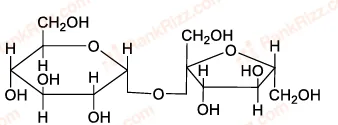
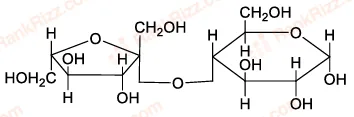
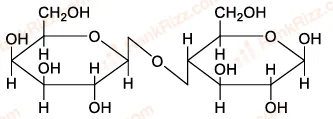
A disaccharide X cannot be oxidised by bromine water. The acid hydrolysis of X leads to a laevorotatory solution. The disaccharide X is

  1. A
    Figure for JEE Advanced 2023 Chemistry question on Carbohydrates: classification and monosaccharides
  2. B
    Figure for JEE Advanced 2023 Chemistry question on Carbohydrates: classification and monosaccharides
  3. C
    Figure for JEE Advanced 2023 Chemistry question on Carbohydrates: classification and monosaccharides
  4. D
    Figure for JEE Advanced 2023 Chemistry question on Carbohydrates: classification and monosaccharides
JEE ADVANCED 2022 · PAPER 2Carbohydrates: classification and monosaccharidesTRANSCRIBED

Treatment of D-glucose with aqueous NaOH results in a mixture of monosaccharides, which are

  1. A
    Figure for JEE Advanced 2022 Chemistry question on Carbohydrates: classification and monosaccharides
  2. B
    Figure for JEE Advanced 2022 Chemistry question on Carbohydrates: classification and monosaccharides
  3. C
    Figure for JEE Advanced 2022 Chemistry question on Carbohydrates: classification and monosaccharides
  4. D
    Figure for JEE Advanced 2022 Chemistry question on Carbohydrates: classification and monosaccharides
JEE ADVANCED 2021 · PAPER 1Carbohydrates: classification and monosaccharidesTRANSCRIBED

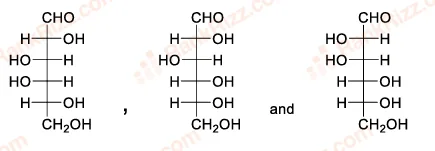
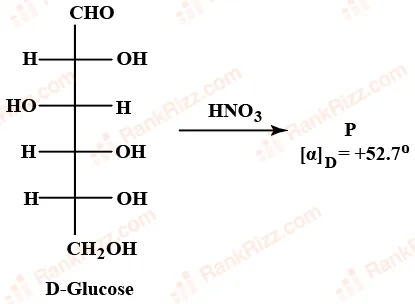
Given:

Figure for JEE Advanced 2021 Chemistry question on Carbohydrates: classification and monosaccharides

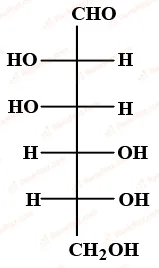
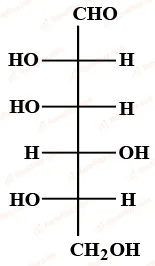
The compound(s), which on reaction with HNO3HNO_3 will give the product having degree of rotation, [α]D=−52.7∘[\alpha]_D = −52.7^\circ is(are)

  1. A
    Figure for JEE Advanced 2021 Chemistry question on Carbohydrates: classification and monosaccharides
  2. B
    Figure for JEE Advanced 2021 Chemistry question on Carbohydrates: classification and monosaccharides
  3. C
    Figure for JEE Advanced 2021 Chemistry question on Carbohydrates: classification and monosaccharides
  4. D
    Figure for JEE Advanced 2021 Chemistry question on Carbohydrates: classification and monosaccharides
JEE ADVANCED 2020 · PAPER 2Proteins and enzymesTRANSCRIBED

The structure of a peptide is given below.

Figure for JEE Advanced 2020 Chemistry question on Proteins and enzymes

If the absolute values of the net charge of the peptide at pH = 2, pH = 6, and pH = 11 are ∣𝑧1∣,∣𝑧2∣\mid 𝑧_1 \mid, \mid 𝑧_2 \mid, and ∣𝑧3∣\mid 𝑧_3 \mid, respectively, then what is ∣𝑧1∣+∣𝑧2∣+∣𝑧3∣\mid 𝑧_1 \mid + \mid 𝑧_2 \mid + \mid 𝑧_3 \mid?

JEE ADVANCED 2019 · PAPER 1Carbohydrates: classification and monosaccharidesTRANSCRIBED

Which of the following statement(s) is (are) true?

  1. A

    Monosaccharides cannot be hydrolysed to give polyhydroxy aldehydes and ketones

  2. B

    Oxidation of glucose with bromine water gives glutamic acid

  3. C

    Hydrolysis of sucrose gives dextrorotatory glucose and laevorotatory fructose

  4. D

    The two six-membered cyclic hemiacetal forms of D-(+)-glucose are called anomers

JEE ADVANCED 2016 · PAPER 2Carbohydrates: classification and monosaccharidesTRANSCRIBED

For ‘invert sugar’, the correct statement(s) is(are)
(Given: specific rotations of( +)-sucrose, (+)-maltose, L-(—)-glucose and L-(+)-fructose in aqueous solution are +66∘,+140∘,−52∘+66^\circ, +140^\circ, -52^\circ and +92∘+92^\circ, respectively)

  1. A

    ‘invert sugar’ is prepared by acid catalyzed hydrolysis of maltose

  2. B

    ‘invert sugar’ is an equimolar mixture of D-(+)-glucose and D-(-)-fructose

  3. C

    specific rotation of‘invert sugar’ is —20∘—20^\circ

  4. D

    on reaction with Br2Br_2 water, ‘invert sugar’ forms saccharic acid as one of the products

JEE ADVANCED 2015 · PAPER 1Carbohydrates: classification and monosaccharidesTRANSCRIBED

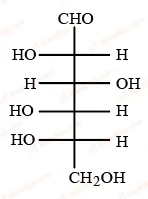
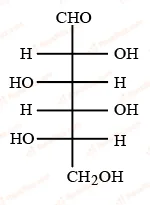
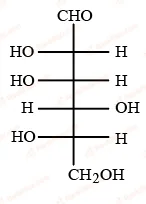
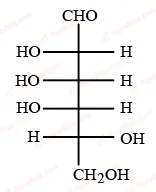
The structure of D-(+)-glucose is

Figure for JEE Advanced 2015 Chemistry question on Carbohydrates: classification and monosaccharides


The structure of L-(—)-glucose is

  1. A
    Figure for JEE Advanced 2015 Chemistry question on Carbohydrates: classification and monosaccharides
  2. B
    Figure for JEE Advanced 2015 Chemistry question on Carbohydrates: classification and monosaccharides
  3. C
    Figure for JEE Advanced 2015 Chemistry question on Carbohydrates: classification and monosaccharides
  4. D
    Figure for JEE Advanced 2015 Chemistry question on Carbohydrates: classification and monosaccharides
JEE ADVANCED 2014 · PAPER 1Proteins and enzymesTRANSCRIBED

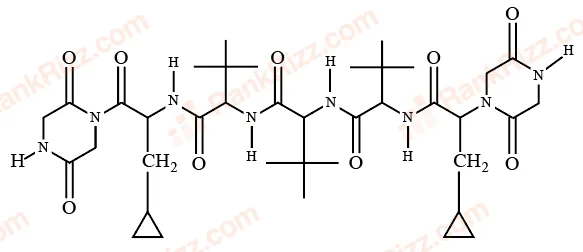
The total number of distinct naturally occurring amino acids obtained by complete acidic hydrolysis of the peptide shown below is

Figure for JEE Advanced 2014 Chemistry question on Proteins and enzymes
JEE ADVANCED 2013 · PAPER 1Proteins and enzymesTRANSCRIBED

A tetrapeptide has -COOH group on alanine. This produces glycine (Gly), valine (Val), phenyl alanine (Phe) and alanine (Ala), on complete hydrolysis. For this tetrapeptide, the number of possible sequences(primary structures) with −NH2-NH_2 group attached to a chiral center is

JEE ADVANCED 2012 · PAPER 1Proteins and enzymesTRANSCRIBED

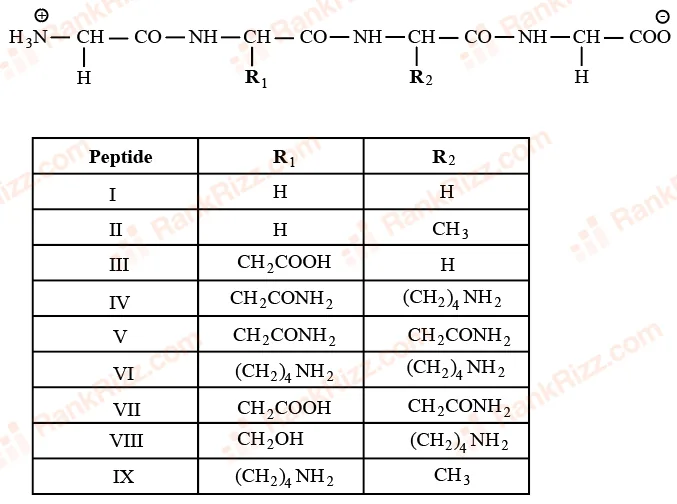
The substituents R1R_1 and R2R_2 for nine peptides are listed in the table given below. How many of these peptides are positively charged at pH = 7.0 ?

Figure for JEE Advanced 2012 Chemistry question on Proteins and enzymes
JEE ADVANCED 2011 · PAPER 2Carbohydrates: classification and monosaccharidesTRANSCRIBED

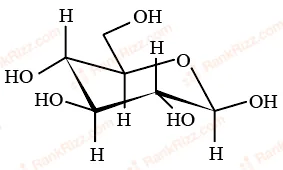
The following carbohydrate is

Figure for JEE Advanced 2011 Chemistry question on Carbohydrates: classification and monosaccharides
  1. A

    a ketohexose

  2. B

    an aldohexose

  3. C

    an α\alpha-furanose

  4. D

    an α\alpha-pyranose

JEE ADVANCED 2011 · PAPER 1Proteins and enzymesTRANSCRIBED

A decapeptide (mol. wt. 796) on complete hydrolysis gives glycine (mol. wt. 75), alanine and phenylalanine. Glycine contributes 47.0% to the total weight of the hydrolysed products. The number of glycine units present in the decapeptide is.

JEE ADVANCED 2010 · PAPER 1Carbohydrates: classification and monosaccharidesTRANSCRIBED

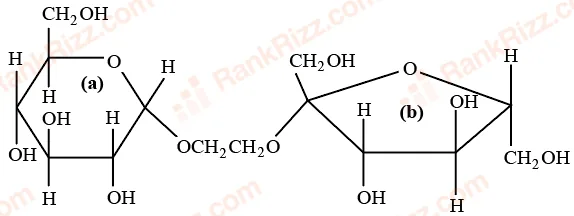
The correct statement about the following disaccharide is

Figure for JEE Advanced 2010 Chemistry question on Carbohydrates: classification and monosaccharides
  1. A

    Ring (a) is pyranose with a-glycosiclic link

  2. B

    Ring (a) is furanose with a-glycosiclic link

  3. C

    Ring (b) is furanose with cx -glycosidic link

  4. D

    Ring (b) is pyranose with β\beta-glycosidic link

JEE ADVANCED 2010 · PAPER 1Proteins and enzymesTRANSCRIBED

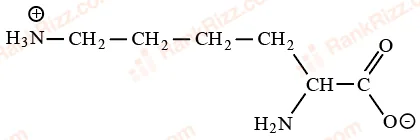
The total number of basic groups in the following form of lysine is

Figure for JEE Advanced 2010 Chemistry question on Proteins and enzymes
JEE ADVANCED 2009 · PAPER 2Carbohydrates: classification and monosaccharidesTRANSCRIBED

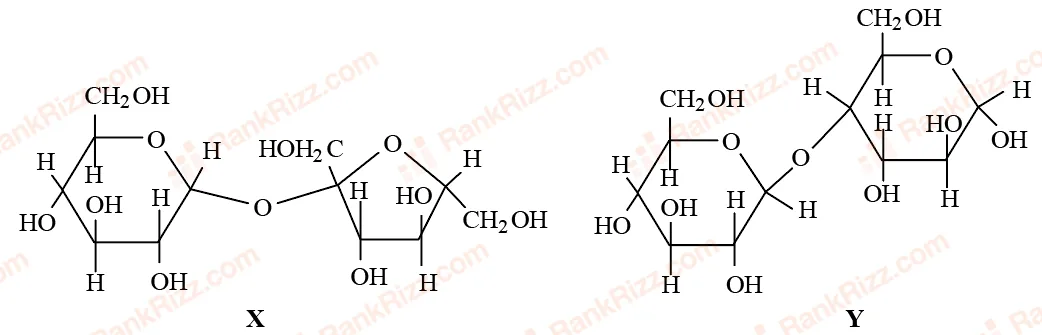
The correct statement(s) about the following sugars X andY is(are)

Figure

  1. A

    X is a reducing sugar and Y is a non-reducing sugar

    Figure for JEE Advanced 2009 Chemistry question on Carbohydrates: classification and monosaccharides
  2. B

    X is a non-reducing sugar and Y is a reducing sugar

  3. C

    The glucosidic linkages in X and Y are α\alpha and β\beta respectively

  4. D

    The glucosidic linkages in X and Y are β\beta and α\alpha respectively