RankRizz

Solutions — JEE Advanced Previous Year Questions

Every Solutions question JEE Advanced has set from 2007–2026, grouped by the idea it tests rather than the order of the syllabus. 26 questions across 7 distinct ideas. Free to read, answer key on every one.

Questions

26

Distinct ideas

7

Share of marks

4.5%

Difficulty

MEDIUM

The ideas inside Solutions

A chapter is not one subject — it is a handful of procedures the examiner reuses. These are the ones Solutions questions actually test.

01Solubility of gases and Henry's lawset 1×
02Raoult's law, ideal and non-ideal solutionsset 4×
03Relative lowering of vapour pressureset 4×
04Elevation in boiling pointset 5×
05Depression in freezing pointset 4×
06Osmosis and osmotic pressureset 2×
07Abnormal molar mass and van't Hoff factorset 6×

Solutions weightage, year by year

The share of each year’s Chemistry questions that came from Solutions, counted from the 19 papers we hold for the last 10 years, and paper by paper inside a year.

Rising: 5.0% of Chemistry questions in 2024–2026, up from 4.3% in 2017–2023. Its heaviest year was 2018, at 11.1%.

20263 / 348.8%PAPER 1 0.0%PAPER 2 16.7%
20251 / 323.1%PAPER 1 0.0%PAPER 2 6.3%
20241 / 342.9%PAPER 1 0.0%PAPER 2 5.9%
20231 / 342.9%PAPER 1 0.0%PAPER 2 5.9%
20221 / 362.8%PAPER 1 0.0%PAPER 2 5.6%
20212 / 385.3%PAPER 1 10.5%PAPER 2 0.0%
20201 / 362.8%PAPER 1 0.0%PAPER 2 5.6%
20191 / 362.8%PAPER 1 5.6%PAPER 2 0.0%
20182 / 1811.1%1 PAPER
20172 / 365.6%PAPER 1 5.6%PAPER 2 5.6%

“QS” is Solutions questions out of all Chemistry questions that year. A year with more sittings asks more questions, which is why the share, not the count, is the number to compare.

Solutions: quick answers

How many Solutions questions has JEE Advanced asked?

26 questions from 2007–2026. Over the last 20 papers, Solutions carried about 4.5% of Chemistry marks.

Which Solutions topics come up most?

Abnormal molar mass and van't Hoff factor (6 questions), Elevation in boiling point (5 questions), Raoult's law, ideal and non-ideal solutions (4 questions). Start with these, they are what the examiner keeps coming back to.

Is Solutions important for JEE Advanced?

Rising: 5.0% of Chemistry questions in 2024–2026, up from 4.3% in 2017–2023. Its heaviest year was 2018, at 11.1%. It has carried about 4.5% of Chemistry marks in recent papers, rated medium on our difficulty scale. The year-by-year table above shows how that has moved.

Do these Solutions PYQs have answers and solutions?

Yes. Every question shows its official answer key, and a worked solution opens on the question’s own page wherever we have one. Reading and checking answers is free, no sign-up needed.

What’s the fastest way to revise Solutions?

Do one past question per idea first: Solutions has 7 distinct ideas, listed above. Then practise the topics you get wrong, or build a timed test from this chapter.

Every Solutions question

1–20 OF 26 · NEWEST FIRST

JEE ADVANCED 2026 · PAPER 2Abnormal molar mass and van't Hoff factorTRANSCRIBED

In a solvent S, a compound B is partially dissociated into C and D as given below:

B⇌2C+2D\mathbf{B}\rightleftharpoons 2\mathbf{C}+2\mathbf{D}

B, C and D are non-volatile in nature. The molar mass of B is 10 times the molar mass of S. The standard boiling point and the standard enthalpy of vaporization of S are 400 K and 10R10R J mol−1^{-1}, respectively (RR is the gas constant in J K−1^{-1} mol−1^{-1}). A solution of B in S with an initial concentration of B as 0.25% (mass/mass) has a boiling point of 408 K at 1 bar pressure. In this solution, the mole percent of B that has been dissociated is ___.
JEE ADVANCED 2026 · PAPER 2Raoult's law, ideal and non-ideal solutionsTRANSCRIBED

Question Stem (Q15 & Q16): Two volatile liquids A and B form an ideal solution. Consider a 5 molal solution of B in A inside a closed container having a total vapour pressure of 100 mm Hg at 300 K. The vapour pressure of pure A at 300 K is 105 mm Hg. Assume that A and B behave as ideal gases in the vapour phase.

Given: The gas constant R=0.08R=0.08 L atm K−1^{-1} mol−1^{-1};
Molar mass of A is 50 g mol−1^{-1};
Molar mass of B is 57 g mol−1^{-1};
Density of liquid B at 300 K is 0.5 g/mL; 1 atm =760=760 mm Hg.

At 300 K, the ratio of the molar volume of pure B in vapour phase to its molar volume in liquid phase is ___.

JEE ADVANCED 2026 · PAPER 2Raoult's law, ideal and non-ideal solutionsTRANSCRIBED

Question Stem (Q15 & Q16): Two volatile liquids A and B form an ideal solution. Consider a 5 molal solution of B in A inside a closed container having a total vapour pressure of 100 mm Hg at 300 K. The vapour pressure of pure A at 300 K is 105 mm Hg. Assume that A and B behave as ideal gases in the vapour phase.

Given: The gas constant R=0.08R=0.08 L atm K−1^{-1} mol−1^{-1};
Molar mass of A is 50 g mol−1^{-1};
Molar mass of B is 57 g mol−1^{-1};
Density of liquid B at 300 K is 0.5 g/mL; 1 atm =760=760 mm Hg.

The mole fraction of B in vapour phase which is in equilibrium with this solution is ___.

JEE ADVANCED 2025 · PAPER 2Osmosis and osmotic pressureTRANSCRIBED

At 300 K, an ideal dilute solution of a macromolecule exerts osmotic pressure that is expressed in terms of the height (h) of the solution (density = 1.00 g cm−3^{-3}) where h is equal to 2.00 cm. If the concentration of the dilute solution of the macromolecule is 2.00 g dm−3^{-3}, the molar mass of the macromolecule is X×104X \times 10^4 g mol−1^{-1}. The value of XX is ______.

Use: Universal gas constant (R) = 8.3 J K−1^{-1} mol−1^{-1} and acceleration due to gravity (g) = 10 m s−2^{-2}

JEE ADVANCED 2024 · PAPER 2Elevation in boiling pointTRANSCRIBED

Vessel-1 contains w2w_2 g of a non-volatile solute X dissolved in w1w_1 g of water. Vessel-2 contains w2w_2 g of another non-volatile solute Y dissolved in w1w_1 g of water. Both the vessels are at the same temperature and pressure. The molar mass of X is 80% of that of Y. The van't Hoff factor for X is 1.2 times of that of Y for their respective concentrations.

The elevation of boiling point for solution in Vessel-1 is ______ % of the solution in Vessel-2.

JEE ADVANCED 2023 · PAPER 2Osmosis and osmotic pressureTRANSCRIBED

50 mL of 0.2 molal urea solution (density = 1.012 g mL−1^{-1} at 300 K) is mixed with 250 mL of a solution containing 0.06 g of urea. Both the solutions were prepared in the same solvent. The osmotic pressure (in Torr) of the resulting solution at 300 K is ____.

[Use: Molar mass of urea = 60 g mol−1^{-1}; gas constant, R = 62 L Torr K−1^{-1} mol−1^{-1}; Assume, ΔmixH=0\Delta_{mix}H = 0, ΔmixV=0\Delta_{mix}V = 0]

JEE ADVANCED 2022 · PAPER 2Abnormal molar mass and van't Hoff factorTRANSCRIBED

An aqueous solution is prepared by dissolving 0.1 mol of an ionic salt in 1.8 kg of water at 35 ∘^\circC. The salt remains 90% dissociated in the solution. The vapour pressure of the solution is 59.724 mm of Hg. Vapor pressure of water at 35 ∘^\circC is 60.000 mm of Hg. The number of ions present per formula unit of the ionic salt is _______.

JEE ADVANCED 2021 · PAPER 1Elevation in boiling pointTRANSCRIBED

The value of x is ___.

JEE ADVANCED 2021 · PAPER 1Elevation in boiling pointTRANSCRIBED

The value of ∣y∣\mid y \mid is ___.

JEE ADVANCED 2020 · PAPER 2Relative lowering of vapour pressureTRANSCRIBED

Liquids A and B form ideal solution for all compositions of A and B at 25 ∘C^\circ C. Two such solutions with 0.25 and 0.50 mole fractions of A have the total vapor pressures of 0.3 and 0.4 bar, respectively. What is the vapor pressure of pure liquid B in bar?

JEE ADVANCED 2019 · PAPER 1Depression in freezing pointTRANSCRIBED

On dissolving 0.5 g of a non-volatile non-ionic solute to 39 g of benzene, its vapor pressure decreases from 650 mm Hg to 640 mm Hg. The depression of freezing point of benzene (in K) upon addition of the solute is ___________ .
(Given data: Molar mass and the molal freezing point depression constant of benzene are 78gmol−1and5.12Kkgmol−178 g mol^{-1} and 5.12 K kg mol^{-1} respectively)

JEE ADVANCED 2018 · PAPER 1Relative lowering of vapour pressureTRANSCRIBED

Liquids A and B form ideal solution over the entire range of composition. At temperature T, equimolar binary solution of liquids A and B has vapour pressure 45 Torr. At the same temperature, a new solution of A and B having mole fractions x𝐴andx𝐵x_{𝐴} and x_{𝐵}, respectively, has vapour pressure of 22.5 Torr. The value of xAxB\frac{x_{A}}{x_{B}} in the new solution is ____.
(given that the vapour pressure of pure liquid A is 20 Torr at temperature T)

JEE ADVANCED 2018 · PAPER 1Abnormal molar mass and van't Hoff factorTRANSCRIBED

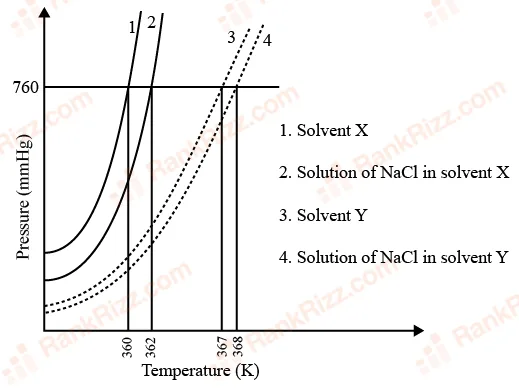
The plot given below shows 𝑃 − 𝑇 curves (where P is the pressure and T is the temperature) for two solvents X and Y and isomolal solutions of NaCl in these solvents. NaCl completely dissociates in both the solvents.

Figure for JEE Advanced 2018 Chemistry question on Abnormal molar mass and van't Hoff factor


On addition of equal number of moles of a non-volatile solute S in equal amount (in kg) of
these solvents, the elevation of boiling point of solvent X is three times that of solvent Y.
Solute S is known to undergo dimerization in these solvents. If the degree of dimerization is
0.7 in solvent Y, the degree of dimerization in solvent X is ____.

JEE ADVANCED 2017 · PAPER 2Depression in freezing pointTRANSCRIBED

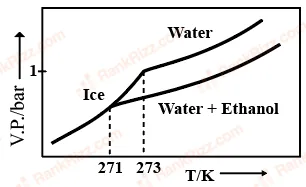
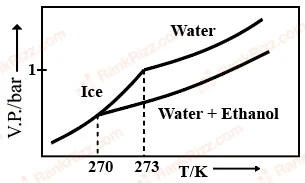
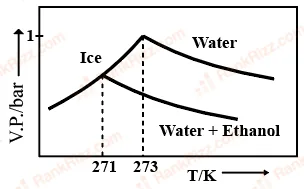
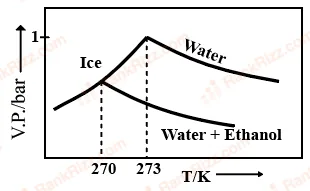
Pure water freezes at 273 K and 1 bar. The addition of 34.5 g of ethanol to 500 g of water changes the freezing point of the solution. Use the freezing point depression constant of water as 2 K kg mol−1mol^{-1} . The figures shown below represent plots of vapour pressure (V.P.) versus temperature (T). [molecular weight of ethanol is 46 g mol−1mol^{-1}] Among the following, the option representing change in the freezing point is

  1. A
    Figure for JEE Advanced 2017 Chemistry question on Depression in freezing point
  2. B
    Figure for JEE Advanced 2017 Chemistry question on Depression in freezing point
  3. C
    Figure for JEE Advanced 2017 Chemistry question on Depression in freezing point
  4. D
    Figure for JEE Advanced 2017 Chemistry question on Depression in freezing point
JEE ADVANCED 2017 · PAPER 1Relative lowering of vapour pressureTRANSCRIBED

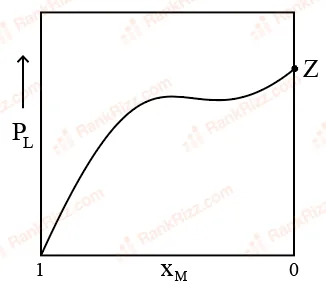
For a solution formed by mixing liquids L and M, the vapour pressure of L plotted against the mole fraction of M in solution is shown in the following figure. Here xLx_L and xMx_M represent mole fractions of L and M, respectively, in the solution. The correct statement(s) applicable to this system is(are)

Figure for JEE Advanced 2017 Chemistry question on Relative lowering of vapour pressure
  1. A

    The point Z represents vapour pressure of pure liquid M and Raoult’s law is obeyed from xL=0x_L = 0 to xL=1x_L = 1

  2. B

    The point Z represents vapour pressure of pure liquid L and Raoult’s law is obeyed when xL→1x_L \rightarrow 1

  3. C

    The point Z represents vapour pressure of pure liquid M and Raoult’s law is obeyed when xL→0x_L \rightarrow 0

  4. D

    Attractive intermolecular interactions between L-L in pure liquid L and M-M in pure liquid M are stronger than those between L-M when mixed in solution

JEE ADVANCED 2016 · PAPER 2Raoult's law, ideal and non-ideal solutionsTRANSCRIBED

Mixture(s) showing positive deviation from Raoult’s law at 35∘C35^\circ C is(are)

  1. A

    carbon tetrachloride + methanol

  2. B

    carbon disulphide + acetone

  3. C

    benzene + toluene

  4. D

    phenol + aniline

JEE ADVANCED 2016 · PAPER 1Raoult's law, ideal and non-ideal solutionsTRANSCRIBED

The mole fraction of a solute in a solution is 0.1. At 298 K, molarity of this solution is the sameas its molality. Density of this solution at 298 K is 2.0 gcm−3^{-3}. Theratio of the molecular weights of the solute and solvent, (MWsoluteMWsolvent)\left(\frac{MW_{solute}}{MW_{solvent}}\right), is

JEE ADVANCED 2015 · PAPER 1Depression in freezing pointTRANSCRIBED

If the freezing point of a 0.01 molal aqueous solution of a cobalt(III) chloride-ammonia complex (which behaves as a strong electrolyte) is −0.0558C∘-0.0558 ^\circ_C the numberof chloride(s) in the coordination sphere of the complex is [Kf[K_f of water = 1.86 K kg mol−1mol^{-1}]

JEE ADVANCED 2014 · PAPER 1Abnormal molar mass and van't Hoff factorTRANSCRIBED

MX2MX_2 dissociates into M2+M^{2+} and X−X^- ions in an aqueous solution, with a degree of dissociation (α)(\alpha) of 0.5. The ratio of the observed depression of freezing point of the aqueous solution to the value of the depression of freezing point in the absence of ionic dissociation is

JEE ADVANCED 2012 · PAPER 2Elevation in boiling pointTRANSCRIBED

For a dilute solution containing 2.5 g of a non- volatile non- electrolyte solute in 100 g of water, the elevation in boiling point at 1 atm pressure is 2∘C2^\circ C. Assuming concentration of solute is much lower than the concentration of solvent, the vapour pressure (mm of Hg) of the solution is (take Kb=0.76K_b = 0.76 K kg mol−1mol^{-1})

  1. A

    724

  2. B

    740

  3. C

    736

  4. D

    718