RankRizz

Chemical Kinetics — JEE Advanced Previous Year Questions

Every Chemical Kinetics question JEE Advanced has set from 2007–2026, grouped by the idea it tests rather than the order of the syllabus. 33 questions across 5 distinct ideas. Free to read, answer key on every one.

Questions

33

Distinct ideas

5

Share of marks

4%

Difficulty

EASY

The ideas inside Chemical Kinetics

A chapter is not one subject — it is a handful of procedures the examiner reuses. These are the ones Chemical Kinetics questions actually test.

01Rate of reactionNot set in Advanced
02Rate law, order and molecularityset 6×
03Integrated rate laws and half-life (zero and first order)set 7×
04Methods to determine order of reactionset 5×
05Parallel, consecutive and reversible reactionsNot set in Advanced
06Arrhenius equation and activation energyNot set in Advanced
07Collision theory and effect of catalyst on rateset 4×
08Radioactivity and nuclear reactionsset 11×

Chemical Kinetics weightage, year by year

The share of each year’s Chemistry questions that came from Chemical Kinetics, counted from the 19 papers we hold for the last 10 years, and paper by paper inside a year.

Rising: 5.0% of Chemistry questions in 2024–2026, up from 3.8% in 2017–2023. Its heaviest year was 2019, at 8.3%. Not asked at all in 2018.

20262 / 345.9%PAPER 1 6.3%PAPER 2 5.6%
20251 / 323.1%PAPER 1 0.0%PAPER 2 6.3%
20242 / 345.9%PAPER 1 5.9%PAPER 2 5.9%
20231 / 342.9%PAPER 1 5.9%PAPER 2 0.0%
20221 / 362.8%PAPER 1 5.6%PAPER 2 0.0%
20211 / 382.6%PAPER 1 0.0%PAPER 2 5.3%
20202 / 365.6%PAPER 1 5.6%PAPER 2 5.6%
20193 / 368.3%PAPER 1 11.1%PAPER 2 5.6%
20180 / 180.0%1 PAPER
20171 / 362.8%PAPER 1 0.0%PAPER 2 5.6%

“QS” is Chemical Kinetics questions out of all Chemistry questions that year. A year with more sittings asks more questions, which is why the share, not the count, is the number to compare.

Chemical Kinetics: quick answers

How many Chemical Kinetics questions has JEE Advanced asked?

33 questions from 2007–2026. Over the last 20 papers, Chemical Kinetics carried about 4% of Chemistry marks.

Which Chemical Kinetics topics come up most?

Radioactivity and nuclear reactions (11 questions), Integrated rate laws and half-life (zero and first order) (7 questions), Rate law, order and molecularity (6 questions). Start with these, they are what the examiner keeps coming back to.

Is Chemical Kinetics important for JEE Advanced?

Rising: 5.0% of Chemistry questions in 2024–2026, up from 3.8% in 2017–2023. Its heaviest year was 2019, at 8.3%. Not asked at all in 2018. It has carried about 4% of Chemistry marks in recent papers, rated easy on our difficulty scale. The year-by-year table above shows how that has moved.

Do these Chemical Kinetics PYQs have answers and solutions?

Yes. Every question shows its official answer key, and a worked solution opens on the question’s own page wherever we have one. Reading and checking answers is free, no sign-up needed.

What’s the fastest way to revise Chemical Kinetics?

Do one past question per idea first: Chemical Kinetics has 5 distinct ideas, listed above. Then practise the topics you get wrong, or build a timed test from this chapter.

Every Chemical Kinetics question

1–20 OF 33 · NEWEST FIRST

JEE ADVANCED 2026 · PAPER 1Integrated rate laws and half-life (zero and first order)TRANSCRIBED

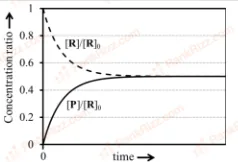
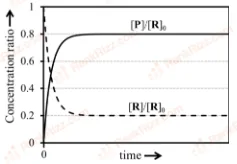
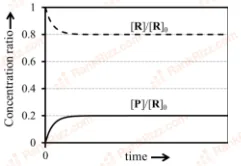
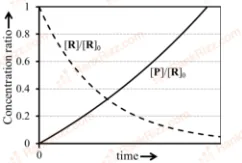
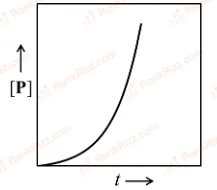
For a reversible reaction R⇌P\mathbf{R}\rightleftharpoons\mathbf{P}, at constant temperature, both the forward and the backward reactions are first order elementary reactions with rate constants kfk_f and kbk_b, respectively. At time zero, the concentration of R\mathbf{R} is [R]0[\mathbf{R}]_0 and the concentration of P\mathbf{P} is zero. At any given time, [R][\mathbf{R}] and [P][\mathbf{P}] are the concentrations of R\mathbf{R} and P\mathbf{P}, respectively. If kb=4kfk_b=4k_f, the correct graphical representation of the reaction is

  1. A
    Figure for JEE Advanced 2026 Chemistry question on Integrated rate laws and half-life (zero and first order)
  2. B
    Figure for JEE Advanced 2026 Chemistry question on Integrated rate laws and half-life (zero and first order)
  3. C
    Figure for JEE Advanced 2026 Chemistry question on Integrated rate laws and half-life (zero and first order)
  4. D
    Figure for JEE Advanced 2026 Chemistry question on Integrated rate laws and half-life (zero and first order)
JEE ADVANCED 2026 · PAPER 2Integrated rate laws and half-life (zero and first order)TRANSCRIBED

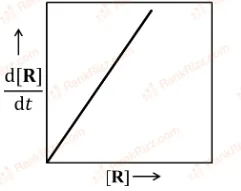
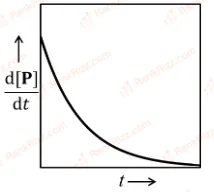
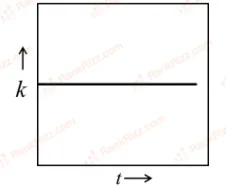
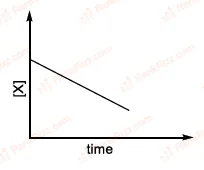
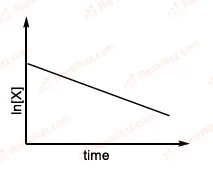
For a first-order reaction R→P\mathrm{R}\rightarrow\mathrm{P} at a given temperature, kk is the rate constant. For this reaction, at the given temperature, the concentrations of R\mathrm{R} and P\mathrm{P} at a time tt are [R][\mathrm{R}] and [P][\mathrm{P}], respectively. The correct graphical representation(s) for this reaction is(are)

  1. A
    Figure for JEE Advanced 2026 Chemistry question on Integrated rate laws and half-life (zero and first order)
  2. B
    Figure for JEE Advanced 2026 Chemistry question on Integrated rate laws and half-life (zero and first order)
  3. C
    Figure for JEE Advanced 2026 Chemistry question on Integrated rate laws and half-life (zero and first order)
  4. D
    Figure for JEE Advanced 2026 Chemistry question on Integrated rate laws and half-life (zero and first order)
JEE ADVANCED 2025 · PAPER 2Rate law, order and molecularityTRANSCRIBED

Consider a reaction A+R→ProductA + R \to Product. The rate of this reaction is measured to be k[A][R]k[A][R]. At the start of the reaction, the concentration of RR, [R]0[R]_0, is 10-times the concentration of AA, [A]0[A]_0. The reaction can be considered to be a pseudo first order reaction with assumption that k[R]=k′k[R] = k' is constant. Due to this assumption, the relative error (in %) in the rate when this reaction is 40% complete, is ______.

[kk and k′k' represent corresponding rate constants]

JEE ADVANCED 2024 · PAPER 1Methods to determine order of reactionTRANSCRIBED

Consider the following reaction,

2H2(g)+2NO(g)→N2(g)+2H2O(g)2H_2(g) + 2NO(g) \rightarrow N_2(g) + 2H_2O(g)

which follows the mechanism given below:

2NO(g)⇌k1k−1N2O2(g)2NO(g) \underset{k_{-1}}{\overset{k_1}{\rightleftharpoons}} N_2O_2(g)     (fast equilibrium)

N2O2(g)+H2(g)→k2N2O(g)+H2O(g)N_2O_2(g) + H_2(g) \overset{k_2}{\rightarrow} N_2O(g) + H_2O(g)     (slow reaction)

N2O(g)+H2(g)→k3N2(g)+H2O(g)N_2O(g) + H_2(g) \overset{k_3}{\rightarrow} N_2(g) + H_2O(g)     (fast reaction)

The order of the reaction is ______?

JEE ADVANCED 2024 · PAPER 2Radioactivity and nuclear reactionsTRANSCRIBED

A sample initially contains only U-238 isotope of uranium. With time, some of the U-238 radioactively decays into Pb-206 while the rest of it remains undisintegrated.

When the age of the sample is P×108P \times 10^8 years, the ratio of mass of Pb-206 to that of U-238 in the sample is found to be 7. The value of P is ______.

[Given : Half-life of U-238 is 4.5×1094.5 \times 10^9 years; log⁡e2\log_e 2 = 0.693]

JEE ADVANCED 2023 · PAPER 1Rate law, order and molecularityTRANSCRIBED

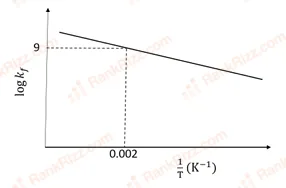
The plot of log kfk_f versus 1/T1/T for a reversible reaction A(g) ⇌\rightleftharpoons P(g) is shown.

Figure for JEE Advanced 2023 Chemistry question on Rate law, order and molecularity

Pre-exponential factors for the forward and backward reactions are 101510^{15} s−1^{-1} and 101110^{11} s−1^{-1}, respectively. If the value of log K for the reaction at 500 K is 6, the value of ∣log⁡kb∣|\log k_b| at 250 K is ______.

[K = equilibrium constant of the reaction,
kfk_f = rate constant of forward reaction,
kbk_b = rate constant of backward reaction]

JEE ADVANCED 2022 · PAPER 1Rate law, order and molecularityTRANSCRIBED

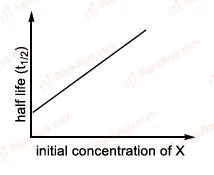
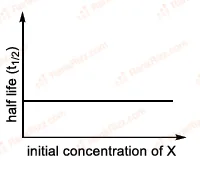
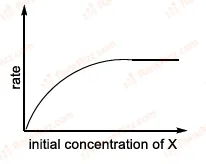
Match the rate expressions in LIST-I for the decomposition of X with the corresponding profiles provided in LIST-II. XsX_s and k constants having appropriate units.

LIST-ILIST-II
(I) rate = k[X]Xs+[X]\frac{k[X]}{X_s + [X]}, under all possible initial concentration of X(P) Figure for JEE Advanced 2022 Chemistry question on Rate law, order and molecularity
(II) rate = k[X]Xs+[X]\frac{k[X]}{X_s + [X]}, where initial concentration of X are much less than XsX_s(Q) Figure for JEE Advanced 2022 Chemistry question on Rate law, order and molecularity
(III) rate = k[X]Xs+[X]\frac{k[X]}{X_s + [X]}, where initial concentration of X are much higher than XsX_s(R) Figure for JEE Advanced 2022 Chemistry question on Rate law, order and molecularity
(IV) rate = k[X]2Xs+[X]\frac{k[X]^2}{X_s + [X]}, where initial concentration of X is much higher than XsX_s(S)Figure for JEE Advanced 2022 Chemistry question on Rate law, order and molecularity
(T) Figure for JEE Advanced 2022 Chemistry question on Rate law, order and molecularity
  1. A

    I →\to P; II →\to Q; III →\to S; IV →\to T

  2. B

    I →\to R; II →\to S; III →\to S; IV →\to T

  3. C

    I →\to P; II →\to Q; III →\to Q; IV →\to R

  4. D

    I →\to R; II →\to S; III →\to Q; IV →\to R

JEE ADVANCED 2021 · PAPER 2Rate law, order and molecularityTRANSCRIBED

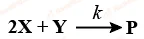
For the following reaction

Figure for JEE Advanced 2021 Chemistry question on Rate law, order and molecularity

the rate of reaction is d[P]dt=k[X]\frac{d[P]}{dt} = k[X]. Two moles of X are mixed with one mole of Y to make 1.0 L of solution. At 50 s, 0.5 mole of Y is left in the reaction mixture. The correct statement(s) about the reaction is(are)
(Use: ln 2 = 0.693)

  1. A

    The rate constant, k, of the reaction is 13.86×10⁻⁴s−113.86 \times 10^{−4} s^{-1}.

  2. B

    Half-life of X is 50 s.

  3. C

    At 50 s, −d[X]dt=13.86×10⁻³molL−1s−1-\frac{d[X]}{dt} = 13.86 \times 10^{-3} mol L^{-1} s^{-1}

  4. D

    At 100 s, −d[Y]dt=3.46×10⁻³molL−1s−1-\frac{d[Y]}{dt} = 3.46 \times 10^{-3} mol L^{-1} s^{-1}

JEE ADVANCED 2020 · PAPER 2Integrated rate laws and half-life (zero and first order)TRANSCRIBED

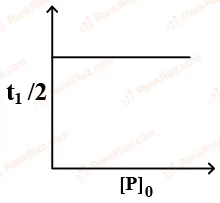
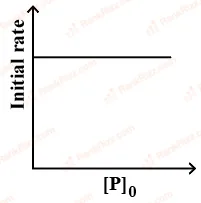
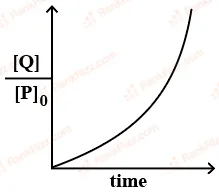
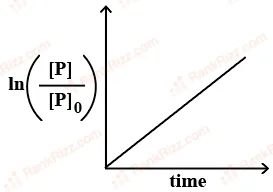
Which of the following plots is(are) correct for the given reaction?
([P]0[P]_0 is the initial concentration of P)

Figure for JEE Advanced 2020 Chemistry question on Integrated rate laws and half-life (zero and first order)
  1. A
    Figure for JEE Advanced 2020 Chemistry question on Integrated rate laws and half-life (zero and first order)
  2. B
    Figure for JEE Advanced 2020 Chemistry question on Integrated rate laws and half-life (zero and first order)
  3. C
    Figure for JEE Advanced 2020 Chemistry question on Integrated rate laws and half-life (zero and first order)
  4. D
    Figure for JEE Advanced 2020 Chemistry question on Integrated rate laws and half-life (zero and first order)
JEE ADVANCED 2020 · PAPER 1Radioactivity and nuclear reactionsTRANSCRIBED

92238U^{238}_{92}U is known to undergo radioactive decay to form 82206Pb^{206}_{82}Pb by emitting alpha and beta particles. A rock initially contained 68×10−668 \times 10^{−6} g of 92238U^{238}_{92}U If the number of alpha particles that it would emit during its radioactive decay of 92238U^{238}_{92}U to 82206Pb^{206}_{82}Pb in three half-lives is Z \times 10^{18}, then what is the value of Z?

JEE ADVANCED 2019 · PAPER 1Radioactivity and nuclear reactionsTRANSCRIBED

In the decay sequence

Figure for JEE Advanced 2019 Chemistry question on Radioactivity and nuclear reactions


X1,X2,X3andX4X_1, X_2, X_3 and X_4 are particles/radiation emitted by the respective isotopes. The correct option(s) is(are)

  1. A

    x1x_1 will deflect towards negatively charged plate

  2. B

    x2isβ−x_2 is \beta^-

  3. C

    x3isγx_3 is \gamma-ray

  4. D

    Z is an isotope of uranium

JEE ADVANCED 2019 · PAPER 2Integrated rate laws and half-life (zero and first order)TRANSCRIBED

The decomposition reaction

Figure for JEE Advanced 2019 Chemistry question on Integrated rate laws and half-life (zero and first order)


is started in a closed cylinder under isothermal isochoric condition at an initial pressure of 1 atm. After Y×103sY \times 10^3 s, the pressure inside the cylinder is found to be 1.45 atm. If the rate constant of the reaction is 5×10⁻⁴s−15 \times 10^{-4} s^{-1}, assuming ideal gas behavior, the value of Y is __________ .

JEE ADVANCED 2019 · PAPER 1Rate law, order and molecularityTRANSCRIBED

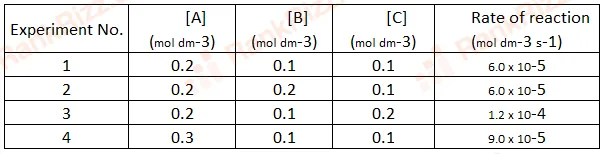
Consider the kinetic data given in the following table for the reaction A + B + C →\rightarrow Product.

Figure for JEE Advanced 2019 Chemistry question on Rate law, order and molecularity


The rate of the reaction for [A]=0.15moldm−3,[B]=0.25moldm−3and[C]=0.15moldm−3[A] = 0.15 mol dm^{-3}, [B] = 0.25 mol dm^{-3} and [C] = 0.15 mol dm^{-3} is found to be Y×10−5moldm−3s−1Y \times 10^{-5} mol dm^{-3} s^{-1}. The value of Y is _______ .

JEE ADVANCED 2017 · PAPER 2Collision theory and effect of catalyst on rateTRANSCRIBED

In a bimolecular reaction, the steric factor P was experimentally determined to be 4.5. The correct option(s) among the following is(are)

  1. A

    The activation energy of the reaction is unaffected by the value of the steric factor

  2. B

    Experimentally determined value of frequency factor is higher than that predicted by Arrhenius equation

  3. C

    Since P = 4.5, the reaction will not proceed unless an effective catalyst is used

  4. D

    The value of frequency factor predicted by Arrhenius equation is higher than that determined experimentally

JEE ADVANCED 2016 · PAPER 1Collision theory and effect of catalyst on rateTRANSCRIBED

According to the Arrhenius equation,

  1. A

    a high activation energy usually implies a fast reaction.

  2. B

    rate constant increases with increase in temperature. This is due to a greater number of collisions whose energy exceeds the activation energy.

  3. C

    higher the magnitude of activation energy, stronger 1s the temperature dependence of the rate constant.

  4. D

    the pre-exponential factor is a measure of the rate at which collisions occur, irrespective of their energy.

JEE ADVANCED 2016 · PAPER 1Radioactivity and nuclear reactionsTRANSCRIBED

A plot of the number of neutrons (NV) against the number of protons (P) of stable nuclei exhibits upward deviation from linearity for atomic number, Z > 20. For an unstable nucleus having N/P ratio less than 1, the possible mode(s) of decay is(are)

  1. A

    β−\beta^{-} decay (β\beta emission)

  2. B

    orbital or K-electron capture

  3. C

    neutron emission

  4. D

    β+\beta^{+} decay (positron emission)

JEE ADVANCED 2015 · PAPER 2Radioactivity and nuclear reactionsTRANSCRIBED

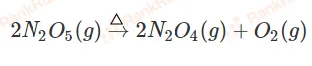
A closed vessel with rigid walls contains 1 mol of 92238U_{92}^{238}U and 1 mol of air at 298 K. Considering complete decay of 92238U_{92}^{238}U to 82206Pb,_{82}^{206}Pb, the ratio of the final pressure to the initial pressure of the system at 298 K is

JEE ADVANCED 2015 · PAPER 2Rate law, order and molecularityTRANSCRIBED

In dilute aqueous H2SO4H_2SO_4, the complex diaquodioxalatoferrate(II) is oxidized by MnO4−MnO_4^-. For this reaction, the ratio of the rate of change of [H+][H^+] to the rate of change of MnO4−MnO_4^- is

JEE ADVANCED 2014 · PAPER 2Methods to determine order of reactionTRANSCRIBED

For the elementary reaction M→NM \rightarrow N, the rate of disappearance of M increases by a factor of 8 upon doubling the concentration of M. The order of the reaction with respect to M is

  1. A

    4

  2. B

    3

  3. C

    2

  4. D

    1

JEE ADVANCED 2013 · PAPER 1Methods to determine order of reactionTRANSCRIBED

In the reaction,
P+Q→R+SP + Q \rightarrow R + S
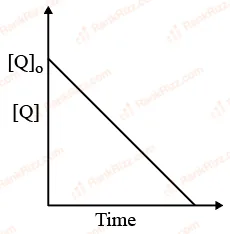
the time taken for 75% reaction of P is twice the time taken for 50% reaction of P. The concentration of Q varies with reaction time as shown in the figure. The overall order of the reaction is

Figure for JEE Advanced 2013 Chemistry question on Methods to determine order of reaction
  1. A

    2

  2. B

    3

  3. C

    0

  4. D

    1