JEE Advanced 2024 Chemistry question — Conductance, conductivity and molar conductivity
In a conductometric titration, small volume of titrant of higher concentration is added stepwise to a larger volume of titrate of much lower concentration, and the conductance is measured after each addition.
The limiting ionic conductivity () values (in mS ) for different ions in aqueous solutions are given below:
| Ions | |||||||||
|---|---|---|---|---|---|---|---|---|---|
| 6.2 | 7.4 | 5.0 | 35.0 | 7.2 | 7.6 | 16.0 | 19.9 | 4.1 |
For different combinations of titrates and titrants given in List-I, the graphs of 'conductance' versus 'volume of titrant' are given in List-II.
Match each entry in List-I with the appropriate entry in List-II and choose the correct option.
| List-I | List-II | ||
|---|---|---|---|
| (P) | Titrate: KCl Titrant: | (1) | 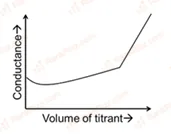 |
| (Q) | Titrate: Titrant: KCl | (2) | 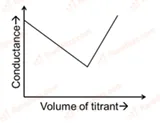 |
| (R) | Titrate: NaOH Titrant: HCl | (3) | 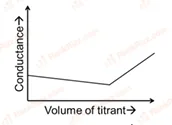 |
| (S) | Titrate: NaOH Titrant: | (4) | 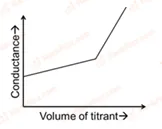 |
| (5) | 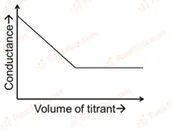 | ||
SOLUTION
Key idea: Before the end point, conductance changes depending on which ion replaces which in solution. After the end point, excess titrant ions raise the conductance.
- (P) KCl titrated with : (7.6) precipitates as AgCl and is replaced by (7.2). Conductance falls slightly, then rises after the end point (excess , ). This is graph 3.
- (Q) titrated with KCl: (6.2) is replaced by (7.4). Conductance rises slightly, then rises more steeply after the end point. This is graph 4.
- (R) NaOH titrated with HCl: (19.9) is replaced by (7.6), so conductance falls sharply. After the end point, excess (35.0) makes it rise sharply. This is the V-shape, graph 2.
- (S) NaOH titrated with : is replaced by (4.1), so conductance falls. After the end point, the excess weak acid barely ionises (common-ion effect), so conductance stays almost flat. This is graph 5.
So P-3, Q-4, R-2, S-5.
Answer: (C)
Tagged Conductance, conductivity and molar conductivity. Machine-assigned, so read it as a strong shortlist rather than a verdict.