JEE ADVANCED 2022 · PAPER 2Group 13: general trends and inert pair effectTRANSCRIBED
The compound(s) which react(s) with NH to give boron nitride (BN) is(are)
- A
B
- B
BH
- C
BO
- D
HBF
Every p-Block Elements: Groups 13 and 14 question JEE Advanced has set from 2007–2022, grouped by the idea it tests rather than the order of the syllabus. 14 questions across 2 distinct ideas. Free to read, answer key on every one.
Questions
14
Distinct ideas
2
Share of marks
0.9%
Difficulty
EASY
A chapter is not one subject — it is a handful of procedures the examiner reuses. These are the ones p-Block Elements: Groups 13 and 14 questions actually test.
The share of each year’s Chemistry questions that came from p-Block Elements: Groups 13 and 14, counted from the 19 papers we hold for the last 10 years, and paper by paper inside a year.
Falling: 0.0% of Chemistry questions in 2024–2026, down from 1.3% in 2017–2023. Its heaviest year was 2017, at 2.8%. Not asked at all in 2018, 2020, 2021, 2023, 2024, 2025, 2026.
“QS” is p-Block Elements: Groups 13 and 14 questions out of all Chemistry questions that year. A year with more sittings asks more questions, which is why the share, not the count, is the number to compare.
14 questions from 2007–2022. Over the last 20 papers, p-Block Elements: Groups 13 and 14 carried about 0.9% of Chemistry marks.
Group 13: general trends and inert pair effect (8 questions), Oxides of carbon, silica, silicones and silicates (6 questions). Start with these, they are what the examiner keeps coming back to.
Falling: 0.0% of Chemistry questions in 2024–2026, down from 1.3% in 2017–2023. Its heaviest year was 2017, at 2.8%. Not asked at all in 2018, 2020, 2021, 2023, 2024, 2025, 2026. It has carried about 0.9% of Chemistry marks in recent papers, rated easy on our difficulty scale. The year-by-year table above shows how that has moved.
Yes. Every question shows its official answer key, and a worked solution opens on the question’s own page wherever we have one. Reading and checking answers is free, no sign-up needed.
Do one past question per idea first: p-Block Elements: Groups 13 and 14 has 2 distinct ideas, listed above. Then practise the topics you get wrong, or build a timed test from this chapter.
1–14 OF 14 · NEWEST FIRST
The compound(s) which react(s) with NH to give boron nitride (BN) is(are)
B
BH
BO
HBF
A tin chloride Q undergoes the following reactions (not balanced)
X is a monoanion having pyramidal geometry. Both Y and Z are neutral compounds. Choose the correct option(s)
The central atom in X is hybridized
There is a coordinate bond in Y
The oxidation state of the central atom in Z is +2
The central atom in Z has one lone pair of electrons
Among the following, the correct statement(s) is(are)
has the three-centre two-electron bonds in its dimeric structure
has the three-centre two-electron bonds in its dimeric structure
has the three-centre two-electron bonds in its dimeric structure
The Lewis acidity of is greater than that of
The increasing order of atomic radii of the following Group 13 elements is
Al < Ga < In < Tl
Ga < Al < In < Tl
Al < In < Ga < Tl
Al < Ga < Tl < In
The crystalline form of borax has
tetranuclear unit
all boron atoms in the same plane
equal number of and hybridized boron atoms
one terminal hydroxide per boron atom
Three moles of are completely reacted with methanol. The number of moles of boron containing product formed is
The correct statement(s) for orthoboric acid is/are
It behaves as a weak acid in water due to self ionization.
Acidity of its aqueous solution increases upon addition of ethylene glycol.
It has a three dimensional structure due to hydrogen bonding.
It is a weak electrolyte in water.
With respect to graphite and diamond, which of the statement(s) given below is (are) correct ?
Graphite is harder than diamond.
Graphite has higher electrical conductivity than diamond
Graphite has higher thermal conductivity than diamond
Graphite has higher C-C bond order than diamond
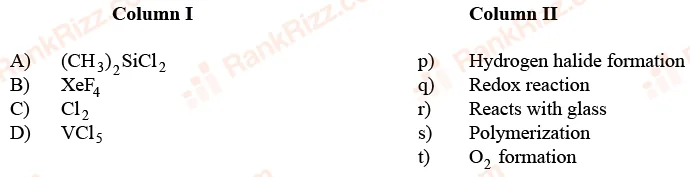
All the compounds listed in Column I react with water. Match the result of the respective reactions with the appropriate options listed in Column II.
The value of n in the molecular formula is
In the reaction
the amine(s) X is (are)
STATEMENT-1: compounds are stronger oxidizing agents than compounds.
and
STATEMENT-2: The higher oxidation states for the group 14 elements are more stable for the heavier members of the group due to ‘inert pair effect’.
STATEMENT-1 is True, STATEMENT-2 is True; STATEMENT-2 is a correct explanation for STATEMENT-1
STATEMENT-1 is True, STATEMENT-2 is True; STATEMENT-2 is NOT a correct explanation for STATEMENT-1
STATEMENT-1 is True, STATEMENT-2 is False
STATEMENT-1 is False, STATEMENT-2 is True
STATEMENT-1: In water, orthoboric acid behaves as a weak monobasic acid.
because
STATEMENT-2: In water, orthoboric acid acts as a proton donor.
Statement-1 is True, Statement-2 is True; Statement-2 is a correct explanation for Statement-1
Statement-1 is True, Statement-2 is True; Statement-2 is NOT a correct explanation for Statement-1
Statement-1 is True, Statement-2 is False
Statement-1 is False, Statement-2 is True
STATEMENT-1: Band gap in germanium is small.
because
STATEMENT-2: The energy spread of each germanium atomic energy level is infinitesimally small.
Statement-1 is True, Statement-2 is True; Statement-2 is a correct explanation for Statement-1
Statement-1 is True, Statement-2 is True; Statement-2 is NOT a correct explanation for Statement-1
Statement-1 is True, Statement-2 is False
Statement-1 is False, Statement-2 is True
JEE Main has set 92 p-Block Elements: Groups 13 and 14 questions too. p-Block Elements: Groups 13 and 14 JEE Main PYQs →
OTHER CHEMISTRY CHAPTERS