RankRizz

General Organic Chemistry — JEE Advanced Previous Year Questions

Every General Organic Chemistry question JEE Advanced has set from 2007–2025, grouped by the idea it tests rather than the order of the syllabus. 66 questions across 7 distinct ideas. Free to read, answer key on every one.

Questions

66

Distinct ideas

7

Share of marks

7.4%

Difficulty

MEDIUM

The ideas inside General Organic Chemistry

A chapter is not one subject — it is a handful of procedures the examiner reuses. These are the ones General Organic Chemistry questions actually test.

01Classification, functional groups and hybridisation in organic compoundsset 2×
02IUPAC nomenclature of organic compoundsset 3×
03Structural isomerismset 23×
04Geometrical isomerismNot set in Advanced
05Optical isomerism and chiralityNot set in Advanced
06ConformationsNot set in Advanced
07Inductive and electromeric effectsNot set in Advanced
08Resonance and hyperconjugationset 24×
09Reactive intermediates and rearrangementsset 7×
10Acidity and basicity of organic compoundsset 5×
11Aromaticityset 2×
12Types of organic reactions, electrophiles and nucleophilesNot set in Advanced

General Organic Chemistry weightage, year by year

The share of each year’s Chemistry questions that came from General Organic Chemistry, counted from the 19 papers we hold for the last 10 years, and paper by paper inside a year.

Falling: 1.0% of Chemistry questions in 2024–2026, down from 10.3% in 2017–2023. Its heaviest year was 2021, at 28.9%. Not asked at all in 2022, 2023, 2024, 2026.

20260 / 340.0%PAPER 1 0.0%PAPER 2 0.0%
20251 / 323.1%PAPER 1 6.3%PAPER 2 0.0%
20240 / 340.0%PAPER 1 0.0%PAPER 2 0.0%
20230 / 340.0%PAPER 1 0.0%PAPER 2 0.0%
20220 / 360.0%PAPER 1 0.0%PAPER 2 0.0%
202111 / 3828.9%PAPER 1 15.8%PAPER 2 42.1%
20205 / 3613.9%PAPER 1 22.2%PAPER 2 5.6%
20193 / 368.3%PAPER 1 0.0%PAPER 2 16.7%
20182 / 1811.1%1 PAPER
20173 / 368.3%PAPER 1 16.7%PAPER 2 0.0%

“QS” is General Organic Chemistry questions out of all Chemistry questions that year. A year with more sittings asks more questions, which is why the share, not the count, is the number to compare.

General Organic Chemistry: quick answers

How many General Organic Chemistry questions has JEE Advanced asked?

66 questions from 2007–2025. Over the last 20 papers, General Organic Chemistry carried about 7.4% of Chemistry marks.

Which General Organic Chemistry topics come up most?

Resonance and hyperconjugation (24 questions), Structural isomerism (23 questions), Reactive intermediates and rearrangements (7 questions). Start with these, they are what the examiner keeps coming back to.

Is General Organic Chemistry important for JEE Advanced?

Falling: 1.0% of Chemistry questions in 2024–2026, down from 10.3% in 2017–2023. Its heaviest year was 2021, at 28.9%. Not asked at all in 2022, 2023, 2024, 2026. It has carried about 7.4% of Chemistry marks in recent papers, rated medium on our difficulty scale. The year-by-year table above shows how that has moved.

Do these General Organic Chemistry PYQs have answers and solutions?

Yes. Every question shows its official answer key, and a worked solution opens on the question’s own page wherever we have one. Reading and checking answers is free, no sign-up needed.

What’s the fastest way to revise General Organic Chemistry?

Do one past question per idea first: General Organic Chemistry has 7 distinct ideas, listed above. Then practise the topics you get wrong, or build a timed test from this chapter.

Every General Organic Chemistry question

1–20 OF 66 · NEWEST FIRST

JEE ADVANCED 2025 · PAPER 1Acidity and basicity of organic compoundsTRANSCRIBED

The reaction sequence given below is carried out with 16 moles of X. The yield of the major product in each step is given below the product in parentheses. The amount (in grams) of S produced is ________.
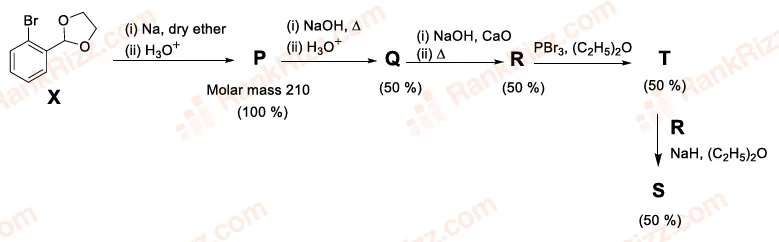
Figure for JEE Advanced 2025 Chemistry question on Acidity and basicity of organic compounds

Use: Atomic mass (in amu): H = 1, C = 12, O = 16, Br = 80
JEE ADVANCED 2021 · PAPER 1Structural isomerismTRANSCRIBED

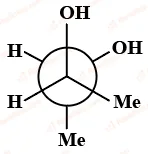
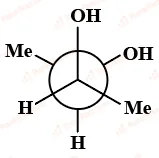
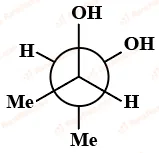
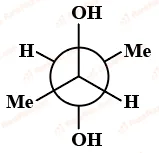
Among the following, the conformation that corresponds to the most stable conformation of meso-butane-2,3-diol is

  1. A
    Figure for JEE Advanced 2021 Chemistry question on Structural isomerism
  2. B
    Figure for JEE Advanced 2021 Chemistry question on Structural isomerism
  3. C
    Figure for JEE Advanced 2021 Chemistry question on Structural isomerism
  4. D
    Figure for JEE Advanced 2021 Chemistry question on Structural isomerism
JEE ADVANCED 2021 · PAPER 1Resonance and hyperconjugationTRANSCRIBED

T he value of y is ___.

JEE ADVANCED 2021 · PAPER 2Resonance and hyperconjugationTRANSCRIBED

The value of α\alpha is ___.

JEE ADVANCED 2021 · PAPER 2Resonance and hyperconjugationTRANSCRIBED

The value of y is ___.

JEE ADVANCED 2021 · PAPER 2Resonance and hyperconjugationTRANSCRIBED

The value of x is _________.

JEE ADVANCED 2021 · PAPER 2Resonance and hyperconjugationTRANSCRIBED

The value of y is _________.

JEE ADVANCED 2021 · PAPER 2Resonance and hyperconjugationTRANSCRIBED

The value of x is _________.

JEE ADVANCED 2021 · PAPER 2Resonance and hyperconjugationTRANSCRIBED

The value of y is _________.

JEE ADVANCED 2021 · PAPER 2Reactive intermediates and rearrangementsTRANSCRIBED

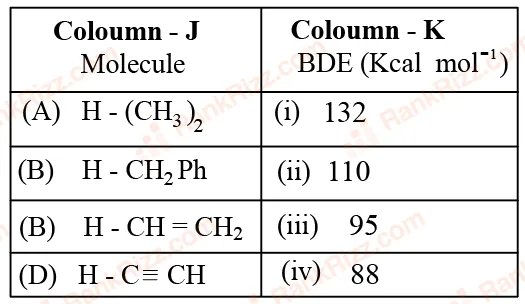
Correct match of the C-H bonds (shown in bold) in Column J with their BDE in Column K is

Figure for JEE Advanced 2021 Chemistry question on Reactive intermediates and rearrangements
  1. A

    P - iii, Q - iv, R - ii, S - i

  2. B

    P - i, Q - ii, R - iii, S - iv

  3. C

    P - iii, Q - ii, R - i, S - iv

  4. D

    P - ii, Q - i, R - iv, S - iii

JEE ADVANCED 2021 · PAPER 2Reactive intermediates and rearrangementsTRANSCRIBED

F or the following reaction

Figure for JEE Advanced 2021 Chemistry question on Reactive intermediates and rearrangements

the correct statement is

  1. A

    Initiation step is exothermic with △H∘=−58\triangle H^{\circ} = -58 kcal mol−1^{-1}.

  2. B

    Propagation step involving ●CH3^{●}CH_3 formation is exothermic with △H∘=+27\triangle H^\circ = +27 kcal mol−1^{-1}

  3. C

    Propagation step involving CH3ClCH_3Cl formation is endothermic with △H∘=+27\triangle H^\circ = +27 kcal mol−1^{-1}.

  4. D

    The reaction is exothermic with △H∘=−25\triangle H^\circ = -25 kcal mol−1^{-1}

JEE ADVANCED 2021 · PAPER 1Structural isomerismTRANSCRIBED

The maximum number of possible isomers (including stereoisomers) which may be formed on mono-bromination of 1-methylcyclohex-1-ene using Br2Br_2 and UV light
is ___.

JEE ADVANCED 2020 · PAPER 1Structural isomerismTRANSCRIBED

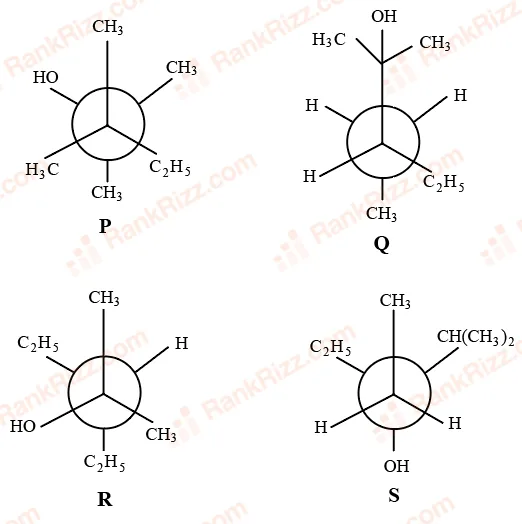
Newman projections P, Q, R and S are shown below:

Figure for JEE Advanced 2020 Chemistry question on Structural isomerism

Which one of the following options represents identical molecules?

  1. A

    P and Q

  2. B

    Q and S

  3. C

    Q and R

  4. D

    R and S

JEE ADVANCED 2020 · PAPER 1IUPAC nomenclature of organic compoundsTRANSCRIBED

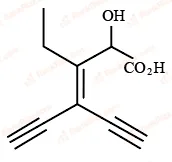
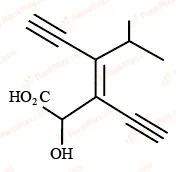
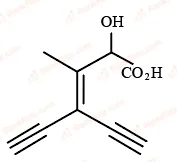
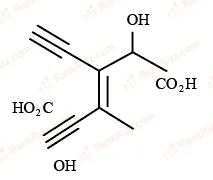
Which one of the following structures has the IUPAC name
3-ethynyl-2-hydroxy-4-methylhex-3-en-5-ynoic acid?

  1. A
    Figure for JEE Advanced 2020 Chemistry question on IUPAC nomenclature of organic compounds
  2. B
    Figure for JEE Advanced 2020 Chemistry question on IUPAC nomenclature of organic compounds
  3. C
    Figure for JEE Advanced 2020 Chemistry question on IUPAC nomenclature of organic compounds
  4. D
    Figure for JEE Advanced 2020 Chemistry question on IUPAC nomenclature of organic compounds
JEE ADVANCED 2020 · PAPER 1Structural isomerismTRANSCRIBED

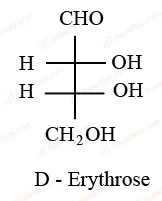
The Fischer projection of D-erythrose is shown below.

Figure for JEE Advanced 2020 Chemistry question on Structural isomerism

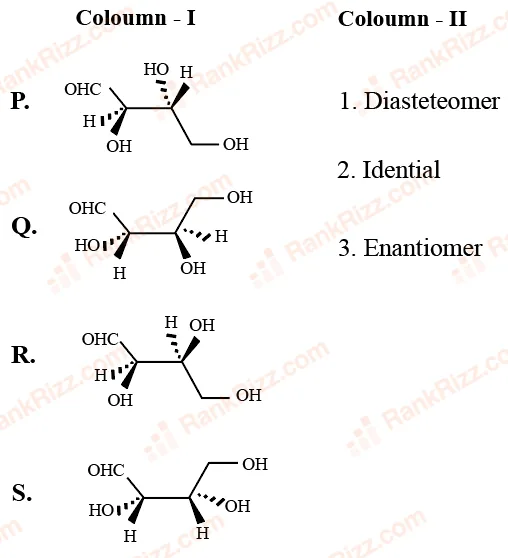
D-Erythrose and its isomers are listed as P, Q, R, and S in Column-I. Choose the correct relationship of P, Q, R, and S with D-erythrose from Column II.

Figure for JEE Advanced 2020 Chemistry question on Structural isomerism
  1. A

    P-2, Q-3, Q-2, Q-2

  2. B

    P-3, Q-1, Q-1, Q-2

  3. C

    P-2, Q-1, Q-1, Q-3

  4. D

    P-2, Q-3, Q-3, Q-1

JEE ADVANCED 2020 · PAPER 1Acidity and basicity of organic compoundsTRANSCRIBED

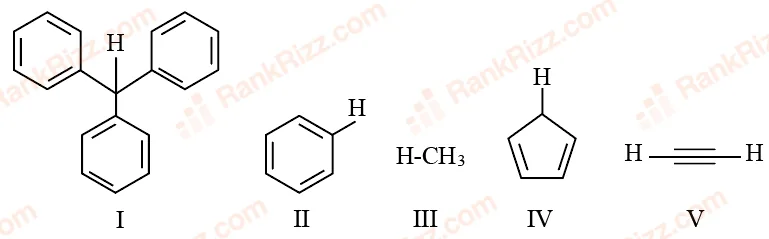
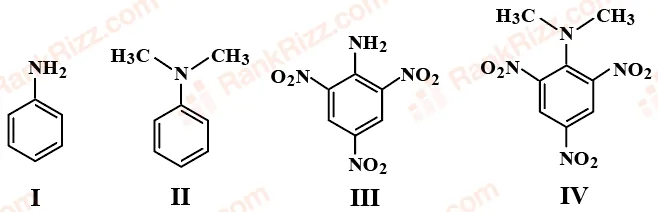
With respect to the compounds I-V, choose the correct statement(s).

Figure for JEE Advanced 2020 Chemistry question on Acidity and basicity of organic compounds
  1. A

    The acidity of compound I is due to delocalization in the conjugate base.

  2. B

    The conjugate base of compound IV is aromatic.

  3. C

    Compound II becomes more acidic, when it has a −NO2-NO_{2} substituent.

  4. D

    The acidity of compounds follows the order I > IV > V > II > III.

JEE ADVANCED 2020 · PAPER 2Acidity and basicity of organic compoundsTRANSCRIBED

Consider the following four compounds I, II, III, and IV.

Figure for JEE Advanced 2020 Chemistry question on Acidity and basicity of organic compounds

Choose the correct statement(s).

  1. A

    The order of basicity is II > I > III > IV.

  2. B

    The magnitude of pKbpK_b difference between I and II is more than that between III and IV.

  3. C

    Resonance effect is more in III than in IV.

  4. D

    Steric effect makes compound IV more basic than III.

JEE ADVANCED 2019 · PAPER 2Structural isomerismTRANSCRIBED

Total number of isomers, considering both structural and stereoisomers, of cyclic ethers with the molecular formula C4H8OC_4H_8O is

JEE ADVANCED 2019 · PAPER 2Resonance and hyperconjugationTRANSCRIBED

Which of the following options has the correct combination considering List-I and List-II?

  1. A

    (I), (P)

  2. B

    (I), (T)

  3. C

    (II), (Q)

  4. D

    (II), (R)

JEE ADVANCED 2019 · PAPER 2Resonance and hyperconjugationTRANSCRIBED

Which of the following options has the correct combination considering List-I and List-II?

  1. A

    (III), (P)

  2. B

    (III), (S)

  3. C

    (IV), (Q)

  4. D

    (IV), (U)