RankRizz

Qualitative Salt Analysis — JEE Advanced Previous Year Questions

Every Qualitative Salt Analysis question JEE Advanced has set from 2007–2025, grouped by the idea it tests rather than the order of the syllabus. 27 questions across 4 distinct ideas. Free to read, answer key on every one.

Questions

27

Distinct ideas

4

Share of marks

3.1%

Difficulty

EASY

The ideas inside Qualitative Salt Analysis

A chapter is not one subject — it is a handful of procedures the examiner reuses. These are the ones Qualitative Salt Analysis questions actually test.

01Preliminary and dry testsset 1×
02Analysis of anionsset 4×
03Group analysis and confirmatory tests of cationsset 20×
04Chemical principles of qualitative analysisset 2×

Qualitative Salt Analysis weightage, year by year

The share of each year’s Chemistry questions that came from Qualitative Salt Analysis, counted from the 19 papers we hold for the last 10 years, and paper by paper inside a year.

Rising: 4.0% of Chemistry questions in 2024–2026, up from 2.6% in 2017–2023. Its heaviest year was 2021, at 7.9%. Not asked at all in 2017, 2018, 2023, 2026.

20260 / 340.0%PAPER 1 0.0%PAPER 2 0.0%
20252 / 326.3%PAPER 1 6.3%PAPER 2 6.3%
20242 / 345.9%PAPER 1 0.0%PAPER 2 11.8%
20230 / 340.0%PAPER 1 0.0%PAPER 2 0.0%
20221 / 362.8%PAPER 1 0.0%PAPER 2 5.6%
20213 / 387.9%PAPER 1 5.3%PAPER 2 10.5%
20201 / 362.8%PAPER 1 5.6%PAPER 2 0.0%
20191 / 362.8%PAPER 1 5.6%PAPER 2 0.0%
20180 / 180.0%1 PAPER
20170 / 360.0%PAPER 1 0.0%PAPER 2 0.0%

“QS” is Qualitative Salt Analysis questions out of all Chemistry questions that year. A year with more sittings asks more questions, which is why the share, not the count, is the number to compare.

Qualitative Salt Analysis: quick answers

How many Qualitative Salt Analysis questions has JEE Advanced asked?

27 questions from 2007–2025. Over the last 20 papers, Qualitative Salt Analysis carried about 3.1% of Chemistry marks.

Which Qualitative Salt Analysis topics come up most?

Group analysis and confirmatory tests of cations (20 questions), Analysis of anions (4 questions), Chemical principles of qualitative analysis (2 questions). Start with these, they are what the examiner keeps coming back to.

Is Qualitative Salt Analysis important for JEE Advanced?

Rising: 4.0% of Chemistry questions in 2024–2026, up from 2.6% in 2017–2023. Its heaviest year was 2021, at 7.9%. Not asked at all in 2017, 2018, 2023, 2026. It has carried about 3.1% of Chemistry marks in recent papers, rated easy on our difficulty scale. The year-by-year table above shows how that has moved.

Do these Qualitative Salt Analysis PYQs have answers and solutions?

Yes. Every question shows its official answer key, and a worked solution opens on the question’s own page wherever we have one. Reading and checking answers is free, no sign-up needed.

What’s the fastest way to revise Qualitative Salt Analysis?

Do one past question per idea first: Qualitative Salt Analysis has 4 distinct ideas, listed above. Then practise the topics you get wrong, or build a timed test from this chapter.

Every Qualitative Salt Analysis question

1–20 OF 27 · NEWEST FIRST

JEE ADVANCED 2025 · PAPER 2Analysis of anionsTRANSCRIBED

During sodium nitroprusside test of sulphide ion in an aqueous solution, one of the ligands coordinated to the metal ion is converted to

  1. A

    NOS−^{-}

  2. B

    SCN−^{-}

  3. C

    SNO−^{-}

  4. D

    NCS−^{-}

JEE ADVANCED 2025 · PAPER 1Group analysis and confirmatory tests of cationsTRANSCRIBED

The correct match of the group reagents in List-I for precipitating the metal ion given in List-II from solutions, is
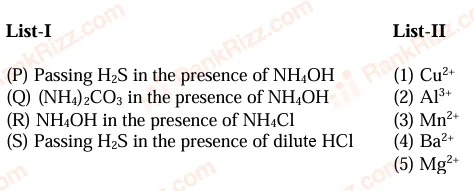
Figure for JEE Advanced 2025 Chemistry question on Group analysis and confirmatory tests of cations
  1. A

    P→\to3; Q→\to4; R→\to2; S→\to1

  2. B

    P→\to4; Q→\to2; R→\to3; S→\to1

  3. C

    P→\to3; Q→\to4; R→\to1; S→\to5

  4. D

    P→\to5; Q→\to3; R→\to2; S→\to4

JEE ADVANCED 2024 · PAPER 2Chemical principles of qualitative analysisTRANSCRIBED

The number of moles of potassium iodide required to produce two moles of P is ______.

JEE ADVANCED 2024 · PAPER 2Chemical principles of qualitative analysisTRANSCRIBED

The number of zinc ions present in the molecular formula of Q is ______.

JEE ADVANCED 2022 · PAPER 2Group analysis and confirmatory tests of cationsTRANSCRIBED

The reaction Pb(NO3_3)2_2 and NaCl in water produces a precipitate that dissolves upon the addition of HCl of appropriate concentration. The dissolution of the precipitate is due to the formation of

  1. A

    PbCl2_2

  2. B

    PbCl4_4

  3. C

    [PbCl4_4]2−^{2-}

  4. D

    [PbCl6_6]2−^{2-}

JEE ADVANCED 2021 · PAPER 2Group analysis and confirmatory tests of cationsTRANSCRIBED

Precipitate X is

  1. A

    Fe4[Fe(CN)6]3Fe_4[Fe(CN)_6]_3

  2. B

    Fe[Fe(CN)6]Fe[Fe(CN)_6]

  3. C

    K2Fe[Fe(CN)6]K_2Fe[Fe(CN)_6]

  4. D

    KFe[Fe(CN)6]KFe[Fe(CN)_6]

JEE ADVANCED 2021 · PAPER 1Group analysis and confirmatory tests of cationsTRANSCRIBED

A mixture of two salts is used to prepare a solution S, which gives the following results:

Figure for JEE Advanced 2021 Chemistry question on Group analysis and confirmatory tests of cations

The correct option(s) for the salt mixture is(are)

  1. A

    Pb(NO3)2Pb(NO_3)_2 and Zn(NO3)2Zn(NO_3)_2

  2. B

    Pb(NO3)2Pb(NO_3)_2 and Bi(NO3)3Bi(NO_3)_3

  3. C

    AgNO3AgNO_3 and Bi(NO3)3Bi(NO_3)_3

  4. D

    Pb(NO3)2Pb(NO_3)_2 and Hg(NO3)2Hg(NO_3)_2

JEE ADVANCED 2021 · PAPER 2Group analysis and confirmatory tests of cationsTRANSCRIBED

Among the following, the brown ring is due to the formation of

  1. A

    [Fe(NO)2(SO4)2]2−[Fe(NO)_2(SO_4)_2]^{2-}

  2. B

    [Fe(NO)2(H2O)4]3+[Fe(NO)_2(H_2O)_4]^{3+}

  3. C

    [Fe(NO)4(SO4)2][Fe(NO)_4(SO_4)_2]

  4. D

    [Fe(NO)(H2O)5]2+[Fe(NO)(H_2O)_5]^{2+}

JEE ADVANCED 2020 · PAPER 1Group analysis and confirmatory tests of cationsTRANSCRIBED

A colorless aqueous solution contains nitrates of two metals, X and Y. When it was added to an aqueous solution of NaCl, a white precipitate was formed. This precipitate was found to be partly soluble in hot water to give a residue P and a solution Q. The residue P was soluble in aq. NH3NH_{3} and also in excess sodium thiosulfate. The hot solution Q gave a yellow precipitate with KI. The metals X and Y, respectively, are

  1. A

    Ag and Pb

  2. B

    Ag and Cd

  3. C

    Cd and Pb

  4. D

    Cd and Zn

JEE ADVANCED 2019 · PAPER 1Preliminary and dry testsTRANSCRIBED

The green colour produced in the borax beadtest of a chromium(III) salt is due to

  1. A

    Cr(BO2)3Cr(BO_2)_3

  2. B

    Cr2(B4O7)3Cr_2(B_4O_7)_3

  3. C

    Cr2O3Cr_2O_3

  4. D

    CrB

JEE ADVANCED 2016 · PAPER 2Analysis of anionsTRANSCRIBED

In the following reaction sequence in aqueous solution, the species X, Y and Z, respectively, are
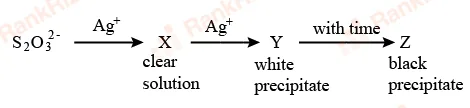
Figure for JEE Advanced 2016 Chemistry question on Analysis of anions
  1. A

    [Ag(S2O3)2]3−,Ag2S2O3,Ag2S[Ag(S_2O_3)_2]^{3-}, Ag_2S_2O_3, Ag_2S

  2. B

    [Ag(S2O3)3]5−,Ag2SO3,Ag2S[Ag(S_2O_3)_3]^{5-}, Ag_2SO_3, Ag_2S

  3. C

    [Ag(SO3)2]3−,Ag2S2O3,Ag[Ag(SO_3)_2]^{3-}, Ag_2S_2O_3, Ag

  4. D

    [Ag(SO3)3]3−,Ag2SO4,Ag[Ag(SO_3)_3]^{3-}, Ag_2SO_4, Ag

JEE ADVANCED 2016 · PAPER 1Analysis of anionsTRANSCRIBED

The reagent(s) that can selectively precipitate S2−S^{2-} from a mixture of S2−S^{2-} and SO42−SO_{4}^{2-} in aqueous solution is(are)

  1. A

    CuCl2CuCl_2

  2. B

    BaCl2BaCl_2

  3. C

    Pb(OOCCH3)2Pb(OOCCH_3)_2

  4. D

    Na2[Fe(CN)5NO]Na_2[Fe(CN)_5 NO]

JEE ADVANCED 2015 · PAPER 2Group analysis and confirmatory tests of cationsTRANSCRIBED

The pair(s) of ions where BOTHtheions are precipitated upon passing H2SH_2S gas in presence of dilute HCl, is(are)

  1. A

    Ba2+,Zn2+Ba^{2+}, Zn^{2+}

  2. B

    Bi3+,Fe3+Bi^{3+}, Fe^{3+}

  3. C

    Cu2+,Pb2+Cu^{2+}, Pb^{2+}

  4. D

    Hg2+,Bi3+Hg^{2+}, Bi^{3+}

JEE ADVANCED 2014 · PAPER 1Group analysis and confirmatory tests of cationsTRANSCRIBED

Among PbS, CuS, HgS, MnS, Ag2SAg_2S, NiS, CoS, Bi2S3Bi_2S_3 and SnS2SnS_2, the total number of BLACK coloured sulfides is

JEE ADVANCED 2014 · PAPER 2Group analysis and confirmatory tests of cationsTRANSCRIBED

M1, Q and R, respectively are

  1. A

    Zn2+Zn^{2+}, KCN and HCl

  2. B

    Ni2+Ni^{2+}, HCl and KCN

  3. C

    Cd2+Cd^{2+}, KCN and HCl

  4. D

    Co2+Co^{2+}, HCl, and KCN

JEE ADVANCED 2014 · PAPER 2Group analysis and confirmatory tests of cationsTRANSCRIBED

Reagent S is

  1. A

    K4[Fe(CN)6]K_4[Fe(CN)_6]

  2. B

    Na2HPO4Na_2HPO_4

  3. C

    K2CrO4K_2CrO_4

  4. D

    KOHKOH

JEE ADVANCED 2013 · PAPER 1Group analysis and confirmatory tests of cationsTRANSCRIBED

Upon treatment with ammoniacal H2SH_2S, the metal ion that precipitates as a sulfide is

  1. A

    Fe(III)

  2. B

    Al(III)

  3. C

    Mg(II)

  4. D

    Zn(II)

JEE ADVANCED 2013 · PAPER 2Group analysis and confirmatory tests of cationsTRANSCRIBED

The precipitate P contains

  1. A

    pb2+pb^{2+}

  2. B

    Hg22+Hg_2^{2+}

  3. C

    Ag+Ag^{+}

  4. D

    Hg2+Hg^{2+}

JEE ADVANCED 2013 · PAPER 2Group analysis and confirmatory tests of cationsTRANSCRIBED

The coloured solution S contains

  1. A

    Fe2(SO4)3Fe_{2}(SO_{4})_{3}

  2. B

    CuSO4CuSO_{4}

  3. C

    ZnSO4ZnSO_{4}

  4. D

    Na2CrO4Na_{2}CrO_{4}

JEE ADVANCED 2011 · PAPER 2Group analysis and confirmatory tests of cationsTRANSCRIBED

Passing H2SH_2S gasinto a mixture of Mn2+,Ni2+,Cu2+Mn^{2+}, Ni^{2+}, Cu^{2+} and Hg2+Hg^{2+} ions in an acidified aqueous solution precipitates

  1. A

    CuS and HgS

  2. B

    MnS and CuS

  3. C

    MnS and NiS

  4. D

    NiS and HgS