JEE ADVANCED 2023 · PAPER 1Extraction of Fe, Cu, Zn, Al, Ag and AuTRANSCRIBED
The correct statement(s) related to processes involved in the extraction of metals is(are)
- A
Roasting of Malachite produces Cuprite.
- B
Calcination of Calamine produces Zincite.
- C
Copper pyrites is heated with silica in a reverberatory furnace to remove iron.
- D
Impure silver is treated with aqueous KCN in the presence of oxygen followed by reduction with zinc metal.
JEE ADVANCED 2022 · PAPER 1Extraction of Fe, Cu, Zn, Al, Ag and AuTRANSCRIBED
The electrochemical extraction of aluminum from bauxite ore involves
- A
the reaction of Al2O3 with coke (C) at a temperature > 2500°C.
- B
the neutralization of aluminate solution by passing CO2 gas to precipitate hydrated alumina (Al2O3.3H2O)
- C
the dissolution of Al2O3 in hot aqueous NaOH.
- D
the electrolysis of Al2O3 mixed with Na3AlF6 to give Al and CO2.
JEE ADVANCED 2022 · PAPER 2Extraction of Fe, Cu, Zn, Al, Ag and AuTRANSCRIBED
The correct option(s) related to the extraction of iron from its ore in the blast furnace operating in the temperature range 900 - 1500 K is(are)
- A
Limestone is used to remove silicate impurity.
- B
Pig iron obtained from blast furnace contains about 4% carbon.
- C
Coke (C) converts CO2 to CO.
- D
Exhaust gases consist of NO2 and CO.
JEE ADVANCED 2021 · PAPER 1Extraction of Fe, Cu, Zn, Al, Ag and AuTRANSCRIBED
T he correct statement(s) related to the metal extraction processes is(are)
- A
A mixture of PbS and PbO undergoes self-reduction to produce Pb and SO2.
- B
In the extraction process of copper from copper pyrites, silica is added to produce copper silicate.
- C
Partial oxidation of sulphide ore of copper by roasting, followed by self-reduction produces blister copper.
- D
In cyanide process, zinc powder is utilized to precipitate gold from Na[Au(CN)2].
JEE ADVANCED 2020 · PAPER 2Extraction of Fe, Cu, Zn, Al, Ag and AuTRANSCRIBED
Which among the following statement(s) is(are) true for the extraction of aluminium from bauxite?
- A
Hydrated Al2O3 precipitates, when CO2 is bubbled through a solution of sodium aluminate.
- B
Addition of Na3AlF6 lowers the melting point of alumina.
- C
CO2 is evolved at the anode during electrolysis.
- D
The cathode is a steel vessel with a lining of carbon.
JEE ADVANCED 2019 · PAPER 2Extraction of Fe, Cu, Zn, Al, Ag and AuTRANSCRIBED
The cyanide process of gold extraction involves leaching out gold from its ore with CN− in the presence of Q in water to form R. Subsequently, R is treated with T to obtain Au and Z. Choose the correct option(s)
- A
- B
- C
Z is [Zn(CN)4]2−
- D
R is [Au(CN)4]−
JEE ADVANCED 2019 · PAPER 1Occurrence of metals: minerals and oresTRANSCRIBED
Calamine, malachite, magnetite and cryolite, respectively, are
- A
ZnSO4,CuCO3,Fe2O3,AlF3
- B
ZnSO4,Cu(OH)2,Fe304,,Na3AlF6
- C
ZnCO3,CuCO3.Cu(OH)2,Fe3O4,Na3AlF6
- D
ZnCO3,CuCO3,Fe2O3,Na3AlF6
JEE ADVANCED 2016 · PAPER 2Extraction of Fe, Cu, Zn, Al, Ag and AuTRANSCRIBED
Extraction of copper from copper pyrite (CuFeS2) involves
- A
crushing followed by concentration of the ore by froth-flotation.
- B
- C
self-reduction step to produce ‘blister copper’following evolution of SO2
- D
refining of ‘blister copper’ by carbon reduction
JEE ADVANCED 2015 · PAPER 1Refining of metalsTRANSCRIBED
Copper is purified by electrolytic refining of blister copper. The correct statement(s) about this process is (are)
- A
Impure Cu strip is used as cathode
- B
Acidified aqueous CuSO4 is used as electrolyte
- C
Pure Cu deposits at cathode
- D
Impurities settle as anode-mud
JEE ADVANCED 2015 · PAPER 1Occurrence of metals: minerals and oresTRANSCRIBED
Match the anionic species given in Column I that are present in the ore(s) given in Column II.
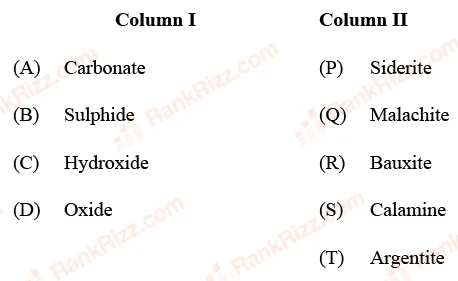
JEE ADVANCED 2014 · PAPER 1Extraction of Fe, Cu, Zn, Al, Ag and AuTRANSCRIBED
Upon heating with Cu2S, the reagent(s) that give copper metal is/are
- A
- B
- C
- D
JEE ADVANCED 2013 · PAPER 2Extraction of Fe, Cu, Zn, Al, Ag and AuTRANSCRIBED
The carbon-based reduction method is NOT used for the extraction of
- A
tin from SnO2
- B
iron from Fe2O3
- C
aluminium from Al2O3
- D
magnesium from MgCO3.CaCO3
JEE ADVANCED 2013 · PAPER 1Occurrence of metals: minerals and oresTRANSCRIBED
Sulfide ores are common for the metals
- A
- B
- C
- D
JEE ADVANCED 2012 · PAPER 2Extraction of Fe, Cu, Zn, Al, Ag and AuTRANSCRIBED
In the cyanide extraction process of silver from argentite ore, the oxidizing and reducing agents used are
- A
O2 and CO respectively
- B
O2 and Zn dust respectively
- C
HNO3 and Zn dust respectively
- D
HNO3 and CO respectively
JEE ADVANCED 2011 · PAPER 2Occurrence of metals: minerals and oresTRANSCRIBED
Oxidation states of the metal in the minerals haematite and magnetite, respectively, are
- A
II, III in haematite and III in magnetite
- B
II, III in haematite and II in magnetite
- C
II in haematite and II, III in magnetite
- D
III in haematite and II, III in magnetite
JEE ADVANCED 2011 · PAPER 1Extraction of Fe, Cu, Zn, Al, Ag and AuTRANSCRIBED
Extraction of metal from the ore cassiterite involves -
- A
carbon reduction of an oxide ore
- B
self-reduction of a sulphide ore
- C
removal of copper impurity
- D
JEE ADVANCED 2010 · PAPER 1Extraction of Fe, Cu, Zn, Al, Ag and AuTRANSCRIBED
Partial roasting of chalcopyrite produces
- A
Cu2S and FeO
- B
Cu2O and FeO
- C
CuS and Fe2O3
- D
Cu2O and Fe2O3
JEE ADVANCED 2010 · PAPER 1Extraction of Fe, Cu, Zn, Al, Ag and AuTRANSCRIBED
Iron is removed from chalcopyrite as
- A
- B
- C
- D
JEE ADVANCED 2010 · PAPER 1Extraction of Fe, Cu, Zn, Al, Ag and AuTRANSCRIBED
In self-reduction, the reducing species is
- A
- B
- C
- D
JEE ADVANCED 2008 · PAPER 1Extraction of Fe, Cu, Zn, Al, Ag and AuTRANSCRIBED
Native silver metal forms a water soluble complex with a dilute aqueous solution of NaCN in the presence of
- A
- B
- C
- D