RankRizz

Haloalkanes and Haloarenes — JEE Advanced Previous Year Questions

Every Haloalkanes and Haloarenes question JEE Advanced has set from 2008–2025, grouped by the idea it tests rather than the order of the syllabus. 8 questions across 2 distinct ideas. Free to read, answer key on every one.

Questions

8

Distinct ideas

2

Share of marks

1.1%

Difficulty

HARD

The ideas inside Haloalkanes and Haloarenes

A chapter is not one subject — it is a handful of procedures the examiner reuses. These are the ones Haloalkanes and Haloarenes questions actually test.

01Haloalkanes: preparation and physical propertiesNot set in Advanced
02Nucleophilic substitution (SN1 and SN2)set 6×
03Elimination reactions (E1 and E2)Not set in Advanced
04Grignard reagents and other organometallic reactionsNot set in Advanced
05Haloarenesset 2×
06Polyhalogen compoundsNot set in Advanced

Haloalkanes and Haloarenes weightage, year by year

The share of each year’s Chemistry questions that came from Haloalkanes and Haloarenes, counted from the 19 papers we hold for the last 10 years, and paper by paper inside a year.

Steady: 1.0% of Chemistry questions in 2024–2026 against 1.3% in 2017–2023, and between 0.0% and 5.9% in every year shown. Not asked at all in 2018, 2019, 2020, 2021, 2022, 2024, 2026.

20260 / 340.0%PAPER 1 0.0%PAPER 2 0.0%
20251 / 323.1%PAPER 1 6.3%PAPER 2 0.0%
20240 / 340.0%PAPER 1 0.0%PAPER 2 0.0%
20232 / 345.9%PAPER 1 5.9%PAPER 2 5.9%
20220 / 360.0%PAPER 1 0.0%PAPER 2 0.0%
20210 / 380.0%PAPER 1 0.0%PAPER 2 0.0%
20200 / 360.0%PAPER 1 0.0%PAPER 2 0.0%
20190 / 360.0%PAPER 1 0.0%PAPER 2 0.0%
20180 / 180.0%1 PAPER
20171 / 362.8%PAPER 1 0.0%PAPER 2 5.6%

“QS” is Haloalkanes and Haloarenes questions out of all Chemistry questions that year. A year with more sittings asks more questions, which is why the share, not the count, is the number to compare.

Haloalkanes and Haloarenes: quick answers

How many Haloalkanes and Haloarenes questions has JEE Advanced asked?

8 questions from 2008–2025. Over the last 20 papers, Haloalkanes and Haloarenes carried about 1.1% of Chemistry marks.

Which Haloalkanes and Haloarenes topics come up most?

Nucleophilic substitution (SN1 and SN2) (6 questions), Haloarenes (2 questions). Start with these, they are what the examiner keeps coming back to.

Is Haloalkanes and Haloarenes important for JEE Advanced?

Steady: 1.0% of Chemistry questions in 2024–2026 against 1.3% in 2017–2023, and between 0.0% and 5.9% in every year shown. Not asked at all in 2018, 2019, 2020, 2021, 2022, 2024, 2026. It has carried about 1.1% of Chemistry marks in recent papers, rated hard on our difficulty scale. The year-by-year table above shows how that has moved.

Do these Haloalkanes and Haloarenes PYQs have answers and solutions?

Yes. Every question shows its official answer key, and a worked solution opens on the question’s own page wherever we have one. Reading and checking answers is free, no sign-up needed.

What’s the fastest way to revise Haloalkanes and Haloarenes?

Do one past question per idea first: Haloalkanes and Haloarenes has 2 distinct ideas, listed above. Then practise the topics you get wrong, or build a timed test from this chapter.

Every Haloalkanes and Haloarenes question

1–8 OF 8 · NEWEST FIRST

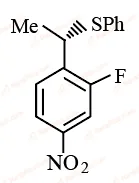
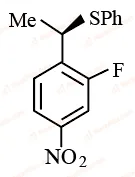
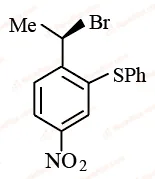
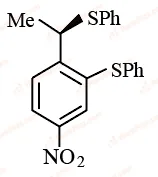
JEE ADVANCED 2025 · PAPER 1Nucleophilic substitution (SN1 and SN2)TRANSCRIBED

For the reaction sequence given below, the correct statement(s) is(are)
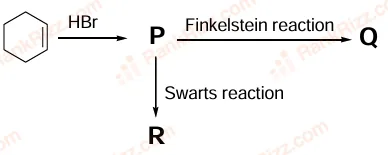
Figure for JEE Advanced 2025 Chemistry question on Nucleophilic substitution (SN1 and SN2)

(In the options, X is any atom other than carbon and hydrogen, and it is different in P, Q and R)

  1. A

    C-X bond length in P, Q and R follows the order Q > R > P.

  2. B

    C-X bond enthalpy in P, Q and R follows the order R > P > Q.

  3. C

    Relative reactivity toward SN_N2 reaction in P, Q and R follows the order P > R > Q.

  4. D

    pKaK_a value of the conjugate acids of the leaving groups in P, Q and R follows the order R > Q > P.
JEE ADVANCED 2023 · PAPER 2Nucleophilic substitution (SN1 and SN2)TRANSCRIBED

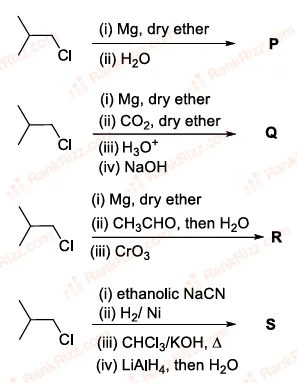
In the following reactions, P, Q, R, and S are the major products.

Figure for JEE Advanced 2023 Chemistry question on Nucleophilic substitution (SN1 and SN2)

The correct statement about P, Q, R, and S is

  1. A

    P is a primary alcohol with four carbons.

  2. B

    Q undergoes Kolbe's electrolysis to give an eight-carbon product.

  3. C

    R has six carbons and it undergoes Cannizzaro reaction.

  4. D

    S is a primary amine with six carbons.

JEE ADVANCED 2023 · PAPER 1Nucleophilic substitution (SN1 and SN2)TRANSCRIBED

Match the reactions in List-I with the features of their products in List-II and choose the correct option.

List-IList-II
(P)(-)-1-Bromo-2-ethylpentane (single enantiomer) →SN2 reactionaq. NaOH\xrightarrow[S_N2 \text{ reaction}]{\text{aq. NaOH}}(1)Inversion of configuration
(Q)(-)-2-Bromopentane (single enantiomer) →SN2 reactionaq. NaOH\xrightarrow[S_N2 \text{ reaction}]{\text{aq. NaOH}}(2)Retention of configuration
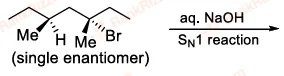
(R)(-)-3-Bromo-3-methylhexane (single enantiomer) →SN1 reactionaq. NaOH\xrightarrow[S_N1 \text{ reaction}]{\text{aq. NaOH}}(3)Mixture of enantiomers
(S)
Figure for JEE Advanced 2023 Chemistry question on Nucleophilic substitution (SN1 and SN2)
(4)Mixture of structural isomers
(5)Mixture of diastereomers
  1. A

    P →\to 1; Q →\to 2; R →\to 5; S →\to 3

  2. B

    P →\to 2; Q →\to 1; R →\to 3; S →\to 5

  3. C

    P →\to 1; Q →\to 2; R →\to 5; S →\to 4

  4. D

    P →\to 2; Q →\to 4; R →\to 3; S →\to 5

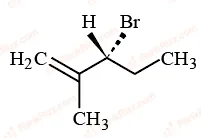
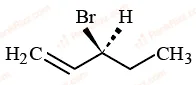
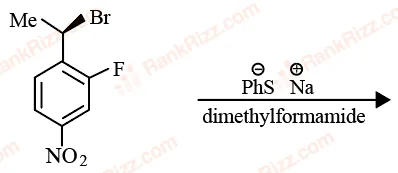
JEE ADVANCED 2017 · PAPER 2Nucleophilic substitution (SN1 and SN2)TRANSCRIBED

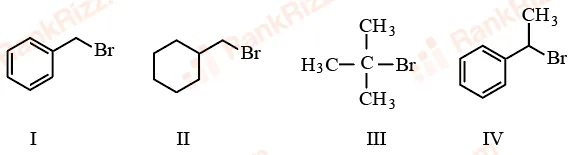
For the following compounds, the correct statement(s) with respect to nucleophilic substitution reactions is(are)

Figure for JEE Advanced 2017 Chemistry question on Nucleophilic substitution (SN1 and SN2)
  1. A

    I and III follow SN1S_{N}1 mechanism

  2. B

    I and II follow SN2S_{N}2 mechanism

  3. C

    Compound IV undergoes inversion of configuration

  4. D

    The order of reactivity for I, III and IV is: IV > I > III

JEE ADVANCED 2015 · PAPER 1Nucleophilic substitution (SN1 and SN2)TRANSCRIBED

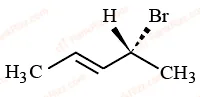
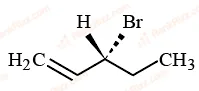
Compound(s) that on hydrogenation produce(s) optically inactive compound(s) is(are)

  1. A
    Figure for JEE Advanced 2015 Chemistry question on Nucleophilic substitution (SN1 and SN2)
  2. B
    Figure for JEE Advanced 2015 Chemistry question on Nucleophilic substitution (SN1 and SN2)
  3. C
    Figure for JEE Advanced 2015 Chemistry question on Nucleophilic substitution (SN1 and SN2)
  4. D
    Figure for JEE Advanced 2015 Chemistry question on Nucleophilic substitution (SN1 and SN2)
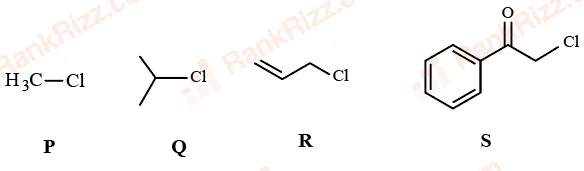
JEE ADVANCED 2013 · PAPER 1Nucleophilic substitution (SN1 and SN2)TRANSCRIBED

KJ in acetone, undergoes SN2S_N2 reaction with each of P, Q, R and S. The rates of the reaction vary as

Figure for JEE Advanced 2013 Chemistry question on Nucleophilic substitution (SN1 and SN2)
  1. A

    P > Q > R > S

  2. B

    S > P > R > Q

  3. C

    P > R > Q > S

  4. D

    R > P > s > Q

JEE ADVANCED 2008 · PAPER 1HaloarenesTRANSCRIBED

The major product of the following reaction is

Figure for JEE Advanced 2008 Chemistry question on Haloarenes
  1. A
    Figure for JEE Advanced 2008 Chemistry question on Haloarenes
  2. B
    Figure for JEE Advanced 2008 Chemistry question on Haloarenes
  3. C
    Figure for JEE Advanced 2008 Chemistry question on Haloarenes
  4. D
    Figure for JEE Advanced 2008 Chemistry question on Haloarenes
JEE ADVANCED 2008 · PAPER 1HaloarenesTRANSCRIBED

STATEMENT-1: Bromobenzene upon reaction with Br,/Fe gives 1,4-dibromobenzene as the major product.
and
STATEMENT-2: In bromobenzene, the inductive effect of the bromo group is more dominant than the mesomeric effect in directing the incoming electrophile.

  1. A

    STATEMENT-1 is True, STATEMENT-2 is True: STATEMENT-2 is a correct explanation for STATEMENT-1

  2. B

    STATEMENT-1 is True, STATEMENT-2 is True: STATEMENT-2 is NOT a correct explanation for STATEMENT-1

  3. C

    STATEMENT-1 is True, STATEMENT-2 is False

  4. D

    STATEMENT-1 is False, STATEMENT-2 is True