RankRizz

Surface Chemistry — JEE Advanced Previous Year Questions

Every Surface Chemistry question JEE Advanced has set from 2007–2026, grouped by the idea it tests rather than the order of the syllabus. 16 questions across 2 distinct ideas. Free to read, answer key on every one.

Questions

16

Distinct ideas

2

Share of marks

2.3%

Difficulty

EASY

The ideas inside Surface Chemistry

A chapter is not one subject — it is a handful of procedures the examiner reuses. These are the ones Surface Chemistry questions actually test.

01Adsorption and adsorption isothermsset 9×
02Catalysis: homogeneous, heterogeneous and enzymeNot set in Advanced
03Classification, preparation and types of colloidsNot set in Advanced
04Properties of colloids and coagulationset 7×

Surface Chemistry weightage, year by year

The share of each year’s Chemistry questions that came from Surface Chemistry, counted from the 19 papers we hold for the last 10 years, and paper by paper inside a year.

Rising: 3.0% of Chemistry questions in 2024–2026, up from 1.7% in 2017–2023. Its heaviest year was 2025, at 3.1%. Not asked at all in 2018, 2019, 2020.

20261 / 342.9%PAPER 1 0.0%PAPER 2 5.6%
20251 / 323.1%PAPER 1 0.0%PAPER 2 6.3%
20241 / 342.9%PAPER 1 0.0%PAPER 2 5.9%
20231 / 342.9%PAPER 1 0.0%PAPER 2 5.9%
20221 / 362.8%PAPER 1 5.6%PAPER 2 0.0%
20211 / 382.6%PAPER 1 5.3%PAPER 2 0.0%
20200 / 360.0%PAPER 1 0.0%PAPER 2 0.0%
20190 / 360.0%PAPER 1 0.0%PAPER 2 0.0%
20180 / 180.0%1 PAPER
20171 / 362.8%PAPER 1 0.0%PAPER 2 5.6%

“QS” is Surface Chemistry questions out of all Chemistry questions that year. A year with more sittings asks more questions, which is why the share, not the count, is the number to compare.

Surface Chemistry: quick answers

How many Surface Chemistry questions has JEE Advanced asked?

16 questions from 2007–2026. Over the last 20 papers, Surface Chemistry carried about 2.3% of Chemistry marks.

Which Surface Chemistry topics come up most?

Adsorption and adsorption isotherms (9 questions), Properties of colloids and coagulation (7 questions). Start with these, they are what the examiner keeps coming back to.

Is Surface Chemistry important for JEE Advanced?

Rising: 3.0% of Chemistry questions in 2024–2026, up from 1.7% in 2017–2023. Its heaviest year was 2025, at 3.1%. Not asked at all in 2018, 2019, 2020. It has carried about 2.3% of Chemistry marks in recent papers, rated easy on our difficulty scale. The year-by-year table above shows how that has moved.

Do these Surface Chemistry PYQs have answers and solutions?

Yes. Every question shows its official answer key, and a worked solution opens on the question’s own page wherever we have one. Reading and checking answers is free, no sign-up needed.

What’s the fastest way to revise Surface Chemistry?

Do one past question per idea first: Surface Chemistry has 2 distinct ideas, listed above. Then practise the topics you get wrong, or build a timed test from this chapter.

Every Surface Chemistry question

1–16 OF 16 · NEWEST FIRST

JEE ADVANCED 2026 · PAPER 2Adsorption and adsorption isothermsTRANSCRIBED

At a given temperature, 0.45 g of acetic acid in 50 mL of water is shaken with 1.0 g of charcoal and the pH of the resulting solution is 3.0. Assume, the adsorption of acetic acid from the aqueous solution by charcoal follows Freundlich isotherm,

xm=kC1/n\dfrac{x}{m}=kC^{1/n}

If the plot of log⁡10(x/m)\log_{10}(x/m) against log⁡10C\log_{10}C gives a straight line with slope 1, the value of kk in L mol−1^{-1} is ___.

Given: The molar mass of acetic acid is 60 g mol−1^{-1}.
The acid dissociation constant of acetic acid is 1.0×10−51.0\times 10^{-5} at the given temperature.
xx is the mass (in grams) of acetic acid adsorbed. mm is the mass (in grams) of charcoal.
CC is the equilibrium concentration of acetic acid in the solution after the adsorption is complete.
kk and nn are constants for acetic acid−-charcoal system at the given temperature.
JEE ADVANCED 2025 · PAPER 2Adsorption and adsorption isothermsTRANSCRIBED

Adsorption of phenol from its aqueous solution on to fly ash obeys Freundlich isotherm. At a given temperature, from 10 mg g−1^{-1} and 16 mg g−1^{-1} aqueous phenol solutions, the concentrations of adsorbed phenol are measured to be 4 mg g−1^{-1} and 10 mg g−1^{-1}, respectively. At this temperature, the concentration (in mg g−1^{-1}) of adsorbed phenol from 20 mg g−1^{-1} aqueous solution of phenol will be ______.

Use: log⁡102=0.3\log_{10} 2 = 0.3

JEE ADVANCED 2024 · PAPER 2Adsorption and adsorption isothermsTRANSCRIBED

To form a complete monolayer of acetic acid on 1 g of charcoal, 100 mL of 0.5 M acetic acid was used. Some of the acetic acid remained unadsorbed. To neutralize the unadsorbed acetic acid, 40 mL of 1 M NaOH solution was required. If each molecule of acetic acid occupies P×10−23P \times 10^{-23} m2m^2 surface area on charcoal, the value of P is ________.

[Use given data : Surface area of charcoal = 1.5×1021.5 \times 10^2 m2g−1m^2 g^{-1}; Avogadro's number (NAN_A) = 6.0×10236.0 \times 10^{23} mol−1mol^{-1}]

JEE ADVANCED 2023 · PAPER 2Properties of colloids and coagulationTRANSCRIBED

Consider the following statements related to colloids.

(I) Lyophobic colloids are not formed by simple mixing of dispersed phase and dispersion medium.

(II) For emulsions, both the dispersed phase and the dispersion medium are liquid.

(III) Micelles are produced by dissolving a surfactant in any solvent at any temperature.

(IV) Tyndall effect can be observed from a colloidal solution with dispersed phase having the same refractive index as that of the dispersion medium.

The option with the correct set of statements is

  1. A

    (I) and (II)

  2. B

    (II) and (III)

  3. C

    (III) and (IV)

  4. D

    (II) and (IV)

JEE ADVANCED 2022 · PAPER 1Adsorption and adsorption isothermsTRANSCRIBED

The correct option(s) related to adsorption processes is(are)

  1. A

    Chemisorption results in a unimolecular layer.

  2. B

    The enthalpy change during physisorption is in the range of 100 to 140 kJ mol−1^{-1}.

  3. C

    Chemisorption is an endothermic process.

  4. D

    Lowering the temperature favors physisorption processes.

JEE ADVANCED 2021 · PAPER 1Properties of colloids and coagulationTRANSCRIBED

The correct statement(s) related to colloids is(are)

  1. A

    The process of precipitating colloidal sol by an electrolyte is called peptization.

  2. B

    Colloidal solution freezes at higher temperature than the true solution at the same concentration.

  3. C

    Surfactants form micelle above critical micelle concentration (CMC). CMC depends on temperature.

  4. D

    Micelles are macromolecular colloids.

JEE ADVANCED 2017 · PAPER 2Adsorption and adsorption isothermsTRANSCRIBED

The correct statement(s) about surface properties is(are)

  1. A

    Adsorption is accompanied by decrease in enthalpy and decrease in entropy of the system

  2. B

    The critical temperatures of ethane and nitrogen are 563 K and 126 K, respectively. The adsorption of ethane will be more than that of nitrogen on same amount of activated charcoal at a given temperature

  3. C

    Cloud is an emulsion type of colloid in which liquid is dispersed phase and gas is dispersion medium

  4. D

    Brownian motion of colloidal particles does not depend on the size of the particles but depends on viscosity of the solution

JEE ADVANCED 2016 · PAPER 2Properties of colloids and coagulationTRANSCRIBED

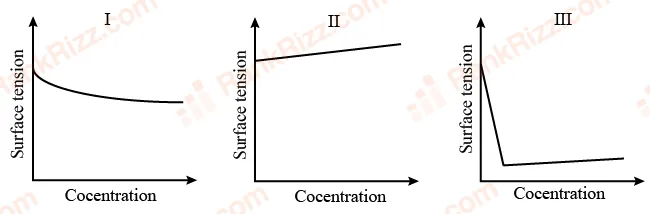
The qualitative sketches I, II and III given below show the variation of surface tension with molar concentration of three different aqueous solutions of KCl, CH3OHCH_3OH and CH3(CH2)11OSO3−Na+CH_3(CH_2)_{11}OSO_3{^-Na^+} at room temperature. The correct assignment of the sketches is

Figure for JEE Advanced 2016 Chemistry question on Properties of colloids and coagulation
  1. A

    I. KClKCl II. CH3OHCH_3OH III. CH3(CH2)11OSO−Na+CH_3(CH_2)_{11} OSO {^-Na^+}

  2. B

    I. CH3(CH2)11OSO−Na+CH_3(CH_2)_{11} OSO {^-Na^+} II. CH3OHCH_3OH III. KClKCl

  3. C

    I. KClKCl II. CH3(CH2)11OSO−Na+CH_3(CH_2)_{11} OSO {^-Na^+} III. CH3OHCH_3OH

  4. D

    I. CH3OHCH_3OH II. KClKCl III. CH3(CH2)11OSO−Na+CH_3(CH_2)_{11} OSO {^-Na^+}

JEE ADVANCED 2015 · PAPER 2Adsorption and adsorption isothermsTRANSCRIBED

When O2O_2 is adsorbed on a metallic surface, electron transfer occurs from the metal to O2O_2. The TRUE statement(s) regarding this adsorption is(are)

  1. A

    O2O_2 is physisorbed

  2. B

    heat is released

  3. C

    occupancy of π2p∗\pi_{2p}^* of O2O_2 is increased

  4. D

    bond length of O2O_2 is increased

JEE ADVANCED 2013 · PAPER 1Adsorption and adsorption isothermsTRANSCRIBED

Methylene blue, from its aqueous solution, is adsorbed on activated charcoal at 25∘C25^\circ C. For this process, the correct statement is

  1. A

    The adsorption requires activation at 25∘C25^\circ C.

  2. B

    The adsorption is accompanied by a decreasein enthalpy.

  3. C

    The adsorption increases with increase of temperature.

  4. D

    The adsorptionis irreversible.

JEE ADVANCED 2012 · PAPER 1Properties of colloids and coagulationTRANSCRIBED

Choose the correct reason(s) for the stability of the lyophobic colloidal particles.

  1. A

    Preferential adsorption of ions on their surface from the solution

  2. B

    Preferential adsorption of solvent on their surface from the solution

  3. C

    Attraction between different particles having opposite charges on their surface

  4. D

    Potential difference between the fixed layer and the diffused layer of opposite charges around the colloidal particles

JEE ADVANCED 2012 · PAPER 2Adsorption and adsorption isothermsTRANSCRIBED

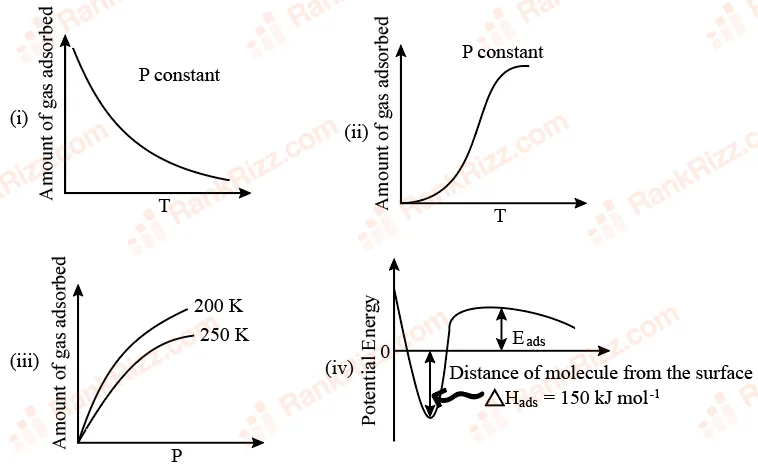
The given graph / data I, II, III and IV represent general trends observed for different physisorption and chemisorption processes under mild conditions of temperature and pressure. Which of the following choice (s) about I, II, III and IV is (are) correct

Figure for JEE Advanced 2012 Chemistry question on Adsorption and adsorption isotherms
  1. A

    I is physisorption and II is chemisorption

  2. B

    I is physisorption and III is chemisorption

  3. C

    IV is chemisorption and II is chemisorption

  4. D

    IV is chemisorption and III is chemisorption

JEE ADVANCED 2011 · PAPER 1Adsorption and adsorption isothermsTRANSCRIBED

The correct statement(s) pertaining to the adsorption of a gas on a solid surface is (are)

  1. A

    Adsorption is always exothermic

  2. B

    Physiosorption may transform into chemisorption at high temperature

  3. C

    Physiosorption increases with increasing temperature but chemisorption decreases with increasing temperature

  4. D

    Chemisorption is more exothermic than physiosorption, however it is very slow due to higher energy of activation

JEE ADVANCED 2009 · PAPER 1Properties of colloids and coagulationTRANSCRIBED

Among the electrolytes Na2SO4, CaCl2, Al2(SO4)3Na_{2}SO_{4},\ CaCl_{2},\ Al_{2}(SO_{4})_{3} and NH4ClNH_{4}Cl, the most effective coagulating agent for Sb2S3solSb_{2}S_{3}sol is

  1. A

    Na2SO4Na_{2}SO_{4}

  2. B

    CaCl2CaCl_{2}

  3. C

    Al2(SO4)3Al_2(SO_4)_3

  4. D

    NH4ClNH_4Cl

JEE ADVANCED 2008 · PAPER 2Properties of colloids and coagulationTRANSCRIBED

Among the following, the surfactant that will form micelles in aqueous solution at the lowest molar concentration at ambient conditions is

  1. A

    CH3(CH2)15N+(CH3)3Br−CH_3(CH_2)_{15}N^{+}(CH_3)_3 Br^{-}

  2. B

    CH3(CH2)11OSO3−Na+CH_3(CH_2)_{11}OSO_{3}^{-} Na^{+}

  3. C

    CH3(CH2)6COO−Na+CH_3(CH_2)_{6}COO^{-} Na^{+}

  4. D

    CH3(CH2)11N+(CH3)3Br−CH_3(CH_2)_{11}N^{+}(CH_3)_3 Br^{-}

JEE ADVANCED 2007 · PAPER 1Properties of colloids and coagulationTRANSCRIBED

STATEMENT-1 : Micelles are formed by surfactant molecules above the critical micellar concentration (CMC).
because
STATEMENT-2 : The conductivity of a solution having surfactant molecules decreases sharply at the CMC.

  1. A

    Statement-1 is True, Statement-2 is True; Statement-2 is a correct explanation for Statement-1

  2. B

    Statement-1 is True, Statement-2 is True; Statement-2 is NOT a correct explanation for Statement-1

  3. C

    Statement-1 is True, Statement-2 is False

  4. D

    Statement-1 is False, Statement-2 is True