The stoichiometric reaction of 516 g of dimethyldichlorosilane with water results in a tetrameric cyclic product X in 75% yield. The weight (in g) of X obtained is ____.
[Use, molar mass (g mol): H = 1, C = 12, O = 16, Si = 28, Cl = 35.5]
Every Some Basic Concepts of Chemistry question JEE Advanced has set from 2009–2023, grouped by the idea it tests rather than the order of the syllabus. 15 questions across 4 distinct ideas. Free to read, answer key on every one.
Questions
15
Distinct ideas
4
Share of marks
2%
Difficulty
EASY
A chapter is not one subject — it is a handful of procedures the examiner reuses. These are the ones Some Basic Concepts of Chemistry questions actually test.
The share of each year’s Chemistry questions that came from Some Basic Concepts of Chemistry, counted from the 19 papers we hold for the last 10 years, and paper by paper inside a year.
Falling: 0.0% of Chemistry questions in 2024–2026, down from 3.0% in 2017–2023. Its heaviest year was 2022, at 8.3%. Not asked at all in 2017, 2018, 2021, 2024, 2025, 2026.
“QS” is Some Basic Concepts of Chemistry questions out of all Chemistry questions that year. A year with more sittings asks more questions, which is why the share, not the count, is the number to compare.
15 questions from 2009–2023. Over the last 20 papers, Some Basic Concepts of Chemistry carried about 2% of Chemistry marks.
Concentration terms and their interconversion (6 questions), Stoichiometry, limiting reagent and percentage yield (4 questions), Units, significant figures and laws of chemical combination (3 questions). Start with these, they are what the examiner keeps coming back to.
Falling: 0.0% of Chemistry questions in 2024–2026, down from 3.0% in 2017–2023. Its heaviest year was 2022, at 8.3%. Not asked at all in 2017, 2018, 2021, 2024, 2025, 2026. It has carried about 2% of Chemistry marks in recent papers, rated easy on our difficulty scale. The year-by-year table above shows how that has moved.
Yes. Every question shows its official answer key, and a worked solution opens on the question’s own page wherever we have one. Reading and checking answers is free, no sign-up needed.
Do one past question per idea first: Some Basic Concepts of Chemistry has 4 distinct ideas, listed above. Then practise the topics you get wrong, or build a timed test from this chapter.
1–15 OF 15 · NEWEST FIRST
The stoichiometric reaction of 516 g of dimethyldichlorosilane with water results in a tetrameric cyclic product X in 75% yield. The weight (in g) of X obtained is ____.
[Use, molar mass (g mol): H = 1, C = 12, O = 16, Si = 28, Cl = 35.5]
The treatment of an aqueous solution of 3.74 g of Cu(NO) with excess KI results in a brown solution along with the formation of a precipitate. Passing HS through this brown solution gives another precipitate X. The amount of X (in g) is ______.
[Given : Atomic mass of H = 1, N = 14, O = 16, S = 32, K = 39, Cu = 63, I = 127]
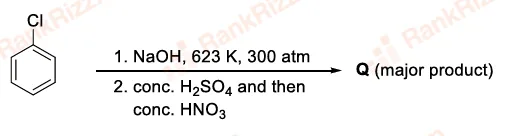
The weight percentage of hydrogen in Q, formed in the following reaction sequence, is ______.

[Given : Atomic mass of H = 1, C = 12, N = 14, O = 16, S = 32, Cl = 35]
To check the principle of multiple proportions, a series of pure binary compounds (PQ) were analyzed and their composition is tabulated below. The correct option(s) is(are)
| Compound | Weight % of P | Weight % of Q |
|---|---|---|
| 1 | 50 | 50 |
| 2 | 44.4 | 55.6 |
| 3 | 40 | 60 |
If empirical formula of compound 3 is PQ, then the empirical formula of compound 2 is PQ.
If empirical formula of compound 3 is PQ and atomic weight of element P is 20, then the atomic weight of Q is 45.
If empirical formula of compound 2 is PQ, then the empirical formula of the compound 1 is PQ.
If atomic weight of P and Q are 70 and 35, respectively, then the empirical formula of compound 1 is PQ.
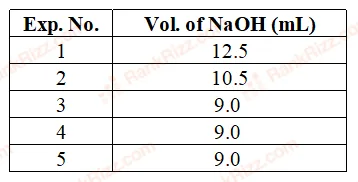
5.00 mL of 0.10 M oxalic acid solution taken in a conical flask is titrated against NaOH from a burette using phenolphthalein indicator. The volume of NaOH required for the appearance of permanent faint pink color is tabulated below for five experiments. What is the concentration, in molarity, of the NaOH solution?

The amount of water produced (in g) in the oxidation of 1 mole of rhombic sulphur by conc. to a compound with the highest oxidation state of sulphur is ___________ .
(Given data: Molar mass of water = )
The mole fraction of urea in an aqueous urea solution containing 900 g of water is 0.05. If the density of the solution is 60 g mol^{-1}18 g mol^{-1},$$ respectively)
If the value of Avogadro number is and the value of Boltzmann constant is , then the number of significant digits in the calculated value of the universal gas constant is
A compound with molar weight of 80 g is dissolved in a solvent having density of . Assuming no change in volume upon dissolution, the molality of a 3.2 molar solution is
29.2% (w/w) HCI stock solution has a density of 1.25 g m. The molecular weight of HCl is 36.5 g . The volume (mL) of stock solution required to prepare a 200 mL solution of 0.4 M HCl is
Dissolving 120 g of urea (mol. wt. 60) in 1000 g of water gave a solution of density 1.15 g/mL. The molarity of the solution is -
1.78 M
2.00 M
2.05 M
2.22 M
The volume (in mL) of 0.1 M required for complete precipitation of chloride ions present in 30 mL of 0.01 M solution of , as silver chloride is close to
Silver (atomic weight = ) has a density of 10.5 g . The number of silver atoms on a surface of area can be expressed in scientific notation as . The value of x is
A student performs a titration with different burettes and finds titre values of 25.2 mL, 25.25 mL, and 25.0 mL. The numberof significant figures in the average titre value is
Given that the abundances of isotopes and are 5%,90% and 5% respectively, the atomic mass of Fe is -
55.85
55.95
55.75
56.05
JEE Main has set 252 Some Basic Concepts of Chemistry questions too. Some Basic Concepts of Chemistry JEE Main PYQs →
OTHER CHEMISTRY CHAPTERS