RankRizz

Chemical and Ionic Equilibrium — JEE Advanced Previous Year Questions

Every Chemical and Ionic Equilibrium question JEE Advanced has set from 2008–2025, grouped by the idea it tests rather than the order of the syllabus. 24 questions across 8 distinct ideas. Free to read, answer key on every one.

Questions

24

Distinct ideas

8

Share of marks

3.4%

Difficulty

MEDIUM

The ideas inside Chemical and Ionic Equilibrium

A chapter is not one subject — it is a handful of procedures the examiner reuses. These are the ones Chemical and Ionic Equilibrium questions actually test.

01Law of mass action and equilibrium constants Kc and Kpset 4×
02Reaction quotient, degree of dissociation and equilibrium calculationsset 1×
03Le Chatelier's principle and factors affecting equilibriumset 3×
04Arrhenius, Bronsted-Lowry and Lewis acid-base conceptsNot set in Advanced
05Ionisation of weak electrolytes and Ostwald's dilution lawset 1×
06pH of acids, bases and their mixturesset 2×
07Buffer solutionsNot set in Advanced
08Hydrolysis of saltsset 3×
09Acid-base indicators and titration curvesset 2×
10Solubility product and common ion effectset 8×

Chemical and Ionic Equilibrium weightage, year by year

The share of each year’s Chemistry questions that came from Chemical and Ionic Equilibrium, counted from the 19 papers we hold for the last 10 years, and paper by paper inside a year.

Falling: 2.0% of Chemistry questions in 2024–2026, down from 3.8% in 2017–2023. Its heaviest year was 2020, at 8.3%. Not asked at all in 2017, 2021, 2024, 2026.

20260 / 340.0%PAPER 1 0.0%PAPER 2 0.0%
20252 / 326.3%PAPER 1 6.3%PAPER 2 6.3%
20240 / 340.0%PAPER 1 0.0%PAPER 2 0.0%
20232 / 345.9%PAPER 1 11.8%PAPER 2 0.0%
20222 / 365.6%PAPER 1 5.6%PAPER 2 5.6%
20210 / 380.0%PAPER 1 0.0%PAPER 2 0.0%
20203 / 368.3%PAPER 1 5.6%PAPER 2 11.1%
20191 / 362.8%PAPER 1 5.6%PAPER 2 0.0%
20181 / 185.6%1 PAPER
20170 / 360.0%PAPER 1 0.0%PAPER 2 0.0%

“QS” is Chemical and Ionic Equilibrium questions out of all Chemistry questions that year. A year with more sittings asks more questions, which is why the share, not the count, is the number to compare.

Chemical and Ionic Equilibrium: quick answers

How many Chemical and Ionic Equilibrium questions has JEE Advanced asked?

24 questions from 2008–2025. Over the last 20 papers, Chemical and Ionic Equilibrium carried about 3.4% of Chemistry marks.

Which Chemical and Ionic Equilibrium topics come up most?

Solubility product and common ion effect (8 questions), Law of mass action and equilibrium constants Kc and Kp (4 questions), Le Chatelier's principle and factors affecting equilibrium (3 questions). Start with these, they are what the examiner keeps coming back to.

Is Chemical and Ionic Equilibrium important for JEE Advanced?

Falling: 2.0% of Chemistry questions in 2024–2026, down from 3.8% in 2017–2023. Its heaviest year was 2020, at 8.3%. Not asked at all in 2017, 2021, 2024, 2026. It has carried about 3.4% of Chemistry marks in recent papers, rated medium on our difficulty scale. The year-by-year table above shows how that has moved.

Do these Chemical and Ionic Equilibrium PYQs have answers and solutions?

Yes. Every question shows its official answer key, and a worked solution opens on the question’s own page wherever we have one. Reading and checking answers is free, no sign-up needed.

What’s the fastest way to revise Chemical and Ionic Equilibrium?

Do one past question per idea first: Chemical and Ionic Equilibrium has 8 distinct ideas, listed above. Then practise the topics you get wrong, or build a timed test from this chapter.

Every Chemical and Ionic Equilibrium question

1–20 OF 24 · NEWEST FIRST

JEE ADVANCED 2025 · PAPER 1pH of acids, bases and their mixturesTRANSCRIBED

At 25 ∘^\circC, the concentration of H+^+ ions in 1.00×10−31.00 \times 10^{-3} M aqueous solution of a weak monobasic acid having acid dissociation constant (KaK_a) of 4.00×10−114.00 \times 10^{-11} is X×10−7X \times 10^{-7} M. The value of XX is ________.

Use: Ionic product of water (KwK_w) = 1.00×10−141.00 \times 10^{-14} at 25 ∘^\circC

JEE ADVANCED 2025 · PAPER 2Solubility product and common ion effectTRANSCRIBED

The solubility of barium iodate in an aqueous solution prepared by mixing 200 mL of 0.010 M barium nitrate with 100 mL of 0.10 M sodium iodate is X×10−6X \times 10^{-6} mol dm−3^{-3}. The value of XX is ______.

Use: Solubility product constant (KspK_{sp}) of barium iodate = 1.58×10−91.58 \times 10^{-9}

JEE ADVANCED 2023 · PAPER 1Solubility product and common ion effectTRANSCRIBED

On decreasing the pH from 7 to 2, the solubility of a sparingly soluble salt (MX) of a weak acid (HX) increased from 10−410^{-4} mol L−1^{-1} to 10−310^{-3} mol L−1^{-1}. The pKa_a of HX is:

  1. A

    3

  2. B

    4

  3. C

    5

  4. D

    2

JEE ADVANCED 2023 · PAPER 1Reaction quotient, degree of dissociation and equilibrium calculationsTRANSCRIBED

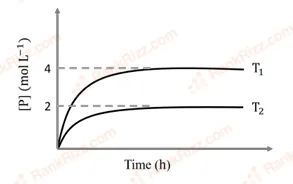
In a one-litre flask, 6 moles of A undergoes the reaction A(g) ⇌\rightleftharpoons P(g). The progress of product formation at two temperatures (in Kelvin), T1T_1 and T2T_2, is shown in the figure:

Figure for JEE Advanced 2023 Chemistry question on Reaction quotient, degree of dissociation and equilibrium calculations


If T1=2T2T_1 = 2T_2 and (ΔG2∘−ΔG1∘)=RT2ln⁡x(\Delta G_2^\circ - \Delta G_1^\circ) = RT_2 \ln x, then the value of x is ______.

[ΔG1∘\Delta G_1^\circ and ΔG2∘\Delta G_2^\circ are standard Gibb's free energy change for the reaction at temperatures T1T_1 and T2T_2, respectively.]

JEE ADVANCED 2022 · PAPER 2Solubility product and common ion effectTRANSCRIBED

Concentration of H2_2SO4_4 and Na2_2SO4_4 in a solution is 1 M and 1.8 ×\times 10−2^{-2} M, respectively. Molar solubility of PbSO4_4 in the same solution is X ×\times 10−Y^{-Y} M (expressed in scientific notation). The value of Y is _______.

[Given: Solubility product of PbSO4_4 (KspK_{sp}) = 1.6 ×\times 10−8^{-8}. For H2_2SO4_4, Ka1K_{a1} is very large and Ka2K_{a2} = 1.2 ×\times 10−2^{-2}]

JEE ADVANCED 2022 · PAPER 1pH of acids, bases and their mixturesTRANSCRIBED

A solution is prepared by mixing 0.01 mol each of H2CO3H_2CO_3, NaHCO3_3, Na2_2CO3_3, and NaOH in 100 mL of water. pH of the resulting solution is ______.

[Given : pKa1pK_{a1} and pKa2pK_{a2} of H2CO3H_2CO_3 are 6.37 and 10.32, respectively ; log 2 = 0.30]

JEE ADVANCED 2020 · PAPER 2Acid-base indicators and titration curvesTRANSCRIBED

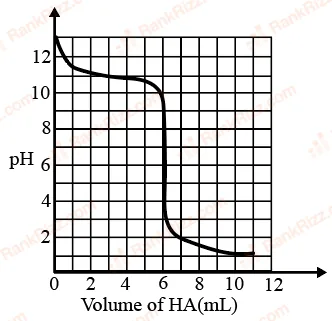
A solution of 0.1 M weak base (B) is titrated with 0.1 M of a strong acid (HA). The variation of pH of the solution with the volume of HA added is shown in the figure below. What is the p𝐾bp𝐾_b of the base? The neutralization reaction is given by B+HA→BH++A−B + HA \rightarrow BH^+ + A^-.

Figure for JEE Advanced 2020 Chemistry question on Acid-base indicators and titration curves
JEE ADVANCED 2020 · PAPER 1Le Chatelier's principle and factors affecting equilibriumTRANSCRIBED

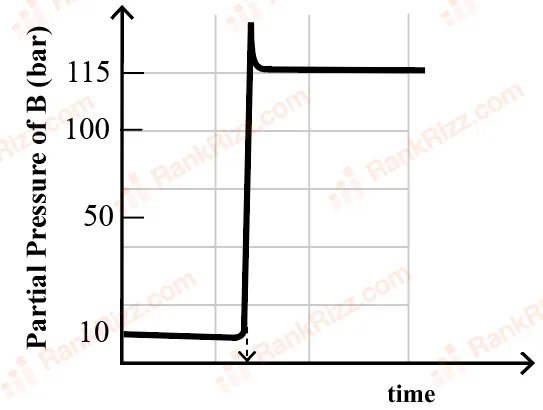
Consider the reaction A ⇌\rightleftharpoons B at 1000 K. At time t’, the temperature of the system was increased to 2000 K and the system was allowed to reach equilibrium. Throughout this experiment the partial pressure of A was maintained at 1 bar. Given below is the plot of the partial pressure of B with time.
What is the ratio of the standard Gibbs energy of the reaction at 1000 K to that at 2000 K?

Screenshot_501
JEE ADVANCED 2020 · PAPER 2Solubility product and common ion effectTRANSCRIBED

An acidified solution of 0.05 M Zn2+Zn^{2+} is saturated with 0.1 M H2SH_2S. What is the minimum molar concentration (M) of H+H^+ required to prevent the precipitation of ZnS?
Use Ksp(ZnS)=1.25×10⁻²²K_{sp}(ZnS) = 1.25 \times 10^{-22} and overall dissociation constant of H2S,KNET=K1K2=1×10⁻²¹H_2S, K_{NET} = K_1K_2 = 1 \times 10^{-21}.

JEE ADVANCED 2019 · PAPER 1Law of mass action and equilibrium constants Kc and KpTRANSCRIBED

For the following reaction, the equilibrium constant K_ at 298 K is 1.6×10171.6 \times 10^{17}
Fe2+(aq)+S2−(aq)⇌FeS(s)Fe^{2+} (aq) + S^{2-} (aq) \rightleftharpoons FeS (s)
When equal volumes of 0.06 M Fe2+Fe^{2+} (aq) and 0.2MS2−(aq)0.2 M S^{2-}(aq) solutions are mixed, the equilibrium concentration of Fe2+Fe^{2+} (aq) is found to be Y×10−17MY \times 10^{-17} M. The value of Y is _________ .

JEE ADVANCED 2018 · PAPER 1Solubility product and common ion effectTRANSCRIBED

The solubility of a salt of weak acid (AB) at pHp^{H} is Y×10−3molL−1Y \times 10^{-3} mol L^{-1} The value of Y is ____.(Given that the value of solubility product of AB(Ksp)=2×10⁻¹⁰AB (K_{sp}) = 2 \times 10^{-10} and the value of ionization constant of HB(Ka)=1×10⁻⁸HB (K_{a}) = 1 \times 10^{-8}

JEE ADVANCED 2016 · PAPER 2Law of mass action and equilibrium constants Kc and KpTRANSCRIBED

The INCORRECT statement amongthe following, for this reaction, is

  1. A

    Decreasein the total pressure will result in formation of more moles of gaseous X

  2. B

    At the start of the reaction, dissociation of gaseous X2X_2 takes place spontaneously

  3. C

    βequilibrium=0.7\beta_{equilibrium} = 0.7

  4. D

    Kc<1K_c < 1

JEE ADVANCED 2015 · PAPER 1Le Chatelier's principle and factors affecting equilibriumTRANSCRIBED

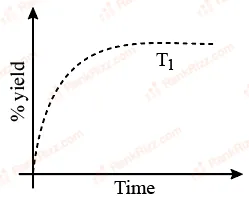
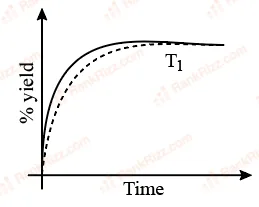
The % yield of ammonia as a function of time in the reaction
N2(g)+3H2(g)⇌2NH3(g),△H<0N_2(g) + 3H_2(g) \rightleftharpoons 2NH_3(g), \triangle H < 0 at (P,T1)(P, T_1) is given below.

Figure for JEE Advanced 2015 Chemistry question on Le Chatelier's principle and factors affecting equilibrium


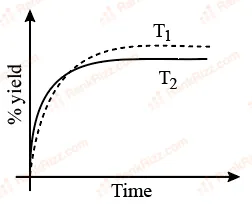
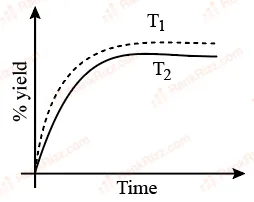
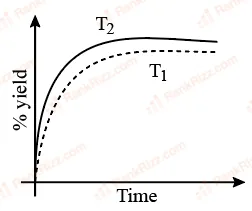
If this reaction is conducted at (P,T2)(P, T_2), with T2>T1T_2 > T_1, the %yield of ammonia as a function of time is represented by

  1. A
    Figure for JEE Advanced 2015 Chemistry question on Le Chatelier's principle and factors affecting equilibrium
  2. B
    Figure for JEE Advanced 2015 Chemistry question on Le Chatelier's principle and factors affecting equilibrium
  3. C
    Figure for JEE Advanced 2015 Chemistry question on Le Chatelier's principle and factors affecting equilibrium
  4. D
    Figure for JEE Advanced 2015 Chemistry question on Le Chatelier's principle and factors affecting equilibrium
JEE ADVANCED 2013 · PAPER 2Law of mass action and equilibrium constants Kc and KpTRANSCRIBED

The thermal dissociation equilibrium CaCO3(s)CaCO_{3}(s) is studied under different conditions.
CaCO3(s)⇌CaO(s)+CO2(g)CaCO_{3}(s)\rightleftharpoons CaO(s)+CO_{2}(g)

  1. A

    △H\triangle H is dependent on T

  2. B

    K is independent of the initial amount of CaCO3CaCO_{3}

  3. C

    Kis dependenton the pressure of CO2CO_{2} at a given T

  4. D

    △H\triangle H is independentof the catalyst, if any

JEE ADVANCED 2013 · PAPER 2Solubility product and common ion effectTRANSCRIBED

The KspK_{sp} of Ag2CrO4Ag_{2}CrO_{4} is 1.1×10−121.1\times10^{-12} at 298 K. The solubility (in molL\frac{mol}{L}) of Ag2CrO4Ag_{2}CrO_{4} in a 0.1M AgNO30.1M \ AgNO_{3} solution is

  1. A

    1.1×10−111.1\times10^{-11}

  2. B

    1.1×10−101.1\times10^{-10}

  3. C

    1.1×10−121.1\times10^{-12}

  4. D

    1.1×10−91.1\times10^{-9}

JEE ADVANCED 2013 · PAPER 1Ionisation of weak electrolytes and Ostwald's dilution lawTRANSCRIBED

The initial rate of hydrolysis of methyl acetate (1M) by a weak acid (HA, 1M) is 1/100th1/100^{th} of that of a strong acid (HX, 1M), at 25∘C25^\circ C. The KaK_a of HA is

  1. A

    1×10−41 \times 10^{-4}

  2. B

    1×10−51 \times 10^{-5}

  3. C

    1×10−61 \times 10^{-6}

  4. D

    1×10⁻³¹ \times 10^{-3}

JEE ADVANCED 2011 · PAPER 2Le Chatelier's principle and factors affecting equilibriumTRANSCRIBED

The equilibrium
2Cu∣⇌CuO+Cu∥2Cu^\mid \rightleftharpoons Cu^O + Cu^\parallel
in aqueous medium at 25∘C25 ^\circ C shifts towards the left in the presence of

  1. A

    NO3−NO_{3}^{-}

  2. B

    Cl−Cl^-

  3. C

    SCN−SCN^-

  4. D

    CN−CN^-

JEE ADVANCED 2011 · PAPER 2Solubility product and common ion effectTRANSCRIBED

In 1 L saturated solution of AgCl[Ksp(AgCl)=1.6×10⁻¹⁰]AgCl[K_{sp}(AgCl) = 1.6 \times 10^{-10}], 0.1 mol of CuCl[Ksp(CuCl)=1.0×10⁻⁶]CuCl[K_{sp}(CuCl) = 1.0 \times 10^{-6}] is added. The resultant concentration of Ag+Ag^+ in the solution is 1.6×10−x1.6 \times 10^{-x}. The value of "x" is

JEE ADVANCED 2010 · PAPER 1Acid-base indicators and titration curvesTRANSCRIBED

Aqueous solutions of HNO3,KOH,CH3COOHHNO_{3}, KOH, CH_{3}COOH and CH3COONaCH_{3}COONa of identical concentrations are provided. The pair(s) of solutions which form a buffer upon mixing is(are)

  1. A

    HNO3HNO_{3} and CH3COOHCH_{3}COOH

  2. B

    KOHKOH and CH3COONaCH_{3}COONa

  3. C

    HNO3HNO_{3} and CH3COONaCH_{3}COONa

  4. D

    CH3COOHCH_{3}COOH and CH3COONaCH_{3}COONa

JEE ADVANCED 2010 · PAPER 1Hydrolysis of saltsTRANSCRIBED

Amongst the following, the total number of compounds whose aqueous solution turns red litmus paper blue is

Figure for JEE Advanced 2010 Chemistry question on Hydrolysis of salts