RankRizz

Electrochemistry — JEE Advanced Previous Year Questions

Every Electrochemistry question JEE Advanced has set from 2007–2026, grouped by the idea it tests rather than the order of the syllabus. 32 questions across 3 distinct ideas. Free to read, answer key on every one.

Questions

32

Distinct ideas

3

Share of marks

4.3%

Difficulty

MEDIUM

The ideas inside Electrochemistry

A chapter is not one subject — it is a handful of procedures the examiner reuses. These are the ones Electrochemistry questions actually test.

01Electrode potentials, electrochemical series and cell EMFset 15×
02Galvanic cells, cell notation and salt bridgeNot set in Advanced
03Nernst equation and concentration cellsNot set in Advanced
04Relation of EMF with Gibbs energy and equilibrium constantNot set in Advanced
05Electrolysis and Faraday's lawsNot set in Advanced
06Conductance, conductivity and molar conductivityset 14×
07Kohlrausch's law and its applicationsNot set in Advanced
08Batteries, fuel cells and corrosionset 3×

Every Electrochemistry question

21–32 OF 32 · NEWEST FIRST

JEE ADVANCED 2012 · PAPER 2Electrode potentials, electrochemical series and cell EMFTRANSCRIBED

The solubility product (Ksp;mol3dm−9K_{sp};mol^3 dm^{-9}) of MX2MX_2 at 298 based on the information available the given concentration cell is (take 2.303×R×298F=0.059V2.303 \times R \times \frac{298}{F} = 0.059 V)

  1. A

    1×10−151 \times 10^{-15}

  2. B

    4×10−154 \times 10^{-15}

  3. C

    1×10−121 \times 10^{-12}

  4. D

    4×10−124 \times 10^{-12}

JEE ADVANCED 2012 · PAPER 2Electrode potentials, electrochemical series and cell EMFTRANSCRIBED

The value of △G(kJmol−1)\triangle G (kJ mol^{-1}) for the given cell is (take 1F = 96500 C mol−1mol^{-1})

  1. A

    -5.7

  2. B

    5.7

  3. C

    11.4

  4. D

    -11.4

JEE ADVANCED 2011 · PAPER 1Conductance, conductivity and molar conductivityTRANSCRIBED

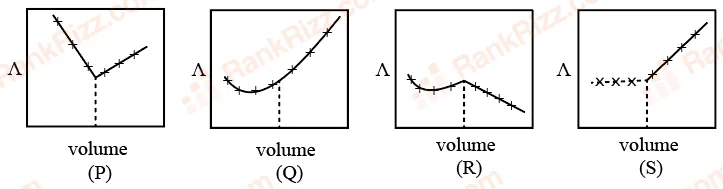
AgNO3AgNO_3 (aq.) was added to an aqueous KCl solution gradually and the conductivity of the solution was measured. The plot of conductance (⋀)(\bigwedge) versus the volume of AgNO3AgNO_3 is-

Figure for JEE Advanced 2011 Chemistry question on Conductance, conductivity and molar conductivity
  1. A

    (P)

  2. B

    (Q)

  3. C

    (R)

  4. D

    (S)

JEE ADVANCED 2011 · PAPER 2Electrode potentials, electrochemical series and cell EMFTRANSCRIBED

Consider the following cell reaction:
2Fe(s)+O2(g)+4H(aq)+→2Fe(aq)2++2H2O(l)E∘=1.67V2Fe_{(s)} + O_{2(g)} + 4H^+_{(aq)} \rightarrow 2Fe^{2+}_{(aq)} + 2H_2O(l) E^\circ = 1.67 V At [Fe2+]=10−3M,P(O2)=0.1[Fe^{2+}] = 10^{-3} M, P(O_2) = 0.1 atm and pH = 3, the cell potential at 25∘C25^\circ C is

  1. A

    1.47 V

  2. B

    1.77 V

  3. C

    1.87 V

  4. D

    1.57 V

JEE ADVANCED 2010 · PAPER 1Electrode potentials, electrochemical series and cell EMFTRANSCRIBED

If the 0.05 molar solution of M+M^{+} is replaced by a 0.0025 molar M+M^{+} solution, then the magnitude of the cell potential would be

  1. A

    35mV35 mV

  2. B

    70mV70 mV

  3. C

    140mV140 mV

  4. D

    700mV700 mV

JEE ADVANCED 2009 · PAPER 2Electrode potentials, electrochemical series and cell EMFTRANSCRIBED

For the reduction of NO3−NO_{3}^{-} ion in an aqueous solution, E0E^0 is +0.96 V. Values of E0E^0 for some metal ions are given below
V2+(aq)+2e−→VV^{2+}(aq) + 2e^{-} \rightarrow V E0=−1.19E^0 = -1.19 V
Fe3+(aq)+3e−→FeFe^{3+}(aq) + 3e^{-} \rightarrow Fe E0=−0.04E^0 = -0.04 V
Au3+(aq)+3e−→AuAu^{3+}(aq) + 3e^{-} \rightarrow Au E0=+1.40E^0 = +1.40 V
Hg2+(aq)+2e−→HgHg^{2+}(aq) + 2e^{-} \rightarrow Hg E0=+0.86E^0 = +0.86 V
The pair(s) of metals that is(are) oxidized by NO3−NO_{3}^{-} in aqueous solution is(are)

  1. A

    V and Hg

  2. B

    Hg and Fe

  3. C

    Fe and Au

  4. D

    Fe and V

JEE ADVANCED 2008 · PAPER 2Conductance, conductivity and molar conductivityTRANSCRIBED

Electrolysis of dilute aqueous NaCl solution was carried out by passing 10 milli ampere current. The time required to liberate 0.01 mol of H, gas at the cathode is (1 Faraday = 96500 C mol−1^{-1})

  1. A

    9.65×1049.65 \times 10^4 sec

  2. B

    19.3×10419.3 \times 10^4 sec

  3. C

    28.95×10428.95 \times 10^4 sec

  4. D

    38.6×10438.6 \times 10^4 sec

JEE ADVANCED 2007 · PAPER 2Electrode potentials, electrochemical series and cell EMFTRANSCRIBED

Among the following, identify the correct statement.

  1. A

    Chloride ion is oxidised by O2O_2

  2. B

    Fe2+Fe^{2+} is oxidised by iodine

  3. C

    Iodide ion is oxidised by chlorine

  4. D

    Mn2+Mn^{2+} is oxidised by chlorine

JEE ADVANCED 2007 · PAPER 2Electrode potentials, electrochemical series and cell EMFTRANSCRIBED

While Fe3+Fe^{3+} is stable, Mn3+Mn^{3+} is not stable in acid solution because

  1. A

    O2O_2 oxidises Mn2+Mn^{2+} to Mn3+Mn^{3+}

  2. B

    O2O_2 oxidises both Mn2+Mn^{2+} to Mn3+Mn^{3+} and Fe2+Fe^{2+} to Fe3+Fe^{3+}

  3. C

    Fe3+Fe^{3+} oxidises H2OH_2O to O2O_2

  4. D

    Mn3+Mn^{3+} oxidises H2OH_2O to O2O_2

JEE ADVANCED 2007 · PAPER 1Conductance, conductivity and molar conductivityTRANSCRIBED

The total number of moles of chlorine gas evolved is

  1. A

    0.5

  2. B

    1.0

  3. C

    2.0

  4. D

    3.0

JEE ADVANCED 2007 · PAPER 1Conductance, conductivity and molar conductivityTRANSCRIBED

If the cathode is a Hg electrode, the maximum weight (g) of amalgam formed from this solution is

  1. A

    200

  2. B

    225

  3. C

    400

  4. D

    446

JEE ADVANCED 2007 · PAPER 1Conductance, conductivity and molar conductivityTRANSCRIBED

The total charge (coulombs) required for complete electrolysis is

  1. A

    24125

  2. B

    48250

  3. C

    96500

  4. D

    193000