RankRizz

Atomic Structure — JEE Advanced Previous Year Questions

Every Atomic Structure question JEE Advanced has set from 2008–2026, grouped by the idea it tests rather than the order of the syllabus. 21 questions across 7 distinct ideas. Free to read, answer key on every one.

Questions

21

Distinct ideas

7

Share of marks

3.1%

Difficulty

MEDIUM

The ideas inside Atomic Structure

A chapter is not one subject — it is a handful of procedures the examiner reuses. These are the ones Atomic Structure questions actually test.

01Subatomic particles and Thomson/Rutherford modelsNot set in Advanced
02Electromagnetic radiation, Planck's quantum theory and photoelectric effectset 1×
03Bohr model of hydrogen-like speciesset 3×
04Hydrogen spectrum and spectral seriesset 1×
05de Broglie wavelength and Heisenberg uncertainty principleset 3×
06Quantum mechanical model, wave function and probabilityset 3×
07Quantum numbers and shapes of orbitalsset 5×
08Radial and angular nodes and orbital energiesset 5×
09Electronic configuration and Aufbau, Pauli and Hund's rulesNot set in Advanced

Atomic Structure weightage, year by year

The share of each year’s Chemistry questions that came from Atomic Structure, counted from the 19 papers we hold for the last 10 years, and paper by paper inside a year.

Rising: 4.0% of Chemistry questions in 2024–2026, up from 3.0% in 2017–2023. Its heaviest year was 2017, at 8.3%. Not asked at all in 2018, 2022, 2025.

20262 / 345.9%PAPER 1 6.3%PAPER 2 5.6%
20250 / 320.0%PAPER 1 0.0%PAPER 2 0.0%
20242 / 345.9%PAPER 1 5.9%PAPER 2 5.9%
20231 / 342.9%PAPER 1 0.0%PAPER 2 5.9%
20220 / 360.0%PAPER 1 0.0%PAPER 2 0.0%
20211 / 382.6%PAPER 1 0.0%PAPER 2 5.3%
20201 / 362.8%PAPER 1 0.0%PAPER 2 5.6%
20191 / 362.8%PAPER 1 0.0%PAPER 2 5.6%
20180 / 180.0%1 PAPER
20173 / 368.3%PAPER 1 16.7%PAPER 2 0.0%

“QS” is Atomic Structure questions out of all Chemistry questions that year. A year with more sittings asks more questions, which is why the share, not the count, is the number to compare.

Atomic Structure: quick answers

How many Atomic Structure questions has JEE Advanced asked?

21 questions from 2008–2026. Over the last 20 papers, Atomic Structure carried about 3.1% of Chemistry marks.

Which Atomic Structure topics come up most?

Quantum numbers and shapes of orbitals (5 questions), Radial and angular nodes and orbital energies (5 questions), Bohr model of hydrogen-like species (3 questions). Start with these, they are what the examiner keeps coming back to.

Is Atomic Structure important for JEE Advanced?

Rising: 4.0% of Chemistry questions in 2024–2026, up from 3.0% in 2017–2023. Its heaviest year was 2017, at 8.3%. Not asked at all in 2018, 2022, 2025. It has carried about 3.1% of Chemistry marks in recent papers, rated medium on our difficulty scale. The year-by-year table above shows how that has moved.

Do these Atomic Structure PYQs have answers and solutions?

Yes. Every question shows its official answer key, and a worked solution opens on the question’s own page wherever we have one. Reading and checking answers is free, no sign-up needed.

What’s the fastest way to revise Atomic Structure?

Do one past question per idea first: Atomic Structure has 7 distinct ideas, listed above. Then practise the topics you get wrong, or build a timed test from this chapter.

Every Atomic Structure question

1–20 OF 21 · NEWEST FIRST

JEE ADVANCED 2026 · PAPER 1Quantum numbers and shapes of orbitalsTRANSCRIBED

The 2s2s and the 2p2p orbital energies of hydrogen atom are E2s(H)E_{2s}(\mathrm{H}) and E2p(H)E_{2p}(\mathrm{H}), respectively. The 2s2s and the 2p2p orbital energies of lithium atom are E2s(Li)E_{2s}(\mathrm{Li}) and E2p(Li)E_{2p}(\mathrm{Li}), respectively. The correct option(s) about the orbital energies is(are)

  1. A

    E2s(Li)<E2p(Li)E_{2s}(\mathrm{Li})\lt E_{2p}(\mathrm{Li})

  2. B

    E2s(H)=E2p(H)E_{2s}(\mathrm{H})=E_{2p}(\mathrm{H})

  3. C

    E2p(H)<E2s(Li)E_{2p}(\mathrm{H})\lt E_{2s}(\mathrm{Li})

  4. D

    E2s(H)>E2s(Li)E_{2s}(\mathrm{H})\gt E_{2s}(\mathrm{Li})

JEE ADVANCED 2026 · PAPER 2Hydrogen spectrum and spectral seriesTRANSCRIBED

Xa+\mathbf{X}^{a+} and Yb+\mathbf{Y}^{b+} are hydrogen-like species. The wavelength of light absorbed during the transition between the states with principal quantum numbers n=1n=1 and n=2n=2 of Xa+\mathbf{X}^{a+} is λ\lambda. The wavelength of light absorbed during the transition between the states with principal quantum numbers n=2n=2 and n=4n=4 of Yb+\mathbf{Y}^{b+} is 9λ9\lambda. The lowest possible value of (a+b)(a+b) is ___.

JEE ADVANCED 2024 · PAPER 2Bohr model of hydrogen-like speciesTRANSCRIBED

According to Bohr's model, the highest kinetic energy is associated with the electron in the

  1. A

    First orbit of H atom

  2. B

    First orbit of He+He^+

  3. C

    Second orbit of He+He^+

  4. D

    Second orbit of Li2+Li^{2+}

JEE ADVANCED 2024 · PAPER 1de Broglie wavelength and Heisenberg uncertainty principleTRANSCRIBED

Among the following the incorrect statement for electrons in an atom is

  1. A

    Uncertainty principle rules out the existence of definite paths for electrons.

  2. B

    The energy of an electron in 2s orbital of an atom is lower than the energy of an electron that is infinitely far away from the nucleus.

  3. C

    According to Bohr's model, the most negative energy value for an electron is given by n=1n = 1, which corresponds to the most stable orbit.

  4. D

    According to Bohr's model, the magnitude of velocity of electrons increases with increase in values of n.

JEE ADVANCED 2023 · PAPER 2Bohr model of hydrogen-like speciesTRANSCRIBED

For He+^+, a transition takes place from the orbit of radius 105.8 pm to the orbit of radius 26.45 pm. The wavelength (in nm) of the emitted photon during the transition is ____.

[Use: Bohr radius, a=52.9a = 52.9 pm; Rydberg constant, RH=2.2×10⁻¹⁸R_H = 2.2 \times 10^{-18} J; Planck's constant, h=6.6×10⁻³⁴h = 6.6 \times 10^{-34} J s; Speed of light, c=3×10⁸c = 3 \times 10^8 m s−1^{-1}]

JEE ADVANCED 2021 · PAPER 2de Broglie wavelength and Heisenberg uncertainty principleTRANSCRIBED

Consider a helium (He) atom that absorbs a photon of wavelength 330 nm. The change in the velocity (in cm s−1^{-1}) of He atom after the photon absorption is ___.
(Assume: Momentum is conserved when photon is absorbed.
Use: Planck constant = 6.6×10−346.6 \times 10^{-34} J s, Avogadro number = 6×10²³mol−16 \times 10^{23} mol^{-1}, Molar mass of He = 4 g mol−1^{-1})

JEE ADVANCED 2020 · PAPER 2Quantum mechanical model, wave function and probabilityTRANSCRIBED

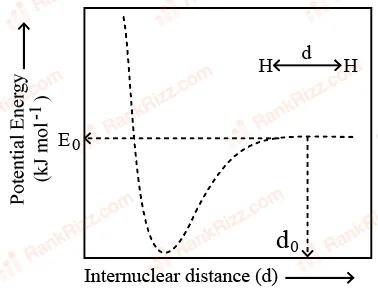
The figure below is the plot of potential energy versus internuclear distance (𝑑) of H2H_2 molecule in the electronic ground state. What is the value of the net potential energy 𝐸0 (as indicated in the figure) in kJ mol−1^{−1}, for 𝑑=𝑑0𝑑 = 𝑑_0 at which the electron-electron repulsion and the nucleus-nucleus repulsion energies are absent? As reference, the potential energy of H atom is taken as zero when its electron and the nucleus are infinitely far apart.
Use Avogadro constant as 6.023×10236.023 \times 10^{23} mol−1^{−1}.

Figure for JEE Advanced 2020 Chemistry question on Quantum mechanical model, wave function and probability
JEE ADVANCED 2019 · PAPER 2Radial and angular nodes and orbital energiesTRANSCRIBED

The ground state energy of hydrogen atom is —13.6 eV. Consider an electronic state ψ\psi of He+He^+ whose energy, azimuthal quantum number and magnetic quantum number are —3.4 eV, 2 and 0, respectively. Which of the following statement(s) is(are) true for the state ψ\psi?

  1. A

    It is a 4d state

  2. B

    It has 2 angular nodes

  3. C

    It has 3 radial nodes

  4. D

    The nuclear charge experienced by the electron in this state is less than 2e, where e is the magnitude of the electronic charge

JEE ADVANCED 2017 · PAPER 1Radial and angular nodes and orbital energiesTRANSCRIBED

For the given orbital in Column 1, the only CORRECT combination for any hydrogen-like species is

  1. A

    (I) (ii) (S)

  2. B

    (IV) (iv) (R)

  3. C

    (II) (ii) (P)

  4. D

    (III) (iii) (P)

JEE ADVANCED 2017 · PAPER 1Radial and angular nodes and orbital energiesTRANSCRIBED

For hydrogen atom, the only CORRECT combination is

  1. A

    (I) (i) (S)

  2. B

    (II) (i) (Q)

  3. C

    (I) (i) (P)

  4. D

    (I) (iv) (R)

JEE ADVANCED 2017 · PAPER 1Radial and angular nodes and orbital energiesTRANSCRIBED

For He+He^+ ion, the only INCORRECT combination is

  1. A

    (I) (i) (R)

  2. B

    (II) (ii) (Q)

  3. C

    (I) (iii) (R)

  4. D

    (I) (i) (S)

JEE ADVANCED 2016 · PAPER 1Quantum mechanical model, wave function and probabilityTRANSCRIBED

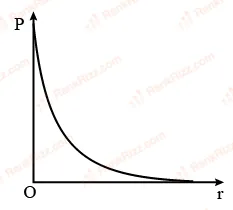
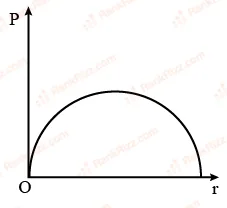
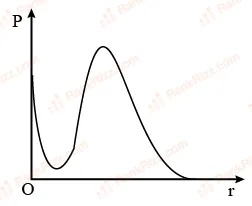
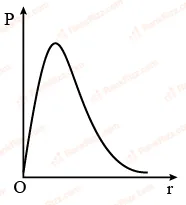
P is the probability of finding the 1s electron of hydrogen atom in a spherical shell of infinitesimal thickness, dr, at a distance r from the nucleus. The volumeof this shell is 4πr2dr4 \pi r^2 dr. The qualitative sketch of the dependence of P on is

  1. A
    Figure for JEE Advanced 2016 Chemistry question on Quantum mechanical model, wave function and probability
  2. B
    Figure for JEE Advanced 2016 Chemistry question on Quantum mechanical model, wave function and probability
  3. C
    Figure for JEE Advanced 2016 Chemistry question on Quantum mechanical model, wave function and probability
  4. D
    Figure for JEE Advanced 2016 Chemistry question on Quantum mechanical model, wave function and probability
JEE ADVANCED 2015 · PAPER 1Quantum mechanical model, wave function and probabilityTRANSCRIBED

Not considering the electronic spin, the degeneracy of the second excited state (n = 3) of H atom is 9, while the degeneracy of the second excited state of H−H^- is

JEE ADVANCED 2014 · PAPER 1Quantum numbers and shapes of orbitalsTRANSCRIBED

In an atom, the total number of electrons having quantum numbers n=4,∣ ml∣=1n = 4, \mid m_l \mid = 1 and ms=−12m_s = -\frac{1}{2} is

JEE ADVANCED 2013 · PAPER 1de Broglie wavelength and Heisenberg uncertainty principleTRANSCRIBED

The atomic masses of He and Ne are 4 and 20 a.m.u., respectively. The value of the de Broglie wavelength of He gas at −73∘C-73^\circ C is "M" imes that of the de Broglie wavelength of Ne at 727∘C.727^\circ C. M is

JEE ADVANCED 2012 · PAPER 1Bohr model of hydrogen-like speciesTRANSCRIBED

The kinetic energy of an electron in the second Bohr orbit of a hydrogen atom is
[a0a_0 is Bohr radius]

  1. A

    h24π2ma02\frac{h^2}{4 \pi^2 m a_{0}^{2}}

  2. B

    h216π2ma02\frac{h^2}{16 \pi^2 m a_{0}^{2}}

  3. C

    h232π2ma02\frac{h^2}{32 \pi^2 m a_{0}^{2}}

  4. D

    h264π2ma02\frac{h^2}{64 \pi^2 m a_{0}^{2}}

JEE ADVANCED 2011 · PAPER 1Quantum numbers and shapes of orbitalsTRANSCRIBED

The maximum number of electrons that can have principal quantum number, n = 3 and spin quantum number, ms = - 1/2, is.

JEE ADVANCED 2011 · PAPER 1Electromagnetic radiation, Planck's quantum theory and photoelectric effectTRANSCRIBED

The work function (ϕ)(\phi) of some metals is listed below. The number of metals which will show photoelectric effect when light of 300 nm wavelength falls on the metal is.

Figure for JEE Advanced 2011 Chemistry question on Electromagnetic radiation, Planck's quantum theory and photoelectric effect
JEE ADVANCED 2010 · PAPER 2Radial and angular nodes and orbital energiesTRANSCRIBED

Energy of the state S1S_1 in units of the hydrogen atom ground state energy is

  1. A

    0.75

  2. B

    1.50

  3. C

    2.25

  4. D

    4.50

JEE ADVANCED 2010 · PAPER 2Quantum numbers and shapes of orbitalsTRANSCRIBED

The orbital angular momentum quantum number of the state S2S_2 is

  1. A

    0

  2. B

    1

  3. C

    2

  4. D

    3