Solid State — JEE Advanced Previous Year Questions
Every Solid State question JEE Advanced has set from 2007–2025, grouped by the idea it tests rather than the order of the syllabus. 20 questions across 3 distinct ideas. Free to read, answer key on every one.
A chapter is not one subject — it is a handful of procedures the examiner reuses. These are the ones Solid State questions actually test.
01Classification of solidsNot set in Advanced
02Crystal lattices, unit cells and densityset 2×
03Close packing and packing efficiencyNot set in Advanced
04Voids, radius ratio and structures of ionic solidsset 16×
05Defects in solidsset 2×
06Electrical and magnetic properties of solidsNot set in Advanced
Solid State weightage, year by year
The share of each year’s Chemistry questions that came from Solid State, counted from the 19 papers we hold for the last 10 years, and paper by paper inside a year.
Falling: 2.0% of Chemistry questions in 2024–2026, down from 2.6% in 2017–2023. Its heaviest year was 2018, at 5.6%. Not asked at all in 2019, 2026.
YEARQSSHARE OF CHEMISTRYBY PAPER
20260 / 340.0%PAPER 1 0.0%PAPER 2 0.0%
20251 / 323.1%PAPER 1 0.0%PAPER 2 6.3%
20241 / 342.9%PAPER 1 0.0%PAPER 2 5.9%
20231 / 342.9%PAPER 1 0.0%PAPER 2 5.9%
20221 / 362.8%PAPER 1 0.0%PAPER 2 5.6%
20211 / 382.6%PAPER 1 5.3%PAPER 2 0.0%
20201 / 362.8%PAPER 1 5.6%PAPER 2 0.0%
20190 / 360.0%PAPER 1 0.0%PAPER 2 0.0%
20181 / 185.6%1 PAPER
20171 / 362.8%PAPER 1 5.6%PAPER 2 0.0%
“QS” is Solid State questions out of all Chemistry questions that year. A year with more sittings asks more questions, which is why the share, not the count, is the number to compare.
Solid State: quick answers
How many Solid State questions has JEE Advanced asked?+
20 questions from 2007–2025. Over the last 20 papers, Solid State carried about 2.6% of Chemistry marks.
Which Solid State topics come up most?+
Voids, radius ratio and structures of ionic solids (16 questions), Crystal lattices, unit cells and density (2 questions), Defects in solids (2 questions). Start with these, they are what the examiner keeps coming back to.
Is Solid State important for JEE Advanced?+
Falling: 2.0% of Chemistry questions in 2024–2026, down from 2.6% in 2017–2023. Its heaviest year was 2018, at 5.6%. Not asked at all in 2019, 2026. It has carried about 2.6% of Chemistry marks in recent papers, rated medium on our difficulty scale. The year-by-year table above shows how that has moved.
Do these Solid State PYQs have answers and solutions?+
Yes. Every question shows its official answer key, and a worked solution opens on the question’s own page wherever we have one. Reading and checking answers is free, no sign-up needed.
What’s the fastest way to revise Solid State?+
Do one past question per idea first: Solid State has 3 distinct ideas, listed above. Then practise the topics you get wrong, or build a timed test from this chapter.
Every Solid State question
1–20 OF 20 · NEWEST FIRST
JEE ADVANCED 2025 · PAPER 2Crystal lattices, unit cells and densityTRANSCRIBED
The density (in g cm−3) of the metal which forms a cubic close packed (ccp) lattice with an axial distance (edge length) equal to 400 pm is ______.
Use: Atomic mass of metal = 105.6 amu and Avogadro's constant = 6×10²³ mol−1
JEE ADVANCED 2024 · PAPER 2Defects in solidsTRANSCRIBED
In a metal deficient oxide sample, MXY2O4 (M and Y are metals), M is present in both +2 and +3 oxidation states and Y is in +3 oxidation state. If the fraction of M2+ ions present in M is 31, the value of X is ______.
JEE ADVANCED 2023 · PAPER 2Crystal lattices, unit cells and densityTRANSCRIBED
Atoms of metals x, y, and z form face-centred cubic (fcc) unit cell of edge length Lx, body-centred cubic (bcc) unit cell of edge length Ly, and simple cubic unit cell of edge length Lz, respectively.
If rz=23ry; ry=38rx; Mz=23My and Mz=3Mx, then the correct statement(s) is (are)
[Given: Mx, My, and Mz are molar masses of metals x, y, and z, respectively. rx, ry, and rz are atomic radii of metals x, y, and z, respectively.]
A
Packing efficiency of unit cell of x > Packing efficiency of unit cell of y > Packing efficiency of unit cell of z
JEE ADVANCED 2022 · PAPER 2Voids, radius ratio and structures of ionic solidsTRANSCRIBED
Atom X occupies the fcc lattice sites as well as alternate tetrahedral voids of the same lattice. The packing efficiency (in %) of the resultant solid is closest to
JEE ADVANCED 2021 · PAPER 1Voids, radius ratio and structures of ionic solidsTRANSCRIBED
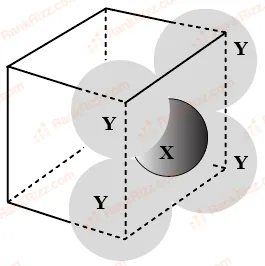
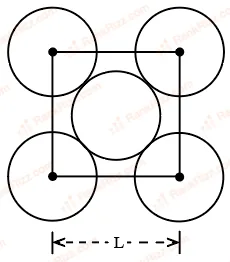
For the given close packed structure of a salt made of cation X and anion Y shown below (ions of only one face are shown for clarity), the packing fraction is approximately (packingfraction=100packingefficiency)
JEE ADVANCED 2020 · PAPER 1Voids, radius ratio and structures of ionic solidsTRANSCRIBED
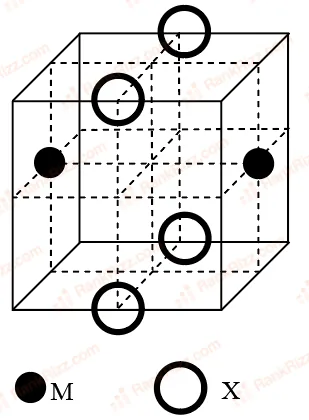
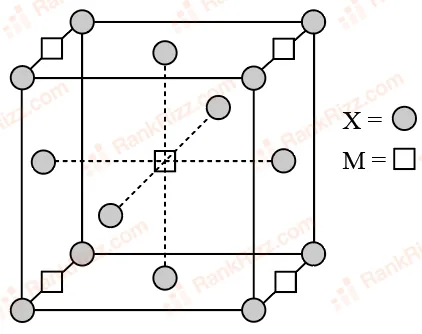
The cubic unit cell structure of a compound containing cation M and anion X is shown below. When compared to the anion, the cation has smaller ionic radius. Choose the correct statement(s).
A
The empirical formula of the compound is MX.
B
The cation M and anion X have different coordination geometries.
C
The ratio of M-X bond length to the cubic unit cell edge length is 0.866.
D
The ratio of the ionic radii of cation M to anion X is 0.414.
JEE ADVANCED 2018 · PAPER 1Voids, radius ratio and structures of ionic solidsTRANSCRIBED
Consider an ionic solid MX with NaCl structure. Construct a new structure (Z) whose unit cell is constructed from the unit cell of MX following the sequential instructions given below. Neglect the charge balance. (i) Remove all the anions (X) except the central one (ii) Replace all the face centered cations (M) by anions (X) (iii) Remove all the corner cations (M) (iv) Replace the central anion (X) with cation (M) The value of (numberofcationsnumberofanions) in Z is ..........
JEE ADVANCED 2017 · PAPER 1Voids, radius ratio and structures of ionic solidsTRANSCRIBED
A crystalline solid of a pure substance has a face-centred cubic structure with a cell edge of 400 pm. If the density of the substance in the crystal is 8 g cm−3, then the number of atoms present in 256 g of the crystal is N×1024. The value of N is
JEE ADVANCED 2015 · PAPER 1Voids, radius ratio and structures of ionic solidsTRANSCRIBED
If the unit cell of a mineral has cubic close packed (ccp) array of oxygen atoms with m fraction of octahedral holes occupied by aluminium ions and n fraction of tetrahedral holes occupied by magnesium ions, m and n, respectively, are
JEE ADVANCED 2007 · PAPER 2Voids, radius ratio and structures of ionic solidsTRANSCRIBED
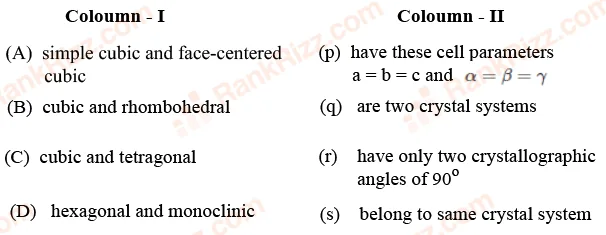
Match the crystal system/unit cells mentioned in Column I with their characteristic features mentioned in Column II. Indicate your answer by darkening the appropriate bubbles of the 4×4 matrix given in the ORS.