JEE Main 2021 Physics question — Stress, strain, Hooke's law and Young's modulus
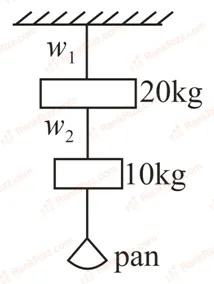
Wires and are made of same material having the breaking stress of N m. and have cross-sectional area of m and m, respectively. Masses of 20 kg and 10 kg hang from them as shown in the figure. The maximum mass that can be placed in the pan without breaking the wires is _________ kg (Use g = 10 m s)
SOLUTION
We need to find the maximum mass that can be placed in the pan without breaking either of the two wires, or .
1. Identify the Properties of the Wires
Both wires are made of the same material, meaning they share the same breaking stress limit:
- Breaking Stress ():
- Area of cross-section of ():
- Area of cross-section of ():
2. Calculate the Maximum Tension Capacity for Each Wire
The maximum tension () a wire can sustain before breaking is given by the formula:
- For Wire 1 ():
- For Wire 2 ():
3. Formulate Tension Equations Based on the Masses
Let be the maximum mass added to the pan. The tensions experienced by the two wires under static equilibrium are determined by the hanging loads beneath them:
- Tension in Wire 2 (): It supports the mass and the pan with its added mass .
- Tension in Wire 1 (): It supports everything below it—the mass, the mass, and the pan with mass .
4. Determine the Safe Mass Limit for Each Wire
To avoid breaking, the actual tension in each wire must not exceed its maximum capacity:
Condition for Wire 1 ():
Condition for Wire 2 ():
5. Select the Limiting Constraint
To ensure neither wire breaks, we must choose the smaller value of the two mass constraints. If the mass exceeds , wire will snap first.
Therefore, the maximum safe mass that can be added to the pan is exactly .
Final Answer: 40
Tagged Stress, strain, Hooke's law and Young's modulus. Machine-assigned, so read it as a strong shortlist rather than a verdict.