JEE Main 2021 Physics question — Stress, strain, Hooke's law and Young's modulus
Two blocks of masses 3 kg and 5 kg are connected by a metal wire going over a smooth pulley. The breaking stress of the metal is N m. What is the minimum radius of the wire?
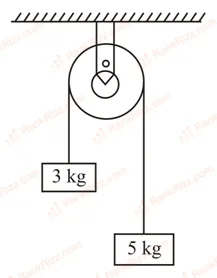
(take g = 10 m s)
SOLUTION
We need to determine the minimum radius of the metal wire supporting two suspended masses in an Atwood machine setup without exceeding its breaking stress.
1. Identify the Given Parameters
From the problem , the system consists of two masses connected across a smooth pulley by a metal wire:
- Mass of the first block () =
- Mass of the second block () =
- Breaking stress of the metal () =
- Acceleration due to gravity () =
2. Calculate the Tension () in the Wire
For a standard ideal pulley system containing two unequal masses, the dynamic tension () developed in the connecting string while the blocks are in motion is given by the formula:
Substituting the given mass values and acceleration due to gravity:
3. Relate Stress to the Minimum Radius ()
The internal mechanical stress experienced by a wire of a circular cross-section is defined as the restoring force per unit area. To prevent the wire from snapping, the operational stress must not exceed the breaking limit:
Rearranging the expression to solve for the radius ():
Substituting the computed values of tension () and breaking stress into the equation:
Taking the square root on both sides to find the radius in meters:
4. Convert the Unit to Centimeters
To match the final options provided in the problem layout, we convert the minimum required radius from meters to centimeters ():
Conclusion
The minimum radius of the wire required to support the moving masses without breaking is 12.5 cm.
Tagged Stress, strain, Hooke's law and Young's modulus. Machine-assigned, so read it as a strong shortlist rather than a verdict.