JEE ADVANCED 2023 · PAPER 2+4MEDIUMTRANSCRIBED
JEE Advanced 2023 Physics question — Multi-step processes and gas-piston-spring systems
One mole of an ideal gas undergoes two different cyclic processes I and II, as shown in the - diagrams below. In cycle I, processes a, b, c and d are isobaric, isothermal, isobaric and isochoric, respectively. In cycle II, processes a', b', c' and d' are isothermal, isochoric, isobaric and isochoric, respectively. The total work done during cycle I is and that during cycle II is . The ratio is ____.
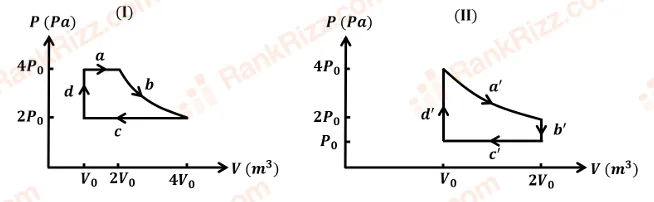
SOLUTION
Total work done in a cyclic process is the sum of the work done in each individual stage, where for isobaric, for isothermal, and for isochoric processes.
For Cycle I:
For Cycle II:
Finding the ratio:
Tagged Multi-step processes and gas-piston-spring systems. Machine-assigned, so read it as a strong shortlist rather than a verdict.