RankRizz
JEE ADVANCED 2024 · PAPER 1+3 / −1HARDTRANSCRIBED

JEE Advanced 2024 Physics question — Multi-step processes and gas-piston-spring systems

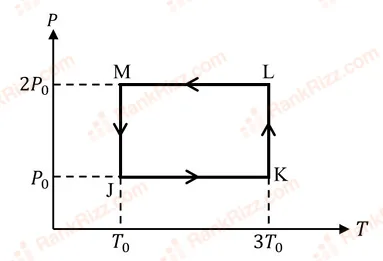
One mole of a monatomic ideal gas undergoes the cyclic process J →\to K →\to L →\to M →\to J, as shown in the P-T diagram.

Figure for JEE Advanced 2024 Physics question on Multi-step processes and gas-piston-spring systems

Match the quantities mentioned in List-I with their values in List-II and choose the correct option.

[RR is the gas constant.]

List-IList-II
(P)Work done in the complete cyclic process(1)RT0−4RT0ln⁡2RT_0 - 4RT_0 \ln 2
(Q)Change in the internal energy of the gas in the process JK(2)00
(R)Heat given to the gas in the process KL(3)3RT03RT_0
(S)Change in the internal energy of the gas in the process MJ(4)−2RT0ln⁡2-2RT_0 \ln 2
(5)−3RT0ln⁡2-3RT_0 \ln 2
SOLUTION

The diagram (not shown here) is a rectangle in the PP-TT plane with the numerical labels

J:(P0,T0),  K:(P0,3T0),  L:(2P0,3T0),  M:(2P0,T0).J:(P_0,T_0),\;K:(P_0,3T_0),\;L:(2P_0,3T_0),\;M:(2P_0,T_0).

One mole of a monatomic ideal gas moves along the four sides JK, KL, LM, MJ in that order.

For one mole the ideal-gas equation is PV=RTPV = RT and the internal energy is U=32RT.U = \tfrac32 RT. Work done by the gas in any step is W=∫P dV,W = \int P\,dV, and the first law gives Q=ΔU+W.Q = \Delta U + W. We treat every leg separately.

Case 1: JK (isobaric at P0P_0)

Temperatures: T0→3T0  (ΔT=2T0).T_0 \rightarrow 3T_0 \;(\Delta T = 2T_0).
Change in internal energy ΔUJK=32R (2T0)=3RT0.\Delta U_{JK} = \tfrac32 R\,(2T_0) = 3RT_0.

Volume rises from VJ=RT0P0V_J = \frac{RT_0}{P_0} to VK=3RT0P0.V_K = \frac{3RT_0}{P_0}. Work done WJK=P0 (VK−VJ)=P0(2RT0P0)=2RT0.W_{JK} = P_0\,(V_K-V_J) = P_0 \left(\frac{2RT_0}{P_0}\right)=2RT_0.

Case 2: KL (isothermal at T=3T0T = 3T_0)

Pressure P0→2P0,P_0 \rightarrow 2P_0, so volume VK=3RT0P0V_K = \frac{3RT_0}{P_0} compresses to VL=3RT02P0=12VK.V_L = \frac{3RT_0}{2P_0} = \tfrac12 V_K. Work done WKL=RTln⁡ ⁣(VLVK)=3RT0ln⁡ ⁣(12)=−3RT0ln⁡2.W_{KL}=RT\ln\!\left(\frac{V_L}{V_K}\right)=3RT_0\ln\!\left(\tfrac12\right)=-3RT_0\ln2.

Because the temperature is constant, ΔUKL=0,\Delta U_{KL}=0, hence QKL=WKL=−3RT0ln⁡2.Q_{KL}=W_{KL}=-3RT_0\ln2.

Case 3: LM (isobaric at 2P02P_0)

Temperature 3T0→T0  (ΔT=−2T0).3T_0 \rightarrow T_0 \;(\Delta T = -2T_0).
Change in internal energy ΔULM=32R(−2T0)=−3RT0.\Delta U_{LM}=\tfrac32 R(-2T_0)=-3RT_0.

Volumes: VL=3RT02P0,  VM=RT02P0V_L=\frac{3RT_0}{2P_0},\;V_M=\frac{RT_0}{2P_0} so ΔV=−RT0P0.\Delta V = -\frac{RT_0}{P_0}. Work done WLM=2P0(−RT0P0)=−2RT0.W_{LM}=2P_0\left(-\frac{RT_0}{P_0}\right)=-2RT_0.

Case 4: MJ (isothermal at T=T0T=T_0)

Pressure 2P0→P0,2P_0 \rightarrow P_0, volume doubles: VM=RT02P0,  VJ=RT0P0=2VM.V_M=\frac{RT_0}{2P_0},\;V_J=\frac{RT_0}{P_0}=2V_M. Work done WMJ=RT0ln⁡ ⁣(VJVM)=RT0ln⁡2.W_{MJ}=RT_0\ln\!\left(\frac{V_J}{V_M}\right)=RT_0\ln2.

Again ΔUMJ=0\Delta U_{MJ}=0 (temperature constant), so QMJ=WMJ=RT0ln⁡2.Q_{MJ}=W_{MJ}=RT_0\ln2.

Total work for the cycle

Wcycle=2RT0+(−3RT0ln⁡2)+(−2RT0)+RT0ln⁡2W_{\text{cycle}} = 2RT_0 + (-3RT_0\ln2) + (-2RT_0) + RT_0\ln2 Wcycle=0−2RT0ln⁡2=−2RT0ln⁡2.\phantom{W_{\text{cycle}}}=0 - 2RT_0\ln2 = -2RT_0\ln2.

Now we can match each quantity with List-II:

(P) Work in the entire cycle: −2RT0ln⁡2-2RT_0\ln2 →\rightarrow (4)
(Q) ΔUJK=3RT0\Delta U_{JK}=3RT_0 →\rightarrow (3)
(R) Heat in KL: QKL=−3RT0ln⁡2Q_{KL}=-3RT_0\ln2 →\rightarrow (5)
(S) ΔUMJ=0\Delta U_{MJ}=0 →\rightarrow (2)

Therefore the correct set of matches is P →\rightarrow 4; Q →\rightarrow 3; R →\rightarrow 5; S →\rightarrow 2, which is Option B.

Tagged Multi-step processes and gas-piston-spring systems. Machine-assigned, so read it as a strong shortlist rather than a verdict.

SubjectPhysics
TopicMulti-step processes and gas-piston-spring systems
TypeMultiple choice