RankRizz
JEE ADVANCED 2025 · PAPER 2+4MEDIUMTRANSCRIBED

JEE Advanced 2025 Physics question — Multi-step processes and gas-piston-spring systems

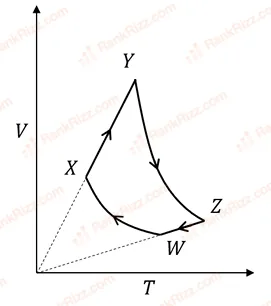
An ideal monatomic gas of nn moles is taken through a cycle WXYZWWXYZW consisting of consecutive adiabatic and isobaric quasi-static processes, as shown in the schematic VV-TT diagram. The volume of the gas at WW, XX and YY points are, 64 cm3^3, 125 cm3^3 and 250 cm3^3, respectively. If the absolute temperature of the gas TWT_W at the point WW is such that nRTW=1nRT_W = 1 J (RR is the universal gas constant), then the amount of heat absorbed (in J) by the gas along the path XYXY is ______.

Figure for JEE Advanced 2025 Physics question on Multi-step processes and gas-piston-spring systems
SOLUTION

For an ideal monatomic gas, the ratio of specific heats is γ=53\gamma = \dfrac{5}{3}.

Case 1: Adiabatic branch W→XW \rightarrow X
For a reversible adiabatic process, TV γ−1=constantT V^{\,\gamma-1} = \text{constant}

Thus TWVW γ−1=TXVX γ−1T_W V_W^{\,\gamma-1} = T_X V_X^{\,\gamma-1} ⇒  TX=TW(VWVX)γ−1=TW(64125)23\Rightarrow \; T_X = T_W \left(\dfrac{V_W}{V_X}\right)^{\gamma-1} = T_W \left(\dfrac{64}{125}\right)^{\frac{2}{3}}$

Since 64=4364 = 4^3 and 125=53125 = 5^3, (64125)23=(4353)23=(45)2=1625=0.64\left(\dfrac{64}{125}\right)^{\frac{2}{3}} = \left(\dfrac{4^3}{5^3}\right)^{\frac{2}{3}} = \left(\dfrac{4}{5}\right)^{2} = \dfrac{16}{25} = 0.64

Therefore, TX=0.64 TW−(1)T_X = 0.64 \,T_W \qquad -(1)

Case 2: Isobaric branch X→YX \rightarrow Y
For an isobaric process, PP is constant, so from the ideal-gas law PV=nRTPV = nRT we have TV=constant  ⟹  TYTX=VYVX\dfrac{T}{V} = \text{constant} \;\Longrightarrow\; \dfrac{T_Y}{T_X} = \dfrac{V_Y}{V_X}

Given VY=250  cm3V_Y = 250\;\text{cm}^3 and VX=125  cm3V_X = 125\;\text{cm}^3, TYTX=250125=2  ⟹  TY=2 TX−(2)\dfrac{T_Y}{T_X} = \dfrac{250}{125} = 2 \;\Longrightarrow\; T_Y = 2\,T_X \qquad -(2)

Using (1)(1) in (2)(2), TY=2×0.64 TW=1.28 TWT_Y = 2 \times 0.64\,T_W = 1.28\,T_W

Hence the temperature rise along X→YX \rightarrow Y is ΔT=TY−TX=1.28 TW−0.64 TW=0.64 TW\Delta T = T_Y - T_X = 1.28\,T_W - 0.64\,T_W = 0.64\,T_W

The heat absorbed in an isobaric process is QXY=nCpΔTQ_{XY} = n C_p \Delta T where, for a monatomic gas, Cp=52RC_p = \dfrac{5}{2}R.

Therefore, QXY=n(52R)(0.64 TW)=52×0.64  (nRTW)Q_{XY} = n\left(\dfrac{5}{2}R\right)(0.64\,T_W) = \dfrac{5}{2} \times 0.64 \; (nRT_W)

The problem states that nRTW=1  JnRT_W = 1\;\text{J}, so QXY=52×0.64×1=2.5×0.64=1.6  JQ_{XY} = \dfrac{5}{2} \times 0.64 \times 1 = 2.5 \times 0.64 = 1.6\;\text{J}

Hence, the heat absorbed by the gas along the path X→YX \rightarrow Y is 1.6 J.

Tagged Multi-step processes and gas-piston-spring systems. Machine-assigned, so read it as a strong shortlist rather than a verdict.

SubjectPhysics
TopicMulti-step processes and gas-piston-spring systems
TypeNumerical answer