JEE Advanced 2023 Physics question — Multi-step processes and gas-piston-spring systems
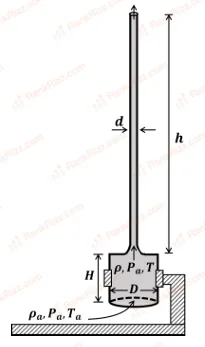
When the chimney is closed using a cap at the top, a pressure difference develops between the top and the bottom surfaces of the cap. If the changes in the temperature and density of the hot air, due to the stoppage of air flow, are negligible then the value of is ____ Nm.
SOLUTION
Inside the furnace the air is heated at the constant (atmospheric) pressure from to .
For an ideal gas, at the same pressure, therefore the density of the hot air is
With the chimney open, the upward motion of the hot air is produced by the difference between the weights of the two vertical columns of air (cold outside, hot inside) of the same height . The driving pressure head is
Neglecting viscous losses, Bernoulli’s theorem for the stream‐line from the furnace inlet (very large area, negligible speed) to the chimney exit gives
This velocity corresponds to a dynamic pressure (stagnation over static) of
Now a cap is fixed at the top of the chimney. The rising air jet strikes the lower face of the cap and comes to rest there; its dynamic pressure therefore appears as an additional static pressure on the underside of the cap. Besides this, the column of hot air inside the furnace of height still exerts its usual hydrostatic pressure difference
Hence the net pressure difference between the top (outer) and the bottom (inner) faces of the cap after it is closed is
Therefore, the required pressure difference is
30 N m−2.
Tagged Multi-step processes and gas-piston-spring systems. Machine-assigned, so read it as a strong shortlist rather than a verdict.