RankRizz

Thermodynamics — JEE Advanced Previous Year Questions

Every Thermodynamics question JEE Advanced has set from 2007–2026, grouped by the idea it tests rather than the order of the syllabus. 42 questions across 3 distinct ideas. Free to read, answer key on every one.

Questions

42

Distinct ideas

3

Share of marks

8%

Difficulty

HARD

The ideas inside Thermodynamics

A chapter is not one subject — it is a handful of procedures the examiner reuses. These are the ones Thermodynamics questions actually test.

01Zeroth and first law of thermodynamicsset 5×
02Work done in thermodynamic processes and P-V diagramsNot set in Advanced
03Isothermal and adiabatic processesNot set in Advanced
04Isobaric, isochoric and polytropic processesNot set in Advanced
05Multi-step processes and gas-piston-spring systemsset 34×
06Second law, heat engines, refrigerators and reversibilityNot set in Advanced
07Carnot engine and Carnot cycleset 3×

Every Thermodynamics question

41–42 OF 42 · NEWEST FIRST

JEE ADVANCED 2008 · PAPER 2Multi-step processes and gas-piston-spring systemsTRANSCRIBED

Column I contains a list of processes involving expansion of an ideal gas. Match this with Column II describing the thermodynamic change during this process. Indicate your answer by darkening the appropriate bubbles of the 4 x 4 matrix given in the ORS.
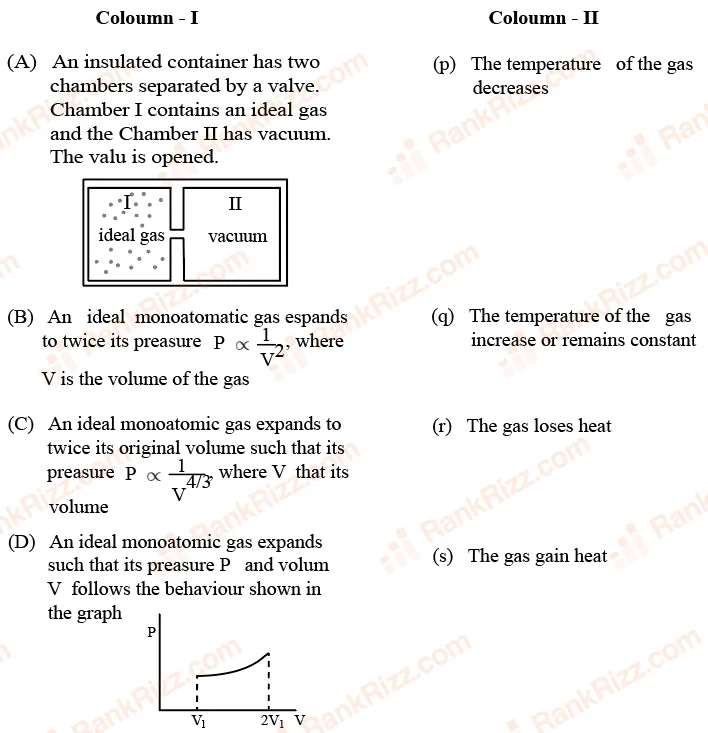
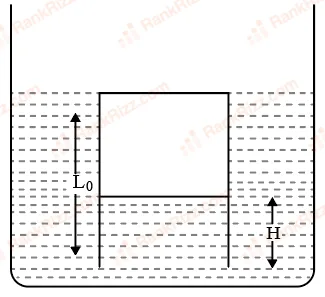
Figure for JEE Advanced 2008 Physics question on Multi-step processes and gas-piston-spring systems
JEE ADVANCED 2007 · PAPER 1Multi-step processes and gas-piston-spring systemsTRANSCRIBED

The piston is taken completely out of the cylinder. The hole at the top is sealed. A water tank is brought below the cylinder and put in a position so that the water surface in the tank is at the same level as the top of the cylinder as shown in the figure. The density of the water is ρ\rho. In equilibrium, the height H of the water column in the cylinder satisfies 

Figure for JEE Advanced 2007 Physics question on Multi-step processes and gas-piston-spring systems
  1. A

    ρg(L0−H)2+P0(L0−H)+L0P0=0\rho g(L_0 - H)^2 + P_0(L_0 - H) + L_0P_0 = 0

  2. B

    ρg(L0−H)2−P0(L0−H)−L0P0=0\rho g(L_0 - H)^2 - P_0(L_0 - H) - L_0P_0 = 0

  3. C

    ρg(L0−H)2+P0(L0−H)−L0P0=0\rho g(L_0 - H)^2 + P_0(L_0 - H) - L_0P_0 = 0

  4. D

    ρg(L0−H)2−P0(L0−H)+L0P0=0\rho g(L_0 - H)^2 - P_0(L_0 - H) + L_0P_0 = 0