JEE Advanced 2025 Physics question — Multi-step processes and gas-piston-spring systems
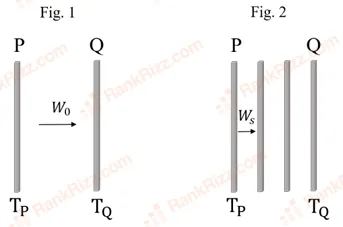
Two identical plates P and Q, radiating as perfect black bodies, are kept in vacuum at constant absolute temperatures and , respectively, with , as shown in Fig. 1. The radiated power transferred per unit area from P to Q is . Subsequently, two more plates, identical to P and Q, are introduced between P and Q, as shown in Fig. 2. Assume that heat transfer takes place only between adjacent plates. If the power transferred per unit area in the direction from P to Q (Fig. 2) in the steady state is , then the ratio is ________.
SOLUTION
For a perfect black body the radiative power transferred per unit area between two surfaces at absolute temperatures and (with ) is given by Stefan-Boltzmann law:
where is the Stefan-Boltzmann constant.
Case 1: Only plates P and Q are present (Fig. 1).
The power per unit area flowing from P Q is therefore
Case 2: Two additional identical black plates are inserted between P and Q (Fig. 2). Let their steady-state temperatures be (next to P) and (next to Q), with . Heat exchange occurs only between adjacent plates, and in steady state the same power per unit area must flow across every gap.
Across the three gaps we have
Divide each equation by to write them purely in terms of temperature differences:
Since the same quantity appears three times, add the three equalities:
The middle terms cancel, leaving
From , .
Substitute this back into any expression for (say the first in ):
Compare and :
Hence the required ratio is
Therefore, .
Tagged Multi-step processes and gas-piston-spring systems. Machine-assigned, so read it as a strong shortlist rather than a verdict.