JEE Advanced 2012 Physics question — Relation between field and potential, equipotential surfaces
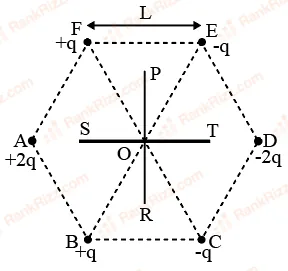
Six point charges are kept at the vertices of a regular hexagon of side L and centre O, as shown in the figure. Given that , which of the following statement (s) is (are) correct?
SOLUTION
The charges are at , at , at and , and at and , each at distance from .
The pair () and () gives along . The pair () and () gives along , and the pair () and () gives along .
and each make with , so their resultant is along , and the net field at is along : (A) is correct.
: (B) is correct.
is the perpendicular bisector of , and , and each of these pairs carries equal and opposite charges, so every point of is equidistant from the two charges of each pair and all along : (C) is correct.
On , points near are closer to the positive charges and points near to the negative ones, so is positive near and negative near : (D) is incorrect.
Hence, the correct options are (A), (B) and (C).
Tagged Relation between field and potential, equipotential surfaces. Machine-assigned, so read it as a strong shortlist rather than a verdict.