JEE ADVANCED 2013 · PAPER 2+3 / −1MEDIUMTRANSCRIBED
JEE Advanced 2013 Physics question — Relation between field and potential, equipotential surfaces
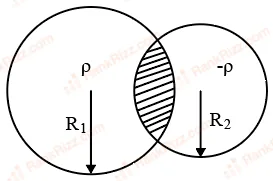
Two non-conducting spheres of radii and and carrying uniform volume charge densities and respectively, are placed such that they partially overlap, as shown in the figure. At all points in the overlapping region,
SOLUTION
Key idea: Inside a uniformly charged sphere, . The figure shows densities and . Superposing the two gives a uniform field in the overlap.
- At a point in the overlap, with and measured from the two centres: Here is the vector from centre 1 to centre 2, which is a constant.
- The field is therefore the same in magnitude and direction everywhere in the overlap. (C) and (D) are correct.
- , so (A) is false. A nonzero field means the potential changes along , so (B) is false.
Answer: (C), (D)
Tagged Relation between field and potential, equipotential surfaces. Machine-assigned, so read it as a strong shortlist rather than a verdict.