JEE Advanced 2020 Chemistry question — Acidity and basicity of organic compounds
Consider the following four compounds I, II, III, and IV.
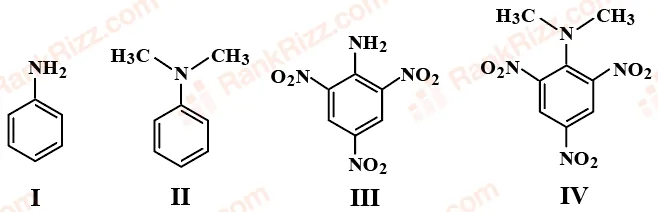
Choose the correct statement(s).
SOLUTION
The basicity of an aromatic amine depends on how free the nitrogen lone pair is to accept a proton.
I (aniline, ) and II (-dimethylaniline, ): in both the lone pair is delocalised into the ring, and the effect of the two methyl groups makes II slightly more basic, so their values differ by only about 0.5.
III (2,4,6-trinitroaniline): the small group lies in the ring plane, so its lone pair is strongly delocalised into the ring and on to the ortho and para groups (), in addition to their effect; III is an extremely weak base.
IV (-dimethyl-2,4,6-trinitroaniline): the bulky group, flanked by two ortho groups, is twisted out of the ring plane (steric inhibition of resonance), so its lone pair is not delocalised and IV is more basic than III by several units. The effect of three groups still keeps IV far less basic than I and II, so the order of basicity is II > I > IV > III.
(A) II > I > III > IV places III above IV. Incorrect.
(B) The difference between I and II (about 0.5) is much smaller than that between III and IV. Incorrect.
(C) Resonance of the nitrogen lone pair with the ring is full in the planar III and largely suppressed in the twisted IV. Correct.
(D) The steric clash of the two methyl groups with the ortho groups inhibits resonance in IV and makes it more basic than III. Correct.
Hence, the correct options are (C) and (D).
Tagged Acidity and basicity of organic compounds. Machine-assigned, so read it as a strong shortlist rather than a verdict.