JEE Advanced 2021 Chemistry question — Reactive intermediates and rearrangements
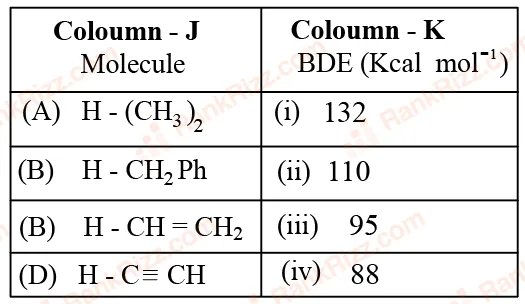
Correct match of the C-H bonds (shown in bold) in Column J with their BDE in Column K is
SOLUTION
The magnitude of a C-H bond dissociation energy (BDE) depends on two main factors:
• s-character of the C-H bond: the order is . Greater s-character shortens and strengthens the bond, therefore increases its BDE.
• Stability of the radical produced after homolytic cleavage: the more stabilised the radical, the lower the BDE of the parent bond.
The four bonds listed in Column J are:
P : Benzylic C-H in - cleavage gives a benzylic radical that is resonance-stabilised.
Q : Allylic (or tertiary) C-H - cleavage gives an allylic/tertiary radical that is highly stabilised by resonance or hyperconjugation.
R : Primary aliphatic C-H - cleavage gives a primary alkyl radical, only weakly stabilised.
S : Vinylic (sp) C-H - the C atom is hybridised; the radical obtained is least stabilised, but the high s-character makes the bond very strong.
Arranging them in ascending order of radical stability (and therefore descending order of BDE):
Radical stability : Allylic/tertiary > Benzylic > Primary > Vinylic
Corresponding BDE : Vinylic (highest) > Primary > Benzylic > Allylic/tertiary (lowest)
Column K provides four numerical ranges (i to iv) that follow the same strength order:
i : highest (≈ 460 kJ mol) (S)
ii : next (≈ 410 kJ mol) (R)
iii : next (≈ 380 kJ mol) (P)
iv : lowest (≈ 345 kJ mol) (Q)
Hence the correct matching is
P iii, Q iv, R ii, S i.
Therefore, the correct option is:
Option A which is: P - iii, Q - iv, R - ii, S - i
Tagged Reactive intermediates and rearrangements. Machine-assigned, so read it as a strong shortlist rather than a verdict.