RankRizz

General Organic Chemistry — JEE Advanced Previous Year Questions

Every General Organic Chemistry question JEE Advanced has set from 2007–2025, grouped by the idea it tests rather than the order of the syllabus. 66 questions across 7 distinct ideas. Free to read, answer key on every one.

Questions

66

Distinct ideas

7

Share of marks

7.4%

Difficulty

MEDIUM

The ideas inside General Organic Chemistry

A chapter is not one subject — it is a handful of procedures the examiner reuses. These are the ones General Organic Chemistry questions actually test.

01Classification, functional groups and hybridisation in organic compoundsset 2×
02IUPAC nomenclature of organic compoundsset 3×
03Structural isomerismset 23×
04Geometrical isomerismNot set in Advanced
05Optical isomerism and chiralityNot set in Advanced
06ConformationsNot set in Advanced
07Inductive and electromeric effectsNot set in Advanced
08Resonance and hyperconjugationset 24×
09Reactive intermediates and rearrangementsset 7×
10Acidity and basicity of organic compoundsset 5×
11Aromaticityset 2×
12Types of organic reactions, electrophiles and nucleophilesNot set in Advanced

Every General Organic Chemistry question

21–40 OF 66 · NEWEST FIRST

JEE ADVANCED 2017 · PAPER 1IUPAC nomenclature of organic compoundsTRANSCRIBED

The IUPAC name(s) of the following compound is(are)
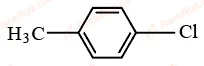
Figure for JEE Advanced 2017 Chemistry question on IUPAC nomenclature of organic compounds
  1. A

    1-chloro-4-methylbenzene

  2. B

    4-chlorotoluene

  3. C

    4-methylchlorobenzene

  4. D

    1-methyl-4-chlorobenzene

JEE ADVANCED 2017 · PAPER 1Structural isomerismTRANSCRIBED

The correct statement(s) for the following addition reactions is(are)
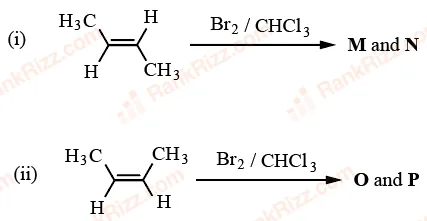
Figure for JEE Advanced 2017 Chemistry question on Structural isomerism
  1. A

    O and P are identical molecules

  2. B

    (M and O) and (N and P) are two pairs of diastereomers

  3. C

    (M and O) and (N and P) are two pairs of enantiomers

  4. D

    Bromination proceeds through trans-addition in both the reactions

JEE ADVANCED 2017 · PAPER 1AromaticityTRANSCRIBED

Among the following, the number of aromatic compound(s) is
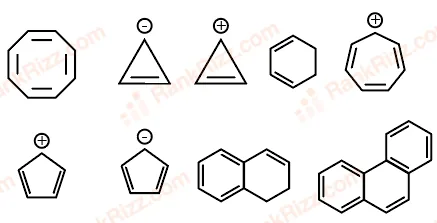
Figure for JEE Advanced 2017 Chemistry question on Aromaticity
JEE ADVANCED 2016 · PAPER 2Resonance and hyperconjugationTRANSCRIBED

The equilibrium constant KpK_p for this reaction at 298 K, in terms of βequilibrium\beta_{equilibrium}, is

  1. A

    8βequilibrium22−βequilibrium\frac{8 \beta_{equilibrium}^{2}}{2 - \beta_{equilibrium}}

  2. B

    8βequilibrium24−βequilibrium2\frac{8 \beta_{equilibrium}^{2}}{4 - \beta_{equilibrium}^{2}}

  3. C

    4βequilibrium22−βequilibrium\frac{4 \beta_{equilibrium}^{2}}{2 - \beta_{equilibrium}}

  4. D

    4βequilibrium24−βequilibrium2\frac{4 \beta_{equilibrium}^{2}}{4 - \beta_{equilibrium}^{2}}

JEE ADVANCED 2016 · PAPER 1Structural isomerismTRANSCRIBED

In the following monobromination reaction, the number of possible chiral products is
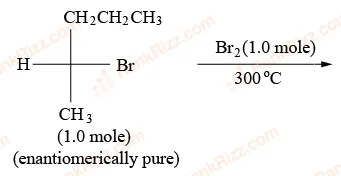
Figure for JEE Advanced 2016 Chemistry question on Structural isomerism
JEE ADVANCED 2015 · PAPER 1Structural isomerismTRANSCRIBED

The total number of stereoisomers that can exist for M is
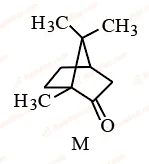
Figure for JEE Advanced 2015 Chemistry question on Structural isomerism
JEE ADVANCED 2015 · PAPER 2Resonance and hyperconjugationTRANSCRIBED

Compound X is

  1. A
    Figure for JEE Advanced 2015 Chemistry question on Resonance and hyperconjugation
  2. B
    Figure for JEE Advanced 2015 Chemistry question on Resonance and hyperconjugation
  3. C
    Figure for JEE Advanced 2015 Chemistry question on Resonance and hyperconjugation
  4. D
    Figure for JEE Advanced 2015 Chemistry question on Resonance and hyperconjugation
JEE ADVANCED 2015 · PAPER 2Resonance and hyperconjugationTRANSCRIBED

Enthalpy of dissociation (in kJ mol−1mol^{-1}) of acetic acid obtained from the Expt. 2 is

  1. A

    1.0

  2. B

    10.0

  3. C

    24.5

  4. D

    51.4

JEE ADVANCED 2015 · PAPER 2Resonance and hyperconjugationTRANSCRIBED

The pH of the solution after Expt. 2 is

  1. A

    2.8

  2. B

    4.7

  3. C

    5.0

  4. D

    7.0

JEE ADVANCED 2015 · PAPER 1Resonance and hyperconjugationTRANSCRIBED

Match the thermodynamic processes given under Column I with the expressions given under Column II.
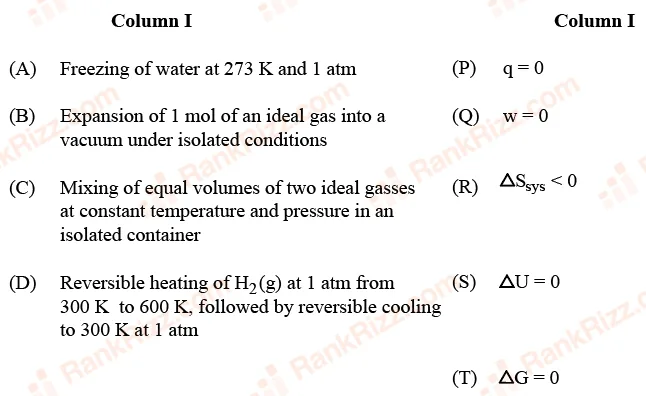
Figure for JEE Advanced 2015 Chemistry question on Resonance and hyperconjugation
JEE ADVANCED 2014 · PAPER 1Structural isomerismTRANSCRIBED

The correct combination of names for isomeric alcohols with molecular formula C4H10OC_4H_{10}O is/are

  1. A

    tert-butanol and 2-methylpropan-2-ol

  2. B

    tert-butanol and 1, 1-dimethylethan-1-ol

  3. C

    n-butanol and butan-1-ol

  4. D

    isobutyl alcohol and 2-methylpropan-1-ol

JEE ADVANCED 2014 · PAPER 2Structural isomerismTRANSCRIBED

Isomers of hexane, based on their branching, can be divided into three distinct classes as shown in the figure.

Figure for JEE Advanced 2014 Chemistry question on Structural isomerism


The correct order of their boiling point is

  1. A

    I > II > III

  2. B

    III > II > I

  3. C

    II > III > I

  4. D

    III > I > II

JEE ADVANCED 2014 · PAPER 1Structural isomerismTRANSCRIBED

The total number(s) of stable conformers with non-zero dipole moment for the following compound is (are)
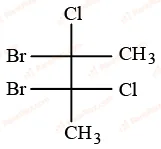
Figure for JEE Advanced 2014 Chemistry question on Structural isomerism
JEE ADVANCED 2014 · PAPER 2Reactive intermediates and rearrangementsTRANSCRIBED

Different possible thermal decomposition pathways for peroxyesters are shown below. Match each pathway from List I with an appropriate structure from List II and select the correct answer using the code given below the lists.
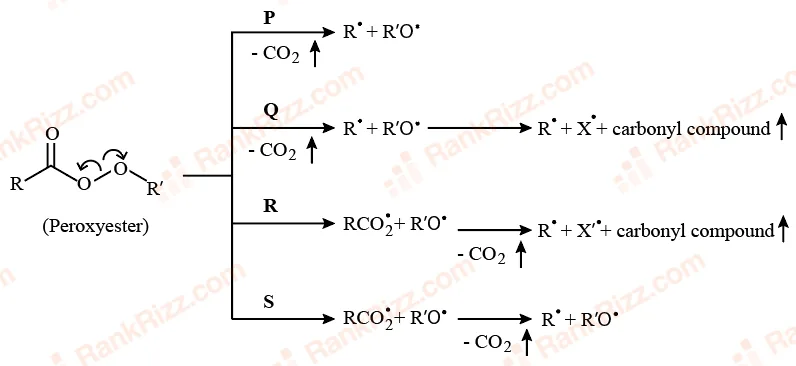
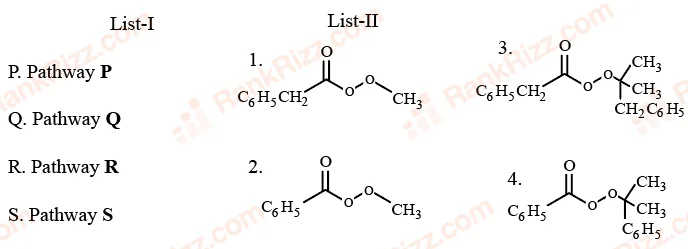
Figure for JEE Advanced 2014 Chemistry question on Reactive intermediates and rearrangementsFigure for JEE Advanced 2014 Chemistry question on Reactive intermediates and rearrangements

Codes:

  1. A

    P - 1, Q - 3, R - 4, S - 2

  2. B

    P - 2, Q - 4, R - 3, S - 1

  3. C

    P - 4, Q - 1, R - 2, S - 3

  4. D

    P - 3, Q - 2, R - 1, S - 4

JEE ADVANCED 2013 · PAPER 2Resonance and hyperconjugationTRANSCRIBED

Inthe nuclear transmutation
49Be+X→48Be+Y_{4}^{9}Be+X\rightarrow_{4}^{8}Be+Y

  1. A

    (γ,n)(\gamma,n)

  2. B

    (p,D)(p, D)

  3. C

    (n,D)(n, D)

  4. D

    (γ,p)(\gamma,p)

JEE ADVANCED 2013 · PAPER 1Resonance and hyperconjugationTRANSCRIBED

The hyperconjugative stabilities of tert-butyl cation and 2-butene, respectively, are due to

  1. A

    σ→p\sigma \rightarrow p (empty) and σ→π\sigma \rightarrow \pi electron delocalisations.

  2. B

    σ→σ\sigma \rightarrow \sigma and σ→π\sigma \rightarrow \pi electron delocalisations.

  3. C

    σ→p\sigma \rightarrow p (filled) and σ→π\sigma \rightarrow \pi electron delocalisations.

  4. D

    p (filled) →σ∗\rightarrow \sigma^* and σ→π∗\sigma \rightarrow \pi^* electron delocalisations.

JEE ADVANCED 2012 · PAPER 1Classification, functional groups and hybridisation in organic compoundsTRANSCRIBED

Inallene (C3H4)(C_3H_4), the type(s) of hybridisation of the carbon atomsis (are)

  1. A

    spsp and sp3sp^3

  2. B

    spsp and sp2sp^2

  3. C

    only sp2sp^2

  4. D

    sp2sp^2 and sp3sp^3

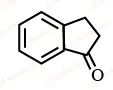
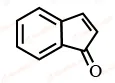
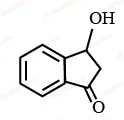
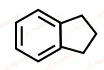
JEE ADVANCED 2012 · PAPER 1AromaticityTRANSCRIBED

Which of the following molecules, in pure form, is (are) unstable at room temperature ?

  1. A
    Figure for JEE Advanced 2012 Chemistry question on Aromaticity
  2. B
    Figure for JEE Advanced 2012 Chemistry question on Aromaticity
  3. C
    Figure for JEE Advanced 2012 Chemistry question on Aromaticity
  4. D
    Figure for JEE Advanced 2012 Chemistry question on Aromaticity