RankRizz

Chemical Thermodynamics — JEE Advanced Previous Year Questions

Every Chemical Thermodynamics question JEE Advanced has set from 2007–2026, grouped by the idea it tests rather than the order of the syllabus. 40 questions across 6 distinct ideas. Free to read, answer key on every one.

Questions

40

Distinct ideas

6

Share of marks

5.7%

Difficulty

EASY

The ideas inside Chemical Thermodynamics

A chapter is not one subject — it is a handful of procedures the examiner reuses. These are the ones Chemical Thermodynamics questions actually test.

01System, surroundings and state functionsset 3×
02First law: work, heat and internal energyset 13×
03Heat capacity and calorimetryset 1×
04Enthalpies of reaction and Hess's lawset 9×
05Bond enthalpy, atomisation, phase-change and solution enthalpiesNot set in Advanced
06Entropy and the second lawset 2×
07Gibbs energy and spontaneityset 12×

Every Chemical Thermodynamics question

21–40 OF 40 · NEWEST FIRST

JEE ADVANCED 2016 · PAPER 1Gibbs energy and spontaneityTRANSCRIBED

One mole of an ideal gas at 300 K in thermal contact with surroundings expands isothermally from 1.0 L to 2.0 L against a constant pressure of 3.0 atm. In this process, the
changein entropy of surroundings (△Ssurr)(\triangle S_{surr}) in JK−1JK^{-1} is (1 Latm = 101.3 d)

  1. A

    5.763

  2. B

    1.013

  3. C

    -1.013

  4. D

    -5.763

JEE ADVANCED 2014 · PAPER 1First law: work, heat and internal energyTRANSCRIBED

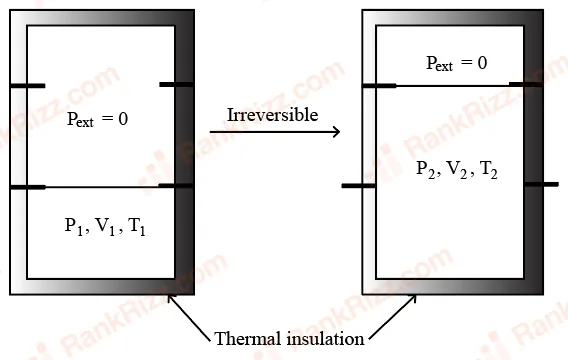
An ideal gas in a thermally insulated vessel at internal pressure = P1P_1, volume = V1V_1 and absolute temperature = T1T_1 expands irreversibly against zero external pressure, as shown in the diagram. The final internal pressure, volume and absolute temperature of the gas are P2,V2P_2, V_2 and T2T_2, respectively. For this expansion,

Figure for JEE Advanced 2014 Chemistry question on First law: work, heat and internal energy
  1. A

    q=0q = 0

  2. B

    T2=T1T_2 = T_1

  3. C

    P2V2=P1V1P_2 V_2 = P_1 V_1

  4. D

    P2V2γ=P1V1γP_2 V_2^\gamma= P_1 V_1^\gamma

JEE ADVANCED 2014 · PAPER 2Gibbs energy and spontaneityTRANSCRIBED

For the process
H2O(l)→H2O(g)H_2O (l) \rightarrow H_2O (g)
at T=100∘CT = 100^\circ C and 1 atmosphere pressure, the correct choice is

  1. A

    △Ssystem>0\triangle S_{system} > 0 and △Ssurroundings>0\triangle S_{surroundings} > 0

  2. B

    △Ssystem>0\triangle S_{system} > 0 and △Ssurroundings<0\triangle S_{surroundings} < 0

  3. C

    △Ssystem<0\triangle S_{system} < 0 and △Ssurroundings>0\triangle S_{surroundings} > 0

  4. D

    △Ssystem<0\triangle S_{system} < 0 and △Ssurroundings<0\triangle S_{surroundings} < 0

JEE ADVANCED 2013 · PAPER 1Enthalpies of reaction and Hess's lawTRANSCRIBED

The standard enthalpies of formation of CO2(g),H2O(l)CO_2(g), H_2O(l) and glucose(s) at 25∘C25^\circ C are -400 kJ/mol, -300 kJ/mol and -1300 kJ/mol, respectively. The standard enthalpy of combustion per gram of glucoseat 25∘C25^\circ C is

  1. A

    +2900 kJ

  2. B

    -2900 kJ

  3. C

    -16.11 kJ

  4. D

    +16.11 kJ

JEE ADVANCED 2013 · PAPER 2First law: work, heat and internal energyTRANSCRIBED

The succeeding operations that enable this transformation of states are

  1. A

    Heating, cooling, heating, cooling

  2. B

    Cooling, heating, cooling, heating

  3. C

    Heating, cooling, cooling, heating

  4. D

    Cooling, heating, heating, cooling

JEE ADVANCED 2013 · PAPER 2System, surroundings and state functionsTRANSCRIBED

The pair of isochoric processes among the transformation of states is

  1. A

    K to L and L to M

  2. B

    L to M and N to K

  3. C

    L to M and M to N

  4. D

    M to N and N to K

JEE ADVANCED 2013 · PAPER 1Gibbs energy and spontaneityTRANSCRIBED

Benzene and naphthalene form an ideal solution at room temperature. For this process, the true statement(s) is(are)

  1. A

    △G\triangle G is positive

  2. B

    △Ssystem\triangle S_{system} is positive

  3. C

    △Ssurroundings=0\triangle S_{surroundings} = 0

  4. D

    △H=0\triangle H = 0

JEE ADVANCED 2012 · PAPER 2Enthalpies of reaction and Hess's lawTRANSCRIBED

Using the data provided, calculate the multiple bond energy (kJmol−1)(kJ mol^{-1}) of a C≡CC \equiv C bond C2H2C_2H_2. That energy is (take the bond energy of a C-H bond as 350 kJ mol−1mol^{-1})

2C(s)+H2(g)→C2H2(g)2C(s) + H_2(g) \rightarrow C_2H_2(g)                          △H=225kJmol−1\triangle H = 225 kJ mol^{-1}

2C(s) →2C(g)2C(s)  \rightarrow 2C(g)                                              △H=1410kJmol−1\triangle H = 1410 kJ mol^{-1}

H2(g)→2H(g)H_2(g) \rightarrow 2H(g)                                             △H=330kJmol−1\triangle H = 330 kJ mol^{-1}

  1. A

    1165

  2. B

    837

  3. C

    865

  4. D

    815

JEE ADVANCED 2012 · PAPER 1Entropy and the second lawTRANSCRIBED

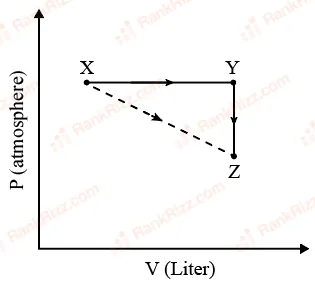
For an ideal gas, consider only P-V work in going from an initial state X to the final state Z. The final state Z can be reached by either of the two paths shown in the figure. Which of the following choice(s) is (are) correct ? [take △S\triangle S as change in entropy and w as work done]

Figure for JEE Advanced 2012 Chemistry question on Entropy and the second law
  1. A

    △Sx→z=△Sx→y+△Sy→z\triangle S_{x \rightarrow z} = \triangle S_{x \rightarrow y} + \triangle S_{y \rightarrow z}

  2. B

    △wx→z=△wx→y+△wy→z\triangle w_{x \rightarrow z} = \triangle w_{x \rightarrow y} + \triangle w_{y \rightarrow z}

  3. C

    △wx→y→z=△wx→y\triangle w_{x \rightarrow y \rightarrow z} = \triangle w_{x \rightarrow y}

  4. D

    △Sx→y→z=△Sx→y\triangle S_{x \rightarrow y \rightarrow z} = \triangle S_{x \rightarrow y}

JEE ADVANCED 2012 · PAPER 2First law: work, heat and internal energyTRANSCRIBED

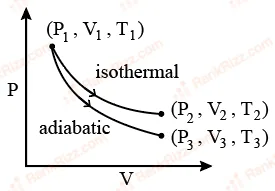
The reversible expansion of an ideal gas under adiabatic and isothermal conditions is shown in the figure. Which of the following statement(s) is (are) correct ?

Figure for JEE Advanced 2012 Chemistry question on First law: work, heat and internal energy
  1. A

    T1=T2T_1 = T_2

  2. B

    T3>T1T_3 > T_1

  3. C

    Wisothermal>WadiabaticW_{isothermal} > W_{adiabatic}

  4. D

    △Uisothermal>△Uadiabatic\triangle U_{isothermal} > \triangle U_{adiabatic}

JEE ADVANCED 2011 · PAPER 2Enthalpies of reaction and Hess's lawTRANSCRIBED

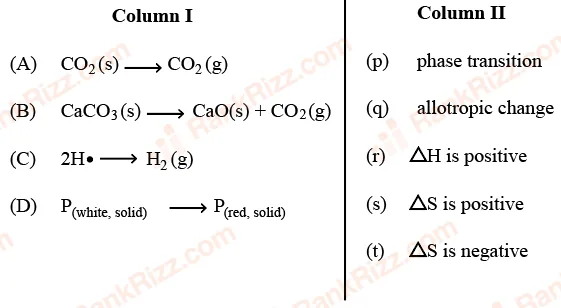
Match the transformations in column I with appropriate options in column II

Figure for JEE Advanced 2011 Chemistry question on Enthalpies of reaction and Hess's law
JEE ADVANCED 2010 · PAPER 1First law: work, heat and internal energyTRANSCRIBED

The species which by definition has ZERO standard molar enthalpy of formation at 298 K is

  1. A

    Br2(g)Br_{2}(g)

  2. B

    Cl2(g)Cl_{2}(g)

  3. C

    H2O(g)H_{2}O(g)

  4. D

    CH4(g)CH_{4}(g)

JEE ADVANCED 2010 · PAPER 1Enthalpies of reaction and Hess's lawTRANSCRIBED

The bond energy (in kcal mol−1mol^{-1}) of a C-C single bond is approximately

  1. A

    1

  2. B

    10

  3. C

    100

  4. D

    1000

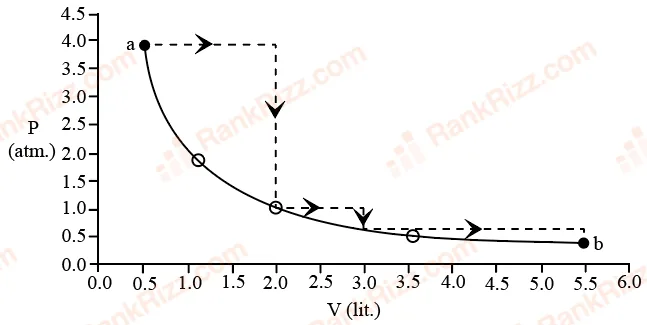
JEE ADVANCED 2010 · PAPER 2First law: work, heat and internal energyTRANSCRIBED

One mole of an ideal gas is taken from a to b along two paths denoted bythe solid and the dashed lines as shownin the graph below. If the work done along the solid line path is WsW_s and that along the dotted line path is WdW_d, then the integer closest to the ratio WdWs\frac{W_d}{W_s} is

Figure for JEE Advanced 2010 Chemistry question on First law: work, heat and internal energy
JEE ADVANCED 2010 · PAPER 1System, surroundings and state functionsTRANSCRIBED

Among the following, the intensive property is (properties are)

  1. A

    molar conductivity

  2. B

    electromotive force

  3. C

    resistance

  4. D

    heat capacity

JEE ADVANCED 2009 · PAPER 2System, surroundings and state functionsTRANSCRIBED

Among the following, the state function(s) is(are)

  1. A

    Internal energy

  2. B

    Irreversible expansion work

  3. C

    Reversible expansion work

  4. D

    Molarenthalpy

JEE ADVANCED 2009 · PAPER 2Enthalpies of reaction and Hess's lawTRANSCRIBED

In a constant volume calorimeter, 3.5 g of a gas with molecular weight 28 was burnt in excess oxygen at 298.0 K. The temperature of the calorimeter was found to increase from 298.0 K to 298.45 K due to the combustion process. Given that the heat capacity of the calorimeteris 2.5 kJ K−1^{-1}, the numerical value for the enthalpy of combustion of the gas in kJ mol−1^{-1} is

JEE ADVANCED 2008 · PAPER 2Entropy and the second lawTRANSCRIBED

STATEMENT-1: There is a natural asymmetry between converting work to heat and converting heat to work.
and
STATEMENT-2: Noprocessis possible in which the sole result is the absorption of heat from a reservoir and its complete conversion into work.

  1. A

    STATEMENT-1 is True, STATEMENT-2 is True; STATEMENT-2 is a correct explanation for STATEMENT-1

  2. B

    STATEMENT-1 is True, STATEMENT-2 is True; STATEMENT-2 is NOT a correct explanation for STATEMENT-1

  3. C

    STATEMENT-1 is True, STATEMENT-2 is False

  4. D

    STATEMENT-1 is False, STATEMENT-2 is True

JEE ADVANCED 2007 · PAPER 2First law: work, heat and internal energyTRANSCRIBED

For the process H2O(l)H_2O(l) (1 bar, 373 K) →H2O(g)\rightarrow H_2O(g)(1 bar, 373 K), the correct set of thermodynamic parameters is

  1. A

    △G=0,△S=+ve\triangle G = 0, \triangle S = +ve

  2. B

    △G=0,△S=−ve\triangle G = 0, \triangle S = -ve

  3. C

    △G=+ve,△S=0\triangle G = +ve, \triangle S = 0

  4. D

    △G=−ve,△S=+ve\triangle G = -ve, \triangle S = +ve

JEE ADVANCED 2007 · PAPER 1Gibbs energy and spontaneityTRANSCRIBED

The value of log⁡10K\log_{10} K for a reaction A⇌BA \rightleftharpoons B is
(Given : △rH298K∘\triangle_rH_{298K}^{\circ} = -54.07 kJ mol−1^{-1}, △rS298K∘\triangle_rS_{298K}^{\circ} = 10 JK−1^{-1} mol−1^{-1} and R = 8.314 JK−1^{-1} mol−1^{-1}; 2.303×8.314×298=57052.303 \times 8.314 \times 298 = 5705)

  1. A

    5

  2. B

    10

  3. C

    95

  4. D

    100