JEE MAIN 2026First law: work, heat and internal energyTRANSCRIBED
For an isothermal free expansion of an ideal gas into vacuum, which one of the following set of values is correct?
- A
- B
- C
- D
Every Chemical Thermodynamics question JEE Main has set from 2004–2026, grouped by the idea it tests rather than the order of the syllabus. 229 questions across 7 distinct ideas. Free to read, answer key on every one.
Questions
229
Distinct ideas
7
Share of marks
4.6%
Difficulty
MEDIUM
A chapter is not one subject — it is a handful of procedures the examiner reuses. These are the ones Chemical Thermodynamics questions actually test.
The share of each year’s Chemistry questions that came from Chemical Thermodynamics, counted from the 168 papers we hold for the last 10 years, and session by session inside a year.
Rising: 4.8% of Chemistry questions in 2024–2026, up from 3.5% in 2017–2023. Its heaviest year was 2017, at 6.7%.
“QS” is Chemical Thermodynamics questions out of all Chemistry questions that year. A year with more sittings asks more questions, which is why the share, not the count, is the number to compare.
229 questions from 2004–2026. Over the last 20 papers, Chemical Thermodynamics carried about 4.6% of Chemistry marks.
Enthalpies of reaction and Hess's law (75 questions), First law: work, heat and internal energy (55 questions), Gibbs energy and spontaneity (54 questions). Start with these, they are what the examiner keeps coming back to.
Rising: 4.8% of Chemistry questions in 2024–2026, up from 3.5% in 2017–2023. Its heaviest year was 2017, at 6.7%. It has carried about 4.6% of Chemistry marks in recent papers, rated medium on our difficulty scale. The year-by-year table above shows how that has moved.
Yes. Every question shows its official answer key, and a worked solution opens on the question’s own page wherever we have one. Reading and checking answers is free, no sign-up needed.
Do one past question per idea first: Chemical Thermodynamics has 7 distinct ideas, listed above. Then practise the topics you get wrong, or build a timed test from this chapter.
1–20 OF 229 · NEWEST FIRST
For an isothermal free expansion of an ideal gas into vacuum, which one of the following set of values is correct?
5 moles of unknown gas is heated at constant volume from 10 °C to 20 °C. The molar specific heat of this gas at constant pressure cal/mol.°C and J/mol.°C. The change in internal energy of the gas is _________ calorie.
Consider the following data.
(i) 2Al(s) + 6HCl(aq) AlCl(aq) + 3H(g) + 1200 kJ/mol
(ii) H(g) + Cl(g) 2HCl(g) + 164 kJ/mol.
(iii) HCl(g) + aq HCl(aq) + 83 kJ/mol.
(iv) AlCl(s) + aq AlCl(aq) + 663 kJ/mol
The enthalpy of formation of anhydrous solid AlCl is :
kJ mol
kJ mol
kJ mol
kJ mol
Given below are two statements:
Statement I: For an ideal gas, heat capacity at constant volume is always greater than the heat capacity at constant pressure.
Statement II: In a constant volume process, no work is produced and all the heat withdrawn goes into the chaotic motion and is reflected by a temperature increase of the ideal gas.
In the light of the above statement, choose the correct answer from the options given below.
Both Statement I and Statement II are true
Both Statement I and Statement II are false
Statement I is true but Statement II is false
Statement I is false but Statement II is true
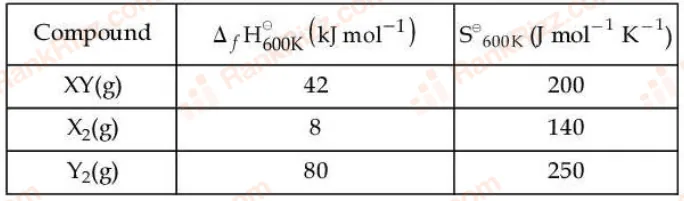
Consider the following data for the reaction
at 600 K. The (in ) for the reaction is :
Match List - I with List - II.
Given and are initial and final volumes respectively.
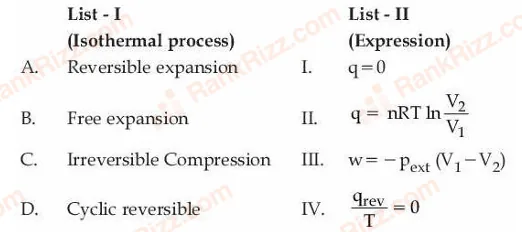
Choose the correct answer from the options given below :
A-II, B-III, C-I, D-IV
A-II, B-I, C-IV, D-III
A-II, B-I, C-III, D-IV
A-I, B-II, C-III, D-IV
Match the LIST-I with LIST-II
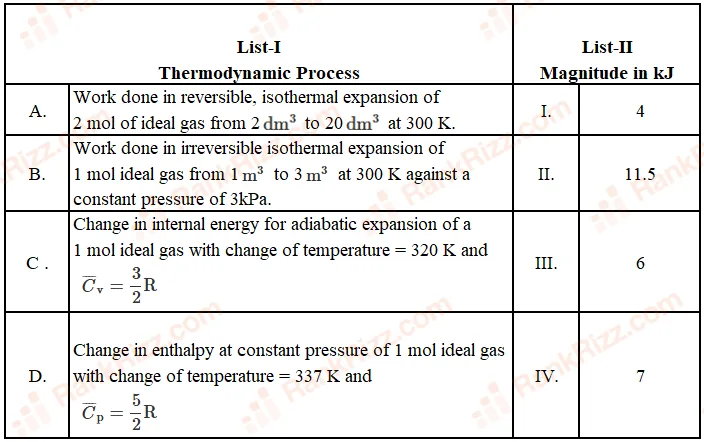
Choose the correct answer from the options given below:
A-I, B-II, C-III, D-IV
A-II, B-III, C-I, D-IV
A-II, B-I, C-III, D-IV
A-III, B-II, C-IV, D-1
The correct order of molar heat capacities measured at 298 K and 1 bar is :
Arrange the following isothermal processes in order of the magnitude of the work (p - V) involved between states 1 and 2.
A. Expansion in single stage
B. Expansion in multi stages
C. Compression in single stage
D. Compression in multi stages
Choose the correct option.
Consider the following data :
(methane, g) = - X kJ
Enthalpy of sublimation of graphite = Y kJ
Dissociation enthalpy of = Zkj
The bond enthalpy of C - H bond is given by :
X + Y + Z
The heat of atomisation of methane and ethane are 'x' kJ and 'y' kJ respectively. The longest wavelength () of light capable of breaking the C-C bond
can be expressed in SI unit as:
Gas 'A' undergoes change from state 'X' to state 'Y'. In this process, the heat absorbed and work done by the gas is 10 J and 18 J respectively. Now gas is brought back to state 'X' by another process during which 6 J of heat is evolved. In the reverse process of 'Y' to 'X' :
18 J of the work is done by the gas 'A'
2 J of the work is done by the gas 'A'
12 J of the work is done on the gas 'A' by the surrounding
14 J of the work is done on the gas 'A' by the surrounding
20.0 of an ideal gas 'X' at 600 K and 0.5 MPa undergoes isothermal reversible expansion until pressure of the gas is 0.2 MPa. Which of the following option is correct?
(Given: )
w = +4.1kJ, U = 0, H = 0; q = -4.1kJ
w = 9.1kJ, U = 9.1J, H = 0; q = 0
w = -3.9kJ, U = 0, H = 0; q = 3.9kJ
w = -9.1kJ, U = 0, H = 0; q = 9.1kJ
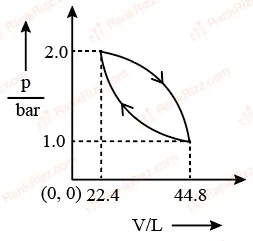
Which of the following graphs between pressure 'p' versus volume 'V' represents the maximum work done?
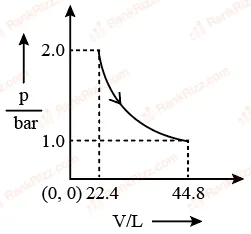
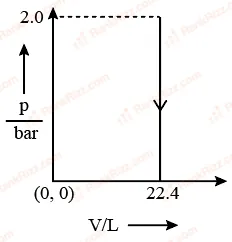
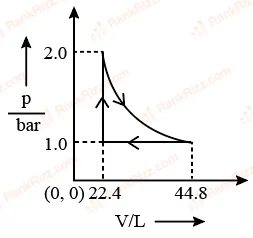
A cup of water at 5°C (system) is placed in a microwave oven and the oven is turned on for one minute during which the water begins to boil. Which of the following option is true ?
q = + ve, w = 0, = - ve
q = + ve, w = - ve, = - ve
q = + ve, w = - ve, = + ve
q = - ve, w = - ve, = - ve
Match the LIST-I with LIST-II
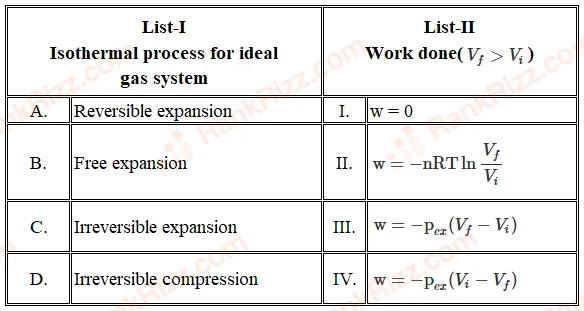
Choose the correct answer from the options given befow:
A-IV, B-II, C-III, D-I
A-II, B-I, C-III, D-IV
A-IV, B-I, C-III, D-II
A-I, B-III, C-II, D-IV
For the reaction , graph is plotted as shown below. Identify correct statements.
A. Standard free energy change for the reaction is .
B. As in graph is positive, will not dissociate into at all.
C. Reverse reaction will go to completion.
D. When 1 mole of changes into equilibrium mixture, value of = -0.84kJ .
E. When 2 mole of changes into equilibrium mixture, for equilibrium mixture is -6.24kJ .
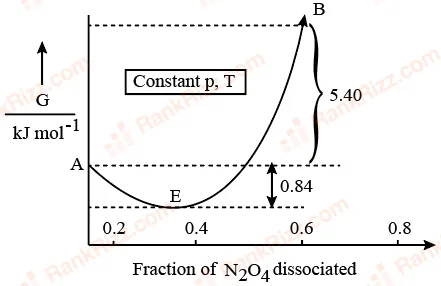
Choose the correct answer from the options given below:
D andE only
B andC only
A and D only
C and E only
If 3.365 g of ethanol (l) is burnt completely in a bomb calorimeter at 298.15 K, the heat produced is 99.472 kJ. The of ethanol at 298.15 K is _________ kJ mol. (Nearest integer)
Given: Standard enthalpy for combustion of graphite = kJ mol
Standard enthalpy of formation of water (l) = kJ mol
Molar mass in g mol of C, H, O are 12, 1 and 16 respectively
Use the following data :
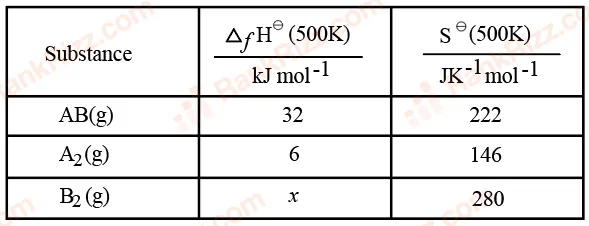
One mole each of and are taken in a 1 L closed flask and allowed to establish the equilibrium at 500K
The value of x in is ____ . (Nearest integer)
(Given: log K=2.2 R= 8.3 kJ )
If the enthalpy of sublimation of Li is 155 kJ , enthalpy of dissociation of is 150 kJ , ionization enthalpy of Li is 520 kJ , electron gain enthalpy of F is - 313 kJ , standard enthalpy of formation of LiF is - 594 kJ . The magnitude of lattice enthalpy of LiF is _________ kJ . (Nearest Integer)
JEE Advanced has set 40 Chemical Thermodynamics questions too. Chemical Thermodynamics JEE Advanced PYQs →
OTHER CHEMISTRY CHAPTERS