JEE Advanced 2012 Chemistry question — Entropy and the second law
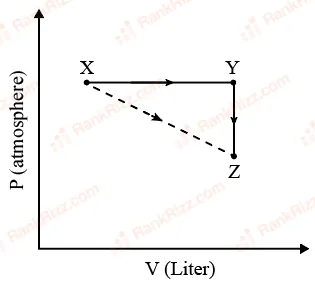
For an ideal gas, consider only P-V work in going from an initial state X to the final state Z. The final state Z can be reached by either of the two paths shown in the figure. Which of the following choice(s) is (are) correct ? [take as change in entropy and w as work done]
SOLUTION
From the figure, X → Y is an expansion at constant pressure and Y → Z is a fall in pressure at constant volume; the dotted line is the direct path X → Z.
(A) Entropy is a state function, so its change from X to Z is the same along any path: . Correct.
(B) Work is a path function. Along X → Y → Z the work equals the area under XY (Y → Z does no work), while along the direct path X → Z it equals the smaller area under the dotted line. So . Incorrect.
(C) Y → Z takes place at constant volume, so and . Correct.
(D) , and , because the temperature falls as the pressure falls at constant volume. Incorrect.
Hence, the correct options are (A) and (C).
Tagged Entropy and the second law. Machine-assigned, so read it as a strong shortlist rather than a verdict.