JEE Advanced 2024 Chemistry question — Proteins and enzymes
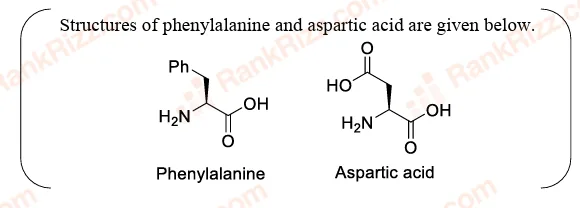
Aspartame, an artificial sweetener, is a dipeptide aspartyl phenylalanine methyl ester. The structure of aspartame is
SOLUTION
Aspartame is named L-aspartyl-L-phenylalanine-1-methyl ester. The systematic name already tells us how every group is connected, so we decode it step by step.
1. “L-aspartyl” means the N-terminal amino acid is L-aspartic acid. Aspartic acid contains
• an α-amino group attached to (the α-carbon),
• an α-carboxyl group , and
• a side-chain carboxyl group .
2. “L-phenylalanine” is the second amino acid. Its α-carbon carries
• an α-amino group (but this is consumed in peptide bonding),
• a benzyl side chain , and
• an α-carboxyl group .
3. “Methyl ester” tells us that the carboxyl group of phenylalanine is esterified with methanol, converting into .
Putting these facts together:
• The peptide bond must be between the α-carboxyl of aspartic acid and the α-amino of phenylalanine (standard NC direction in peptides).
• The side-chain carboxyl of aspartic acid remains free as .
• The phenylalanine α-carboxyl is not a free acid; it is present as .
Only one of the given structures shows simultaneously
✔ a peptide linkage between the correct α-centres,
✔ a free second on the aspartyl side chain, and
✔ the ester on the phenylalanine end,
with both chiral centres having the L-configuration. That structure is shown in Option B.
Hence, the correct structure of aspartame is given in Option B.
Answer: Option B which is: the L-aspartyl-L-phenylalanine-1-methyl ester structure
Tagged Proteins and enzymes. Machine-assigned, so read it as a strong shortlist rather than a verdict.