JEE Advanced 2014 Chemistry question — Proteins and enzymes
The total number of distinct naturally occurring amino acids obtained by complete acidic hydrolysis of the peptide shown below is
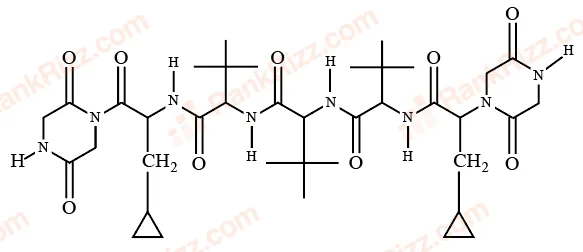
SOLUTION
Acidic hydrolysis cleaves every amide C(=O)–N bond but not an amine C–N single bond.
The left 2,5-diketopiperazine ring (cyclo-Gly-Gly) opens to two molecules of glycine; the bond from its ring N to the carbonyl of the next residue is also an amide and is cleaved.
The three residues with side chains give tert-leucine (2-amino-3,3-dimethylbutanoic acid), and the left residue with a cyclopropylmethyl side chain gives 3-cyclopropylalanine (2-amino-3-cyclopropylpropanoic acid).
In the right ring the nitrogen is bonded directly to the -carbon of the last cyclopropylmethyl residue by an amine C–N bond, which survives. This ring opens to one glycine and (R = cyclopropylmethyl), an N-substituted amino acid.
Of the four distinct amino acids obtained (glycine, tert-leucine, 3-cyclopropylalanine and the N-carboxymethyl derivative), only glycine is a naturally occurring amino acid.
Hence, the answer is 1.
Tagged Proteins and enzymes. Machine-assigned, so read it as a strong shortlist rather than a verdict.