RankRizz

Mechanical Properties of Fluids — JEE Main Previous Year Questions

Every Mechanical Properties of Fluids question JEE Main has set from 2004–2026, grouped by the idea it tests rather than the order of the syllabus. 193 questions across 9 distinct ideas. Free to read, answer key on every one.

Questions

193

Distinct ideas

9

Share of marks

4.2%

Difficulty

MEDIUM

The ideas inside Mechanical Properties of Fluids

A chapter is not one subject — it is a handful of procedures the examiner reuses. These are the ones Mechanical Properties of Fluids questions actually test.

Every Mechanical Properties of Fluids question

121–140 OF 193 · NEWEST FIRST

JEE MAIN 2021 · 27 JUL S2Speed of efflux and applications of Bernoulli's theoremTRANSCRIBED

The water is filled up to a height of 12 m in a tank having vertical sidewalls. A hole is made in one of the walls at a depth hh below the water level. The value of hh for which the emerging stream of water strikes the ground at the maximum range is _________ m.
JEE MAIN 2021 · 24 FEB S1Fluid pressure, Pascal's law and accelerated/rotating liquidsTRANSCRIBED

A hydraulic press can lift 100 kg when a mass mm is placed on the smaller piston. It can lift ______ kg when the diameter of the larger piston is increased by 4 times and that of the smaller piston is decreased by 4 times keeping the same mass mm on the smaller piston.

JEE MAIN 2021 · 18 MAR S2Speed of efflux and applications of Bernoulli's theoremTRANSCRIBED

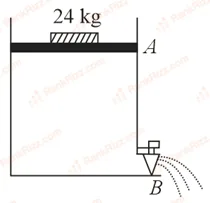
Consider a water tank as shown in the figure. It's cross-sectional area is 0.4 m2^2. The tank has an opening B near the bottom whose cross-section area is 1 cm2^2. A load of 24 kg is applied on the water at the top when the height of the water level is 40 cm above the bottom, the velocity of water coming out the opening B is v m s−1^{-1}. The value of vv, to the nearest integer, is ___. [Take the value of gg to be 10 m s−2^{-2}]

Figure for JEE Main 2021 Physics question on Speed of efflux and applications of Bernoulli's theorem
JEE MAIN 2021 · 26 AUG S1Excess pressure in drops and bubblesTRANSCRIBED

A soap bubble of the radius 3 cm is formed inside another soap bubble of radius 6 cm. The radius of an equivalent soap bubble that has the same excess pressure as inside the smaller bubble with respect to the atmospheric pressure is _________ cm.

JEE MAIN 2020 · 03 SEP S1Excess pressure in drops and bubblesTRANSCRIBED

Pressure inside two soap bubbles are 1.01 and 1.02 atmosphere, respectively. The ratio of their volumes is:

  1. A

    4:14 : 1

  2. B

    0.8:10.8 : 1

  3. C

    8:18 : 1

  4. D

    2:12 : 1

JEE MAIN 2020 · 02 SEP S2Angle of contact and capillary riseTRANSCRIBED

A capillary tube made of glass of radius 0.15 mm is dipped vertically in a beaker filled with methylene iodide (surface tension = 0.05 N m−1^{-1}, density = 667 kg m−3^{-3}) which rises to height h in the tube. It is observed that the two tangents drawn from observed that the two tangents drawn from liquid-glass interfaces (from opp. sides of the capillary) make an angle of 60°° with one another. Then h is close to (g = 10 m s−2^{-2}):

  1. A

    0.049 m

  2. B

    0.087 m

  3. C

    0.137 m

  4. D

    0.172 m

JEE MAIN 2020 · 05 SEP S2Stokes' law and terminal velocityTRANSCRIBED

In an experiment to verify Stokes law, a small spherical ball of radius rr and density ρ\rho falls under gravity through a distance hh in air before entering a tank of water. If the terminal velocity of the ball inside water is same as its velocity just before entering the water surface, then the value of hh is proportional to: (ignore viscosity of air)

  1. A

    r4r^4

  2. B

    rr

  3. C

    r3r^3

  4. D

    r2r^2

JEE MAIN 2020 · 09 JAN S1Equation of continuity and Bernoulli's theoremTRANSCRIBED

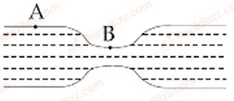
Water flows in a horizontal tube (see figure). The pressure of water changes by 700  Nm−2700 \; Nm^{-2} between AA and BB where the area of cross section are 40  cm240 \; cm^2 and 20  cm220 \; cm^2, respectively. Find the rate of flow of water through the tube. (density of water =1000  kgm−3= 1000 \; kgm^{-3})

Figure for JEE Main 2020 Physics question on Equation of continuity and Bernoulli's theorem
  1. A

    3020  cm3/s3020 \; cm^3/s

  2. B

    2720  cm3/s2720 \; cm^3/s

  3. C

    2420  cm3/s2420 \; cm^3/s

  4. D

    1810  cm3/s1810 \; cm^3/s

JEE MAIN 2020 · 05 SEP S1Archimedes' principle and floatationTRANSCRIBED

A hollow spherical shell at outer radius RR floats just submerged under the water surface. The inner radius of the shell is rr. If the specific gravity of the shell material is 278\frac{27}{8} with respect to water, the value of rr is:

  1. A

    89R\frac{8}{9}R

  2. B

    49R\frac{4}{9}R

  3. C

    23R\frac{2}{3}R

  4. D

    13R\frac{1}{3}R

JEE MAIN 2020 · 07 JAN S2Equation of continuity and Bernoulli's theoremTRANSCRIBED

An ideal fluid flows (laminar flow) through a pipe of non-uniform diameter. The maximum and minimum diameters of the pipes are 6.4 cm and 4.8 cm, respectively. The ratio of the minimum and the maximum velocities of fluid in this pipe is:

  1. A

    916\frac{9}{16}

  2. B

    32\frac{\sqrt{3}}{2}

  3. C

    34\frac{3}{4}

  4. D

    81256\frac{81}{256}

JEE MAIN 2020 · 04 SEP S1Archimedes' principle and floatationTRANSCRIBED

An air bubble of radius 1 cm in water has an upward acceleration of 9.8 cms−2^{-2}. The density of water is 1 gm cm−3^{-3} and water offers negligible drag force on the bubble. The mass of the bubble is (g=980(g = 980 cm/s2)^2).

  1. A

    4.51 gm

  2. B

    3.15 gm

  3. C

    4.15 gm

  4. D

    1.52 gm

JEE MAIN 2020 · 08 JAN S1Archimedes' principle and floatationTRANSCRIBED

A leak proof cylinder of length 1 m, made of a metal which has very low coefficient of expansion is floating vertically in water at 0∘^\circC such that its height above the water surface is 20 cm. When the temperature of water is increased to 4∘^\circC, the height of the cylinder above the water surface becomes 21 cm. The density of water at T = 4∘^\circC, relative to the density at T = 0∘^\circC is close to:

  1. A

    1.26

  2. B

    1.04

  3. C

    1.01

  4. D

    1.03

JEE MAIN 2020 · 06 SEP S2Equation of continuity and Bernoulli's theoremTRANSCRIBED

A fluid is flowing through a horizontal pipe of varying cross-section, with speed v ms−1v\,\text{ms}^{-1} at a point where the pressure is P Pascal. At another point where pressure is P2\frac{P}{2} Pascal its speed is V ms−1V\,\text{ms}^{-1}. If the density of the fluid is ρ kg m−3\rho\,\text{kg m}^{-3} and the flow is streamline, then VV is equal to:

  1. A

    Pρ+v\sqrt{\frac{P}{\rho} + v}

  2. B

    2Pρ+v2\sqrt{\frac{2P}{\rho} + v^2}

  3. C

    P2ρ+v2\sqrt{\frac{P}{2\rho} + v^2}

  4. D

    Pρ+v2\sqrt{\frac{P}{\rho} + v^2}

JEE MAIN 2020 · 08 JAN S1Archimedes' principle and floatationTRANSCRIBED

Consider a solid sphere of radius RR and mass density ρ(r)=ρ0(1−r2R2)\rho(r) = \rho_0\left(1 - \frac{r^2}{R^2}\right), 0<r≤R0 < r \le R. The minimum density of a liquid in which it will float is:

  1. A

    ρ03\frac{\rho_0}{3}

  2. B

    ρ05\frac{\rho_0}{5}

  3. C

    2ρ05\frac{2\rho_0}{5}

  4. D

    2ρ03\frac{2\rho_0}{3}

JEE MAIN 2020 · 08 JAN S2Fluid pressure, Pascal's law and accelerated/rotating liquidsTRANSCRIBED

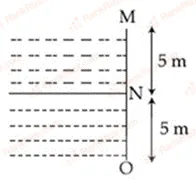
Two liquids of densities ρ1\rho_1 and ρ2\rho_2 (ρ2=2ρ1\rho_2 = 2\rho_1) are filled up behind a square wall of side 10 m as shown in figure. Each liquid has a height of 5 m. The ratio of the forces due to these liquids exerted on upper part MN to that at the lower part NO is (Assume that the liquids are not mixing):

Figure for JEE Main 2020 Physics question on Fluid pressure, Pascal's law and accelerated/rotating liquids
  1. A

    13\frac{1}{3}

  2. B

    23\frac{2}{3}

  3. C

    12\frac{1}{2}

  4. D

    14\frac{1}{4}

JEE MAIN 2020 · 02 SEP S1Fluid pressure, Pascal's law and accelerated/rotating liquidsTRANSCRIBED

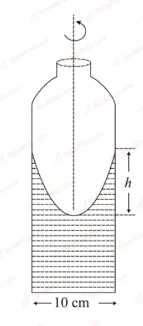
A cylindrical vessel containing a liquid is rotated about its axis so that the liquid rises at its sides as shown in the figure. The radius of vessel is 5 cm and the angular speed of rotation is ω\omega rad s−1^{-1}. The difference in the height, h (in cm) of liquid at the Centre of vessel and at the sides of the vessel will be:

Figure for JEE Main 2020 Physics question on Fluid pressure, Pascal's law and accelerated/rotating liquids
  1. A

    2ω225g\frac{2\omega^2}{25g}

  2. B

    5ω22g\frac{5\omega^2}{2g}

  3. C

    25ω22g\frac{25\omega^2}{2g}

  4. D

    2ω25g\frac{2\omega^2}{5g}

JEE MAIN 2020 · 09 JAN S2Surface tension and surface energyTRANSCRIBED

A small spherical droplet of density dd is floating exactly half immersed in a liquid of density ρ\rho and surface tension TT. The radius of the droplet is (take note that the surface tension applies an upward force on the droplet):

  1. A

    r=2T3(d+ρ)gr = \sqrt{\frac{2T}{3(d+\rho)g}}

  2. B

    r=T(d−ρ)gr = \sqrt{\frac{T}{(d-\rho)g}}

  3. C

    r=T(d+ρ)gr = \sqrt{\frac{T}{(d+\rho)g}}

  4. D

    r=3T(2d−ρ)gr = \sqrt{\frac{3T}{(2d-\rho)g}}

JEE MAIN 2020 · 04 SEP S2Fluid pressure, Pascal's law and accelerated/rotating liquidsTRANSCRIBED

Two identical cylindrical vessels are kept on the ground and each contain the same liquid of density dd. The area of the base of both vessels is SS but the height of liquid in one vessel is x1x_1 and in the other x2x_2. When both cylinders are connected through a pipe of negligible volume very close to the bottom, the liquid flows from one vessel to the other until it comes to equilibrium at a new height. The change in energy of the system in the process is:

  1. A

    gdS(x22+x12)gdS(x_2^2 + x_1^2)

  2. B

    gdS(x2+x1)2gdS(x_2 + x_1)^2

  3. C

    34gdS(x2−x1)2\frac{3}{4}gdS(x_2 - x_1)^2

  4. D

    14gdS(x2−x1)2\frac{1}{4}gdS(x_2 - x_1)^2

JEE MAIN 2020 · 03 SEP S1Angle of contact and capillary riseTRANSCRIBED

When a long glass capillary tube of radius 0.015 cm is dipped in a liquid, the liquid rises to a height of 15 cm within it. If the contact angle between the liquid and glass is close to 0°, the surface tension of the liquid, in milliNewton m−1^{-1}, is [ρ(liquid)=900 kg m−3,  g=10 m s−2]\left[\rho_{\text{(liquid)}} = 900 \text{ kg m}^{-3},\; g = 10 \text{ m s}^{-2}\right] (Given answer in closed integer)

JEE MAIN 2019 · 10 APR S1Angle of contact and capillary riseTRANSCRIBED

The ratio of surface tensions of mercury and water is given to be 7.5, while the ratio of their densities is 13.6. Their contact angles, with glass, are close to 135° and 0°, respectively. If it is observed that mercury gets depressed by an amount hh in a capillary tube of radius r1r_1, while water rises by the same amount hh in a capillary tube of radius r2r_2, then the ratio r1r2\frac{r_1}{r_2} is close to

  1. A

    35\frac{3}{5}

  2. B

    23\frac{2}{3}

  3. C

    45\frac{4}{5}

  4. D

    25\frac{2}{5}