JEE MAIN 2022 · 25 JUL S2Surface tension and surface energyTRANSCRIBED
A drop of liquid of density is floating half immersed in a liquid of density and surface tension . The radius of drop in cm will be: (Take: )
- A
- B
- C
- D
Every Mechanical Properties of Fluids question JEE Main has set from 2004–2026, grouped by the idea it tests rather than the order of the syllabus. 193 questions across 9 distinct ideas. Free to read, answer key on every one.
Questions
193
Distinct ideas
9
Share of marks
4.2%
Difficulty
MEDIUM
A chapter is not one subject — it is a handful of procedures the examiner reuses. These are the ones Mechanical Properties of Fluids questions actually test.
101–120 OF 193 · NEWEST FIRST
A drop of liquid of density is floating half immersed in a liquid of density and surface tension . The radius of drop in cm will be: (Take: )
Given below are two statements: One is labelled as Assertion (A) and the other is labelled as Reason (R).
Assertion (A): Clothes containing oil or grease stains cannot be cleaned by water wash.
Reason (R): Because the angle of contact between the oil/grease and water is obtuse.
In the light of the above statements, choose the correct answer from the option given below.
Both (A) and (R) are true and (R) is the correct explanation of (A)
Both (A) and (R) are true but (R) is not the correct explanation of (A)
(A) is true but (R) is false
(A) is true but (R) is true
A tube of length 50 cm is filled completely with an incompressible liquid of mass 250 g and closed at both ends. The tube is then rotated in horizontal plane about one of its ends with a uniform angular velocity rad s. If F be the force exerted by the liquid at the other end then the value of x will be _____
The area of cross-section of a large tank is m. It has a narrow opening near the bottom having area of cross-section cm. A load of kg is applied on the water at the top in the tank. Neglecting the speed of water in the tank, the velocity of the water, coming out of the opening at the time when the height of water level in the tank is cm above the bottom, will be ______ cm s.
[Take m s]
A small spherical ball of radius 0.1 mm and density kg m falls freely under gravity through a distance before entering a tank of water. If, after entering the water the velocity of ball does not change and it continue to fall with same constant velocity inside water, then the value of will be ______ m. (Given m s, viscosity of water N-s m).
A liquid of density 750 kg m flows smoothly through a horizontal pipe that tapers in cross-sectional area from m to . The pressure difference between the wide and narrow sections of the pipe is 4500 Pa. The rate of flow of liquid is ______ m s.
The velocity of a small ball of mass 0.3 g and density 8 g cc when dropped in a container filled with glycerine becomes constant after some time. If the density of glycerine is 1.3 g cc, then the value of viscous force acting on the ball will be N, the value of x is _____ [use m s]
The velocity of upper layer of water in a river is km h. Shearing stress between horizontal layers of water is N m. Depth of the river is ______ m. (Co-efficient of viscosity of water is Pa s)
A spherical soap bubble of radius 3 cm is formed inside another spherical soap bubble of radius 6 cm. If the internal pressure of the smaller bubble of radius 3 cm in the above system is equal to the internal pressure of another single soap bubble of radius cm. The value of is _____
The diameter of an air bubble which was initially 2 mm, rises steadily through a solution of density 1750 kg/m at the rate of 0.35 cm/s. Coefficient of viscosity of the solution is _____ Poise. (Assume mass of the bubble to be negligible) (Answer in Poise to the nearest integer)
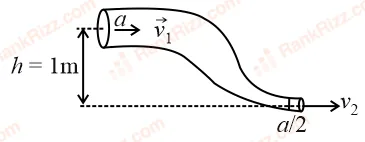
An ideal fluid of density kg m, flows smoothly through a bent pipe (as shown in the figure) that tapers in cross-sectional area from to . The pressure difference between the wide and narrow sections of pipe is Pa. At the wider section, the velocity of the fluid is m s for ______. (Given m s)
What will be the nature of flow of water from a circular tap, when its flow rate increased from 0.18 L (min) to 0.48 L (min)? The radius of the tap and viscosity of water are 0.5 cm and Pa s, respectively. (Density of water: kg m)
Unsteady to steady flow
Remains steady flow
Remains turbulent flow
Steady flow to unsteady flow
Two narrow bores of diameter 5.0 mm and 8.0 mm are joined together to form a U-shaped tube open at both ends. If this U-tube contains water, what is the difference in the level of two limbs of the tube.
[Take surface tension of water N m, angle of contact = 0, m s and density of water = kg m]
5.34 mm
3.62 mm
2.19 mm
4.97 mm
The pressure acting on a submarine is Pa at a certain depth. If the depth is doubled, the percentage increase in the pressure acting on the submarine would be: (Assume that atmospheric pressure is Pa, density of water is kg m, g = 10 ms)
%
%
%
%
In Millikan's oil drop experiment, what is viscous force acting on an uncharged drop of radius m and density kg m? Take viscosity of liquid = N s m. (Neglect buoyancy due to air).
N
N
N
N
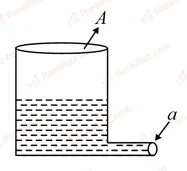
A light cylindrical vessel is kept on a horizontal surface. Area of the base is . A hole of cross-sectional area is made just at its bottom side. The minimum coefficient of friction necessary to prevent sliding the vessel due to the impact force of the emerging liquid is
None of these
When two soap bubbles of radii and () coalesce, the radius of curvature of common surface is:
A raindrop with radius R = 0.2 mm falls from a cloud at a height h = 2000 m above the ground. Assume that the drop is spherical throughout its fall and the force of buoyancy may be neglected, then the terminal speed attained by the raindrop is: [Density of water kg m and Density of air kg m, g = 10 m/s, Coefficient of viscosity of air = N s m]
250.6 m s
43.56 m s
4.94 m s
14.4 m s
Two spherical soap bubbles of radii and in vacuum combine under isothermal conditions. The resulting bubble has a radius equal to:
Two small drops of mercury each of radius coalesce to form a single large drop. The ratio of total surface energy before and after the change is:
JEE Advanced has set 33 Mechanical Properties of Fluids questions too. Mechanical Properties of Fluids JEE Advanced PYQs →
OTHER PHYSICS CHAPTERS