RankRizz

Archimedes' principle and floatation — JEE Main Previous Year Questions

Every JEE Main question on Archimedes' principle and floatation, one of the ideas inside Mechanical Properties of Fluids: 16 questions from 2008–2026, 7 of them in the last five years. Newest first, answer key on every one. Free to read.

Questions

16

Years asked

8

Since

2008

Of the chapter

8%

When JEE Main asked it

Questions on Archimedes' principle and floatation in each year it was asked.

20263
20252
20242
20204
20192
20131
20101
20081

Every Archimedes' principle and floatation question

1–16 OF 16 · NEWEST FIRST

JEE MAIN 2026Archimedes' principle and floatationTRANSCRIBED

A wooden block is floating in a liquid, 40\ \%\ of its volume is inside the liquid when the vessel is stationary. Percentage of volume immersed when the vessel moves upwards with an acceleration a=5 m.s−2a=5\ m.s^{-2} is

  1. A

    60\ \%\

  2. B

    40\ \%\

  3. C

    20\ \%\

  4. D

    33.33\%\

JEE MAIN 2026 · 24 JAN S2Archimedes' principle and floatationTRANSCRIBED

A cubical block of density ρb=600kg/m3\rho_{b}= 600kg/m^{3} floats in a liquid of density ρe=900kg/m3\rho_{e}= 900kg/m^{3}. If the height of block is H = 8.0 cm then height of the submerged part is ________ cm.

  1. A

    6.3

  2. B

    4.3

  3. C

    7.3

  4. D

    5.3

JEE MAIN 2026 · 02 APR S1Archimedes' principle and floatationTRANSCRIBED

A tub is filled with water and a wooden cube 10 cm × 10 cm × 10 cm is placed in the water. The wooden cube is found to float on the water with a part of it submerged in water. When a metal coin is placed on the wooden cube, the submerged part is increased by 3.87 cm. The mass of the metal coin is __________ gram. (Take water density as 1 g/cm3^3 and density of wood = 0.4 g/cm3^3)

JEE MAIN 2025 · 28 JAN S2Archimedes' principle and floatationTRANSCRIBED

A 400 g solid cube having an edge of length 10 cm floats in water. How much volume of the cube is outside the water ? (Given : density of water =1000kgm−3= 1000 kg m^{-3})

  1. A

    1400 cm3cm^{3}

  2. B

    600 cm3cm^{3}

  3. C

    4000 cm3cm^{3}

  4. D

    400 cm3cm^{3}

JEE MAIN 2025 · 08 APR S2Archimedes' principle and floatationTRANSCRIBED

A cube having a side of 10 cm with unknown mass and 200 gm mass were hung at two ends of an uniform rigid rod of 27 cm long. The rod along with masses was placed on a wedge keeping the distance between wedge point and 200 gm weight as 25 cm. Initially the masses were not at balance. A beaker is placed beneath the unknown mass and water is added slowly to it. At given point the masses were in balance and half volume of the unknown mass was inside the water. The unknown mass is _____ kg.

JEE MAIN 2024 · 08 APR S2Archimedes' principle and floatationTRANSCRIBED

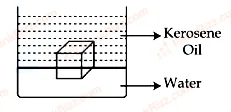
A cube of ice floats partly in water and partly in kerosene oil. The ratio of volume of ice immersed in water to that in kerosene oil (specific gravity of Kerosene oil =0.8= 0.8, specific gravity of ice =0.9= 0.9)

page2_img1
  1. A

    1 : 1

  2. B

    5 : 4

  3. C

    8 : 9

  4. D

    9 : 10

JEE MAIN 2024 · 09 APR S1Archimedes' principle and floatationTRANSCRIBED

A sphere of relative density σ\sigma and diameter DD has concentric cavity of diameter dd. The ratio of Dd\frac{D}{d}, if it just floats on water in a tank is :

  1. A

    (σ−2σ+2)1/3\left(\frac{\sigma - 2}{\sigma + 2}\right)^{1/3}

  2. B

    (σσ−1)1/3\left(\frac{\sigma}{\sigma - 1}\right)^{1/3}

  3. C

    (σ−1σ)1/3\left(\frac{\sigma - 1}{\sigma}\right)^{1/3}

  4. D

    (σ+1σ−1)1/3\left(\frac{\sigma + 1}{\sigma - 1}\right)^{1/3}

JEE MAIN 2020 · 05 SEP S1Archimedes' principle and floatationTRANSCRIBED

A hollow spherical shell at outer radius RR floats just submerged under the water surface. The inner radius of the shell is rr. If the specific gravity of the shell material is 278\frac{27}{8} with respect to water, the value of rr is:

  1. A

    89R\frac{8}{9}R

  2. B

    49R\frac{4}{9}R

  3. C

    23R\frac{2}{3}R

  4. D

    13R\frac{1}{3}R

JEE MAIN 2020 · 04 SEP S1Archimedes' principle and floatationTRANSCRIBED

An air bubble of radius 1 cm in water has an upward acceleration of 9.8 cms−2^{-2}. The density of water is 1 gm cm−3^{-3} and water offers negligible drag force on the bubble. The mass of the bubble is (g=980(g = 980 cm/s2)^2).

  1. A

    4.51 gm

  2. B

    3.15 gm

  3. C

    4.15 gm

  4. D

    1.52 gm

JEE MAIN 2020 · 08 JAN S1Archimedes' principle and floatationTRANSCRIBED

A leak proof cylinder of length 1 m, made of a metal which has very low coefficient of expansion is floating vertically in water at 0∘^\circC such that its height above the water surface is 20 cm. When the temperature of water is increased to 4∘^\circC, the height of the cylinder above the water surface becomes 21 cm. The density of water at T = 4∘^\circC, relative to the density at T = 0∘^\circC is close to:

  1. A

    1.26

  2. B

    1.04

  3. C

    1.01

  4. D

    1.03

JEE MAIN 2020 · 08 JAN S1Archimedes' principle and floatationTRANSCRIBED

Consider a solid sphere of radius RR and mass density ρ(r)=ρ0(1−r2R2)\rho(r) = \rho_0\left(1 - \frac{r^2}{R^2}\right), 0<r≤R0 < r \le R. The minimum density of a liquid in which it will float is:

  1. A

    ρ03\frac{\rho_0}{3}

  2. B

    ρ05\frac{\rho_0}{5}

  3. C

    2ρ05\frac{2\rho_0}{5}

  4. D

    2ρ03\frac{2\rho_0}{3}

JEE MAIN 2019 · 09 APR S2Archimedes' principle and floatationTRANSCRIBED

A wooden block floating in a bucket of water has 45\frac{4}{5} of its volume submerged. When certain amount of an oil is poured into the bucket, it is found that the block is just under the oil surface with half of its volume under water and half in oil. The density of oil relative to that of water is:

  1. A

    0.8

  2. B

    0.7

  3. C

    0.5

  4. D

    0.6

JEE MAIN 2019 · 10 APR S2Archimedes' principle and floatationTRANSCRIBED

A cubical block of side 0.5 m floats on water with 30% of its volume under water. What is the maximum weight that can be put on the block without fully submerging it under water?
[Take, density of water = 103^3 kg/m3^3]

  1. A

    87.5 kg

  2. B

    65.4 kg

  3. C

    30.1 kg

  4. D

    46.3 kg

JEE MAIN 2013 · 07 APR ONLINEArchimedes' principle and floatationTRANSCRIBED

A uniform cylinder of length L and mass M having cross-sectional area A is suspended, with its length vertical, from a fixed point by a massless spring, such that it is half submerged in a liquid of density σ\sigma at equilibrium position. The extension x0x_0 of the spring when it is in equilibrium is :

  1. A

    Mgk(1−LAσ2M)\frac{Mg}{k}\left(1 - \frac{LA\sigma}{2M}\right)

  2. B

    Mgk(1+LAσM)\frac{Mg}{k}\left(1 + \frac{LA\sigma}{M}\right)

  3. C

    Mgk\frac{Mg}{k}

  4. D

    Mgk(1−LAσM)\frac{Mg}{k}\left(1 - \frac{LA\sigma}{M}\right)

JEE MAIN 2010Archimedes' principle and floatationTRANSCRIBED

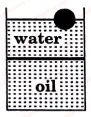
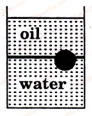
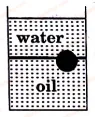
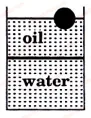
A ball is made of a material of density ρ\rho where ρoil<ρ<ρwater\rho_{\text{oil}} < \rho < \rho_{\text{water}} with ρoil\rho_{\text{oil}} and ρwater\rho_{\text{water}} representing the densities of oil and water, respectively. The oil and water are immiscible. If the above ball is in equilibrium in a mixture of this oil and water, which of the following pictures represents its equilibrium position?

  1. A
    Figure for JEE Main 2010 Physics question on Archimedes' principle and floatation
  2. B
    Figure for JEE Main 2010 Physics question on Archimedes' principle and floatation
  3. C
    Figure for JEE Main 2010 Physics question on Archimedes' principle and floatation
  4. D
    Figure for JEE Main 2010 Physics question on Archimedes' principle and floatation
JEE MAIN 2008Archimedes' principle and floatationTRANSCRIBED

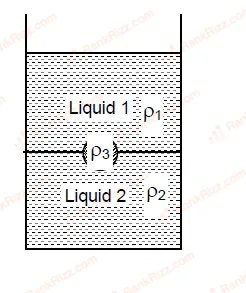
A jar filled with two non mixing liquids 1 and 2 having densities ρ1\rho_1 and ρ2\rho_2 respectively. A solid ball, made of a material of density ρ3\rho_3, is dropped in the jar. It comes to equilibrium in the position shown in the figure. Which of the following is true for ρ1,ρ2\rho_1, \rho_2 and ρ3\rho_3?Figure for JEE Main 2008 Physics question on Archimedes' principle and floatation

  1. A

    ρ3<ρ1<ρ2\rho_3 < \rho_1 < \rho_2

  2. B

    ρ1<ρ3<ρ2\rho_1 < \rho_3 < \rho_2

  3. C

    ρ1<ρ2<ρ3\rho_1 < \rho_2 < \rho_3

  4. D

    ρ3<ρ2<ρ1\rho_3 < \rho_2 < \rho_1