RankRizz

Mechanical Properties of Fluids — JEE Main Previous Year Questions

Every Mechanical Properties of Fluids question JEE Main has set from 2004–2026, grouped by the idea it tests rather than the order of the syllabus. 193 questions across 9 distinct ideas. Free to read, answer key on every one.

Questions

193

Distinct ideas

9

Share of marks

4.2%

Difficulty

MEDIUM

The ideas inside Mechanical Properties of Fluids

A chapter is not one subject — it is a handful of procedures the examiner reuses. These are the ones Mechanical Properties of Fluids questions actually test.

Every Mechanical Properties of Fluids question

141–160 OF 193 · NEWEST FIRST

JEE MAIN 2019 · 12 JAN S2Fluid pressure, Pascal's law and accelerated/rotating liquidsTRANSCRIBED

A long cylindrical vessel is half filled with a liquid. When the vessel is rotated about its own vertical axis, the liquid rises up near the wall. If the radius of vessel is 5 cm and its rotational speed is 2 rotations per second, then the difference in the heights between the center and the sides, in cm, will be:

  1. A

    0.4

  2. B

    2.0

  3. C

    1.2

  4. D

    0.1

JEE MAIN 2019 · 11 JAN S1Equation of continuity and Bernoulli's theoremTRANSCRIBED

A liquid of density ρ\rho is coming out of a hose pipe of radius aa with horizontal speed vv and hits a mesh. 50% of the liquid passes through the mesh unaffected. 25% loses all of its momentum and 25% comes back with the same speed. The resultant pressure on the mesh will be:

  1. A

    14ρv2\frac{1}{4}\rho v^2

  2. B

    34ρv2\frac{3}{4}\rho v^2

  3. C

    12ρv2\frac{1}{2}\rho v^2

  4. D

    ρv2\rho v^2

JEE MAIN 2019 · 09 JAN S2Speed of efflux and applications of Bernoulli's theoremTRANSCRIBED

The top of a water tank is open to air and its water level is maintained. It is giving out 0.74 m3^3 water per minute through a circular opening of 2 cm radius in its wall. The depth of the centre of the opening from the level of water in the tank is close to:

  1. A

    2.9 m

  2. B

    4.8 m

  3. C

    6.0 m

  4. D

    9.6 m

JEE MAIN 2019 · 12 APR S2Stokes' law and terminal velocityTRANSCRIBED

A solid sphere, of radius R acquires a terminal velocity v1v_1 when falling (due to gravity) through a viscous fluid having a coefficient of viscosity η\eta. The sphere is broken into 27 identical solid spheres. If each of these spheres acquires a terminal velocity, v2v_2, when falling through the same fluid, the ratio (v1v2)\left(\frac{v_1}{v_2}\right) equals:

  1. A

    19\frac{1}{9}

  2. B

    27

  3. C

    127\frac{1}{27}

  4. D

    9

JEE MAIN 2019 · 10 JAN S1Speed of efflux and applications of Bernoulli's theoremTRANSCRIBED

Water flows into a large tank with flat bottom at the rate of 10−410^{-4} m3^3s−1^{-1}. Water is also leaking out of a hole of area 1 cm2^2 at its bottom. If the height of the water in the tank remains steady then this height is:

  1. A

    5.1 cm

  2. B

    1.7 cm

  3. C

    2.9 cm

  4. D

    4 cm

JEE MAIN 2019 · 09 APR S1Angle of contact and capillary riseTRANSCRIBED

If 'M' is the mass of water that rises in a capillary tube of radius 'r', then mass of water which will rise in a capillary tube of radius '2r' is:

  1. A

    4 M

  2. B

    2 M

  3. C

    M2\frac{M}{2}

  4. D

    M

JEE MAIN 2019 · 09 APR S2Archimedes' principle and floatationTRANSCRIBED

A wooden block floating in a bucket of water has 45\frac{4}{5} of its volume submerged. When certain amount of an oil is poured into the bucket, it is found that the block is just under the oil surface with half of its volume under water and half in oil. The density of oil relative to that of water is:

  1. A

    0.8

  2. B

    0.7

  3. C

    0.5

  4. D

    0.6

JEE MAIN 2019 · 08 APR S1Viscosity, Poiseuille's equation and Reynolds numberTRANSCRIBED

Water from a pipe is coming at a rate of 100 liters per minute. If the radius of the pipe is 5 cm, the Reynolds number for the flow is of the order of: (density of water = 100 kg/m3^{3}, coefficient of viscosity of water = 1 mPa s)

  1. A

    10210^{2}

  2. B

    10410^{4}

  3. C

    10310^{3}

  4. D

    10610^{6}

JEE MAIN 2019 · 12 JAN S2Excess pressure in drops and bubblesTRANSCRIBED

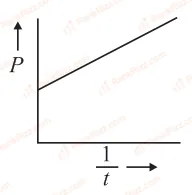
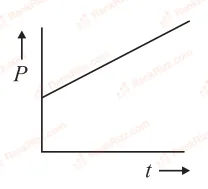
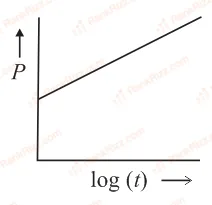
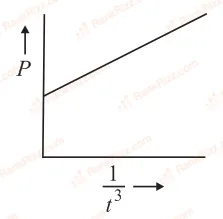
A soap bubble, blown by a mechanical pump at the mouth of a tube increases in volume with time at a constant rate. The graph that correctly depicts the time dependence of pressure inside the bubble is given by:

  1. A
    Figure for JEE Main 2019 Physics question on Excess pressure in drops and bubbles
  2. B
    Figure for JEE Main 2019 Physics question on Excess pressure in drops and bubbles
  3. C
    Figure for JEE Main 2019 Physics question on Excess pressure in drops and bubbles
  4. D
    Figure for JEE Main 2019 Physics question on Excess pressure in drops and bubbles
JEE MAIN 2019 · 10 APR S2Archimedes' principle and floatationTRANSCRIBED

A cubical block of side 0.5 m floats on water with 30% of its volume under water. What is the maximum weight that can be put on the block without fully submerging it under water?
[Take, density of water = 103^3 kg/m3^3]

  1. A

    87.5 kg

  2. B

    65.4 kg

  3. C

    30.1 kg

  4. D

    46.3 kg

JEE MAIN 2019 · 10 APR S2Equation of continuity and Bernoulli's theoremTRANSCRIBED

Water from a tap emerges vertically downwards with an initial speed of 1.0 ms−1^{-1}. The cross-sectional area of the tap is 10−410^{-4} m2^2. Assume that the pressure is constant throughout the stream of water and that the flow is streamlined. The cross-sectional area of the stream, 0.15 m below the tap would be:
(Take g = 10 ms−2^{-2})

  1. A

    1×10−51 \times 10^{-5} m2^2

  2. B

    5×10−45 \times 10^{-4} m2^2

  3. C

    2×10−52 \times 10^{-5} m2^2

  4. D

    5×10−55 \times 10^{-5} m2^2

JEE MAIN 2019 · 10 APR S2Fluid pressure, Pascal's law and accelerated/rotating liquidsTRANSCRIBED

A submarine experiences a pressure of 5.05×1065.05 \times 10^6 Pa at a depth of d1_1 in a sea. When it goes further to a depth of d2_2, it experiences a pressure of 8.08×1068.08 \times 10^6 Pa. Then d2_2 - d1_1 is approximately (density of water = 103^3 kg/m3^3 and acceleration due to gravity = 10 ms−2^{-2}):

  1. A

    600 m

  2. B

    500 m

  3. C

    300 m

  4. D

    400 m

JEE MAIN 2018 · 16 APR ONLINEExcess pressure in drops and bubblesTRANSCRIBED

A small soap bubble of radius 4 cm is trapped inside another bubble of radius 6 cm without any contact. Let P2_2 be the pressure inside the inner bubble and P0_0, the pressure outside the outer bubble. Radius of another bubble with pressure difference P2_2 - P0_0 between its inside and outside would be:

  1. A

    2.4 cm

  2. B

    12 cm

  3. C

    4.8 cm

  4. D

    6 cm

JEE MAIN 2018 · 15 APR S2Fluid pressure, Pascal's law and accelerated/rotating liquidsTRANSCRIBED

When an air bubble of radius r rises from the bottom to the surface of a lake, its radius becomes 5r4\frac{5r}{4}. Taking the atmospheric pressure to be equal to 10 m height of water column, the depth of the lake would approximately be (ignore the surface tension and the effect of temperature):

  1. A

    10.5 m

  2. B

    8.7 m

  3. C

    11.2 m

  4. D

    9.5 m

JEE MAIN 2018 · 15 APR S1Fluid pressure, Pascal's law and accelerated/rotating liquidsTRANSCRIBED

A thin uniform tube is bent into a circle of radius r in the vertical plane. Equal volumes of two immiscible liquids, whose densities are ρ1\rho_1 and ρ2\rho_2 (ρ1>ρ2\rho_1 > \rho_2) fill half the circle. The angle θ\theta between the radius vector passing through the common interface and the vertical is:

  1. A

    θ=tan⁡−1[π2(ρ1−ρ2ρ1+ρ2)]\theta = \tan^{-1}\left[\frac{\pi}{2}\left(\frac{\rho_1 - \rho_2}{\rho_1 + \rho_2}\right)\right]

  2. B

    θ=tan⁡−1π2(ρ1+ρ2ρ1−ρ2)\theta = \tan^{-1}\frac{\pi}{2}\left(\frac{\rho_1 + \rho_2}{\rho_1 - \rho_2}\right)

  3. C

    θ=tan⁡−1π(ρ1ρ2)\theta = \tan^{-1}\pi\left(\frac{\rho_1}{\rho_2}\right)

  4. D

    θ=tan⁡−1π2(ρ2ρ1)\theta = \tan^{-1}\frac{\pi}{2}\left(\frac{\rho_2}{\rho_1}\right)

JEE MAIN 2017 · 09 APR ONLINEViscosity, Poiseuille's equation and Reynolds numberTRANSCRIBED

Two tubes of radii r1r_1 and r2r_2 and lengths l1l_1 and l2l_2, respectively, are connected in series and a liquid flows through each of them in stream line conditions. P1P_1 and P2P_2 are pressure differences across the two tubes. If P2P_2 is 4P14P_1 and l2l_2 is l14\frac{l_1}{4} then the radius r2r_2 will be equal to:

  1. A

    4r14r_1

  2. B

    r1r_1

  3. C

    2r12r_1

  4. D

    r12\frac{r_1}{2}

JEE MAIN 2016 · 09 APR ONLINEStokes' law and terminal velocityTRANSCRIBED

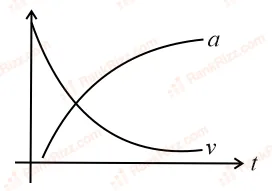
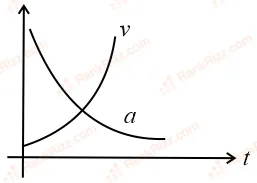
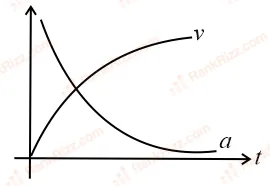
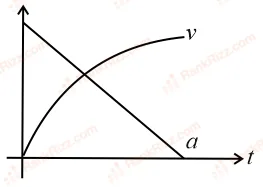
Which of the following option correctly describes the variation of the speed v and acceleration 'a' of a point mass falling vertically in a viscous medium that applies a force F=−kvF = -kv, where 'k' is a constant, on the body? (Graphs are schematic and not drawn to scale)

  1. A
    Figure for JEE Main 2016 Physics question on Stokes' law and terminal velocity
  2. B
    Figure for JEE Main 2016 Physics question on Stokes' law and terminal velocity
  3. C
    Figure for JEE Main 2016 Physics question on Stokes' law and terminal velocity
  4. D
    Figure for JEE Main 2016 Physics question on Stokes' law and terminal velocity
JEE MAIN 2016 · 09 APR ONLINESpeed of efflux and applications of Bernoulli's theoremTRANSCRIBED

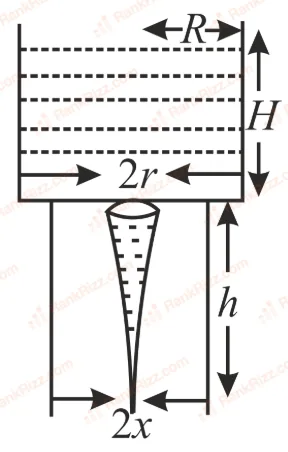
Consider a water jar of radius R that has water filled up to height H and is kept on a stand of height h. Through a hole of radius r (r << R) at its bottom, the water leaks out and the stream of water coming down towards the ground has a shape like a funnel as shown in the figure. If the radius of the cross-section of water stream when it hits the ground is x, then:

Figure for JEE Main 2016 Physics question on Speed of efflux and applications of Bernoulli's theorem
  1. A

    x=r(HH+h)1/4x = r\left(\frac{H}{H+h}\right)^{1/4}

  2. B

    x=r(HH+h)x = r\left(\frac{H}{H+h}\right)

  3. C

    x=r(HH+h)2x = r\left(\frac{H}{H+h}\right)^2

  4. D

    x=r(HH+h)1/2x = r\left(\frac{H}{H+h}\right)^{1/2}

JEE MAIN 2015 · 10 APR ONLINEExcess pressure in drops and bubblesTRANSCRIBED

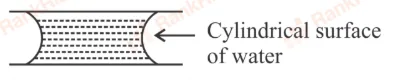
If two glass plates have water between them and are separated by very small distance (see the figure below), it is very difficult to pull them apart. It is because the water in between forms cylindrical surface on the side that gives rise to lower pressure in the water in comparison to atmosphere. If the radius of the cylindrical surface is R and surface tension of water is T then the pressure in water between the plates is lower by:

Figure for JEE Main 2015 Physics question on Excess pressure in drops and bubbles
  1. A

    TR\frac{T}{R}

  2. B

    T4R\frac{T}{4R}

  3. C

    4TR\frac{4T}{R}

  4. D

    2TR\frac{2T}{R}

JEE MAIN 2015 · 10 APR ONLINEViscosity, Poiseuille's equation and Reynolds numberTRANSCRIBED

If it takes 5 minutes to fill a 15 litre bucket from a water tap of diameter 2π\frac{2}{\sqrt{\pi}} cm then the Reynolds number for the flow is (density of water = 10310^3 kg/m3^3 and viscosity of water = 10−310^{-3} Pa.s) close to:

  1. A

    5500

  2. B

    550

  3. C

    1100

  4. D

    11,000