RankRizz
JEE MAIN 2020 · 08 JAN S2+4 / −1MEDIUMTRANSCRIBED

JEE Main 2020 Physics question — Fluid pressure, Pascal's law and accelerated/rotating liquids

Two liquids of densities ρ1\rho_1 and ρ2\rho_2 (ρ2=2ρ1\rho_2 = 2\rho_1) are filled up behind a square wall of side 10 m as shown in figure. Each liquid has a height of 5 m. The ratio of the forces due to these liquids exerted on upper part MN to that at the lower part NO is (Assume that the liquids are not mixing):
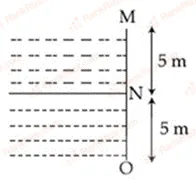
Figure for JEE Main 2020 Physics question on Fluid pressure, Pascal's law and accelerated/rotating liquids
SOLUTION

Let the width of the square wall be L=10 mL = 10\text{ m} and height of each layer be h=5 mh = 5\text{ m}.

Average pressure on the upper part MN: Pavg1=0+ρ1gh2=12ρ1ghP_{\text{avg1}} = \frac{0 + \rho_1 gh}{2} = \frac{1}{2}\rho_1 gh

Hydrostatic force on the upper part MN: FMN=Pavg1×(L×h)=12ρ1gh2LF_{\text{MN}} = P_{\text{avg1}} \times (L \times h) = \frac{1}{2}\rho_1 gh^2 L

Pressure at depth hh (interface point N) and depth 2h2h (bottom point O): PN=ρ1gh,PO=ρ1gh+ρ2ghP_N = \rho_1 gh, \quad P_O = \rho_1 gh + \rho_2 gh

Average pressure on the lower part NO: Pavg2=PN+PO2=ρ1gh+(ρ1gh+ρ2gh)2=ρ1gh+12ρ2ghP_{\text{avg2}} = \frac{P_N + P_O}{2} = \frac{\rho_1 gh + (\rho_1 gh + \rho_2 gh)}{2} = \rho_1 gh + \frac{1}{2}\rho_2 gh

Pavg2=ρ1gh+12(2ρ1)gh=2ρ1ghP_{\text{avg2}} = \rho_1 gh + \frac{1}{2}(2\rho_1)gh = 2\rho_1 gh

Hydrostatic force on the lower part NO: FNO=Pavg2×(L×h)=2ρ1gh2LF_{\text{NO}} = P_{\text{avg2}} \times (L \times h) = 2\rho_1 gh^2 L

FMNFNO=12ρ1gh2L2ρ1gh2L=14\frac{F_{\text{MN}}}{F_{\text{NO}}} = \frac{\frac{1}{2}\rho_1 gh^2 L}{2\rho_1 gh^2 L} = \frac{1}{4}

Tagged Fluid pressure, Pascal's law and accelerated/rotating liquids. Machine-assigned, so read it as a strong shortlist rather than a verdict.

SubjectPhysics
TopicFluid pressure, Pascal's law and accelerated/rotating liquids
TypeMultiple choice