Fluid pressure, Pascal's law and accelerated/rotating liquids — JEE Main Previous Year Questions
Every JEE Main question on Fluid pressure, Pascal's law and accelerated/rotating liquids, one of the ideas inside Mechanical Properties of Fluids: 24 questions from 2014–2026, 13 of them in the last five years. Newest first, answer key on every one. Free to read.
Questions on Fluid pressure, Pascal's law and accelerated/rotating liquids in each year it was asked.
20262
20253
20242
20234
20222
20212
20203
20192
20182
20142
Every Fluid pressure, Pascal's law and accelerated/rotating liquids question
1–20 OF 24 · NEWEST FIRST
JEE MAIN 2026 · 23 JAN S2Fluid pressure, Pascal's law and accelerated/rotating liquidsTRANSCRIBED
An air bubble of volume 2.9 cm3 rises from the bottom of a swimming pool of 5 m deep. At the bottom of the pool water temperature is 17oC. The volume of the bubble when it reaches the surface, where the water temperature is 27oC, is ______cm3. (g=10m/s2, density of water = 103kg/m3, and 1 atm pressure is 105 Pa)
JEE MAIN 2026 · 22 JAN S1Fluid pressure, Pascal's law and accelerated/rotating liquidsTRANSCRIBED
Given below are two statements:
Statement I : Pressure of a fluid is exerted only on a solid surface in contact as the fluid-pressure does not exist everywhere in a still fluid. Statement II: Excess potential energy of the molecules on the surface of a liquid, when compared to interior, results in surface tension.
In the light of the above statements, choose the correct answer from the options given below
JEE MAIN 2025 · 03 APR S2Fluid pressure, Pascal's law and accelerated/rotating liquidsTRANSCRIBED
Two cylindrical vessels of equal cross sectional area of 2 m2 contain water upto height 10 m and 6 m, respectively. If the vessels are connected at their bottom, then the work done by the force of gravity is: (Density of water is 103 kg/m3 and g=10 m/s2)
JEE MAIN 2025 · 29 JAN S1Fluid pressure, Pascal's law and accelerated/rotating liquidsTRANSCRIBED
In a hydraulic lift, the surface area of the input piston is 6cm2 and that of the output piston is 1500cm2. If 100 N force is applied to the input piston to raise the output piston by 20 cm, then the work done is _______ kJ.
JEE MAIN 2025 · 02 APR S1Fluid pressure, Pascal's law and accelerated/rotating liquidsTRANSCRIBED
A vessel with square cross-section and height of 6 m is vertically partitioned. A small window of 100 cm2 with hinged door is fitted at a depth of 3 m in the partition wall. One part of the vessel is filled completely with water and the other side is filled with the liquid having density 1.5×10³ kg/m3. What force one needs to apply on the hinged door so that it does not get opened?
JEE MAIN 2024 · 04 APR S2Fluid pressure, Pascal's law and accelerated/rotating liquidsTRANSCRIBED
Mercury is filled in a tube of radius 2 cm up to a height of 30 cm. The force exerted by mercury on the bottom of the tube is _____ N. (Given, atmospheric pressure =105 Nm−2, density of mercury =1.36×10⁴ kg m−3, g=10 m s−2, π=722)
JEE MAIN 2024 · 05 APR S2Fluid pressure, Pascal's law and accelerated/rotating liquidsTRANSCRIBED
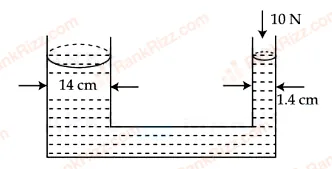
A hydraulic press containing water has two arms with diameters as mentioned in the figure. A force of 10 N is applied on the surface of water in the thinner arm. The force required to be applied on the surface of water in the thicker arm to maintain equilibrium of water is ______ N.
JEE MAIN 2023 · 08 APR S2Fluid pressure, Pascal's law and accelerated/rotating liquidsTRANSCRIBED
A hydraulic automobile lift is designed to lift vehicles of mass 5000 kg. The area of cross section of the cylinder carrying load is 250 cm2. The maximum pressure the smaller piston would have to bear is [Assume g=10 m s−2]
JEE MAIN 2023 · 06 APR S2Fluid pressure, Pascal's law and accelerated/rotating liquidsTRANSCRIBED
Given below are two statements: one is labelled as Assertion A and the other is labelled as Reason R Assertion A: When you squeeze one end of a tube to get toothpaste out from the other end, Pascal's principle is observed. Reason R: A change in the pressure applied to an enclosed incompressible fluid is transmitted undiminished to every portion of the fluid and to the walls of its container.
A
Both A and R are correct but R is NOT the correct explanation of A
B
A is not correct but R is correct
C
A is correct but R is not correct
D
Both A and R is correct and R is the correct explanation of A
JEE MAIN 2023 · 10 APR S1Fluid pressure, Pascal's law and accelerated/rotating liquidsTRANSCRIBED
Given below are two statements: Statement I: Pressure in a reservoir of water is same at all points at the same level of water. Statement II: The pressure applied to enclosed water is transmitted in all directions equally. In the light of the above statements, choose the correct answer from the options given below:
JEE MAIN 2023 · 08 APR S1Fluid pressure, Pascal's law and accelerated/rotating liquidsTRANSCRIBED
An air bubble of volume 1 cm3 rises from the bottom of a lake 40 m deep to the surface at a temperature of 12°C. The atmospheric pressure is 1×10⁵ Pa, the density of water is 1000 kg m−3 and g=10 m s−2. There is no difference of the temperature of water at the depth of 40 m and on the surface. The volume of air bubble when it reaches the surface will be
JEE MAIN 2022 · 27 JUL S1Fluid pressure, Pascal's law and accelerated/rotating liquidsTRANSCRIBED
Two cylindrical vessels of equal cross-sectional area 16 cm2 contain water upto heights 100 cm and 150 cm respectively. The vessels are interconnected so that the water levels in them become equal. The work done by the force of gravity during the process, is [Take density of water =103 kg m−3 and g=10 m s−2]
JEE MAIN 2022 · 29 JUL S2Fluid pressure, Pascal's law and accelerated/rotating liquidsTRANSCRIBED
A tube of length 50 cm is filled completely with an incompressible liquid of mass 250 g and closed at both ends. The tube is then rotated in horizontal plane about one of its ends with a uniform angular velocity xF rad s−1. If F be the force exerted by the liquid at the other end then the value of x will be _____
JEE MAIN 2021 · 16 MAR S1Fluid pressure, Pascal's law and accelerated/rotating liquidsTRANSCRIBED
The pressure acting on a submarine is 3×10⁵ Pa at a certain depth. If the depth is doubled, the percentage increase in the pressure acting on the submarine would be: (Assume that atmospheric pressure is 1×10⁵ Pa, density of water is 103 kg m−3, g = 10 ms−2)
JEE MAIN 2021 · 24 FEB S1Fluid pressure, Pascal's law and accelerated/rotating liquidsTRANSCRIBED
A hydraulic press can lift 100 kg when a mass m is placed on the smaller piston. It can lift ______ kg when the diameter of the larger piston is increased by 4 times and that of the smaller piston is decreased by 4 times keeping the same mass m on the smaller piston.
JEE MAIN 2020 · 08 JAN S2Fluid pressure, Pascal's law and accelerated/rotating liquidsTRANSCRIBED
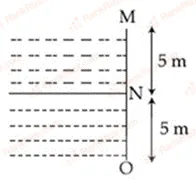
Two liquids of densities ρ1 and ρ2 (ρ2=2ρ1) are filled up behind a square wall of side 10 m as shown in figure. Each liquid has a height of 5 m. The ratio of the forces due to these liquids exerted on upper part MN to that at the lower part NO is (Assume that the liquids are not mixing):
JEE MAIN 2020 · 02 SEP S1Fluid pressure, Pascal's law and accelerated/rotating liquidsTRANSCRIBED
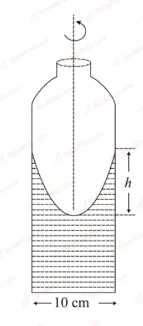
A cylindrical vessel containing a liquid is rotated about its axis so that the liquid rises at its sides as shown in the figure. The radius of vessel is 5 cm and the angular speed of rotation is ω rad s−1. The difference in the height, h (in cm) of liquid at the Centre of vessel and at the sides of the vessel will be:
JEE MAIN 2020 · 04 SEP S2Fluid pressure, Pascal's law and accelerated/rotating liquidsTRANSCRIBED
Two identical cylindrical vessels are kept on the ground and each contain the same liquid of density d. The area of the base of both vessels is S but the height of liquid in one vessel is x1 and in the other x2. When both cylinders are connected through a pipe of negligible volume very close to the bottom, the liquid flows from one vessel to the other until it comes to equilibrium at a new height. The change in energy of the system in the process is:
JEE MAIN 2019 · 12 JAN S2Fluid pressure, Pascal's law and accelerated/rotating liquidsTRANSCRIBED
A long cylindrical vessel is half filled with a liquid. When the vessel is rotated about its own vertical axis, the liquid rises up near the wall. If the radius of vessel is 5 cm and its rotational speed is 2 rotations per second, then the difference in the heights between the center and the sides, in cm, will be:
JEE MAIN 2019 · 10 APR S2Fluid pressure, Pascal's law and accelerated/rotating liquidsTRANSCRIBED
A submarine experiences a pressure of 5.05×10⁶ Pa at a depth of d1 in a sea. When it goes further to a depth of d2, it experiences a pressure of 8.08×10⁶ Pa. Then d2 - d1 is approximately (density of water = 103 kg/m3 and acceleration due to gravity = 10 ms−2):