An air bubble of radius lies at a depth of below the free surface of a liquid of density If the pressure inside the bubble is greater than the atmospheric pressure, then the surface tension of the liquid in SI unit is
- A
0.1
- B
0.05
- C
0.02
- D
0.25
Every JEE Main question on Excess pressure in drops and bubbles, one of the ideas inside Mechanical Properties of Fluids: 20 questions from 2004–2025, 12 of them in the last five years. Newest first, answer key on every one. Free to read.
Questions
20
Years asked
11
Since
2004
Of the chapter
10%
Questions on Excess pressure in drops and bubbles in each year it was asked.
1–20 OF 20 · NEWEST FIRST
An air bubble of radius lies at a depth of below the free surface of a liquid of density If the pressure inside the bubble is greater than the atmospheric pressure, then the surface tension of the liquid in SI unit is
0.1
0.05
0.02
0.25
Two soap bubbles of radius 2 cm and 4 cm , respectively, are in contact with each other. The radius of curvature of the common surface, in cm , is ________ .
The excess pressure inside a soap bubble A in air is half the excess pressure inside another soap bubble B in air. If the volume of the bubble A is times the volume of the bubble B, then the value of n is ________.
An air bubble of radius 1.0 mm is observed at a depth of 20 cm below the free surface of a liquid having surface tension and density . The difference between pressure inside the bubble and atmospheric pressure is _____
The excess pressure inside a soap bubble is thrice the excess pressure inside a second soap bubble. The ratio between the volume of the first and the second bubble is:
Pressure inside a soap bubble is greater than the pressure outside by an amount : (given : = Radius of bubble, = Surface tension of bubble)
A liquid column of height balances excess pressure of a soap bubble of certain radius. If density of liquid is and surface tension of soap solution is , then diameter of the soap bubble is ______ cm. (if )
There is an air bubble of radius mm in a liquid of surface tension N m and density kg m at a depth of cm below the free surface. The amount by which the pressure inside the bubble is greater than the atmospheric pressure is _____ Pa ( m s).
A spherical soap bubble of radius 3 cm is formed inside another spherical soap bubble of radius 6 cm. If the internal pressure of the smaller bubble of radius 3 cm in the above system is equal to the internal pressure of another single soap bubble of radius cm. The value of is _____
When two soap bubbles of radii and () coalesce, the radius of curvature of common surface is:
Two spherical soap bubbles of radii and in vacuum combine under isothermal conditions. The resulting bubble has a radius equal to:
A soap bubble of the radius 3 cm is formed inside another soap bubble of radius 6 cm. The radius of an equivalent soap bubble that has the same excess pressure as inside the smaller bubble with respect to the atmospheric pressure is _________ cm.
Pressure inside two soap bubbles are 1.01 and 1.02 atmosphere, respectively. The ratio of their volumes is:
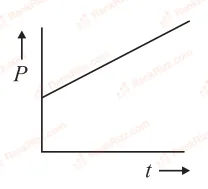
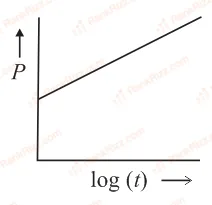
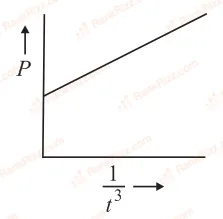
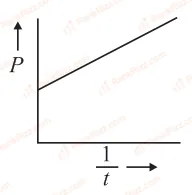
A soap bubble, blown by a mechanical pump at the mouth of a tube increases in volume with time at a constant rate. The graph that correctly depicts the time dependence of pressure inside the bubble is given by:


A small soap bubble of radius 4 cm is trapped inside another bubble of radius 6 cm without any contact. Let P be the pressure inside the inner bubble and P, the pressure outside the outer bubble. Radius of another bubble with pressure difference P - P between its inside and outside would be:
2.4 cm
12 cm
4.8 cm
6 cm
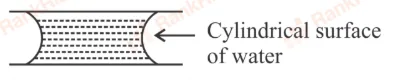
If two glass plates have water between them and are separated by very small distance (see the figure below), it is very difficult to pull them apart. It is because the water in between forms cylindrical surface on the side that gives rise to lower pressure in the water in comparison to atmosphere. If the radius of the cylindrical surface is R and surface tension of water is T then the pressure in water between the plates is lower by:

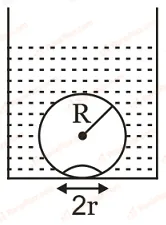
On heating water, bubbles being formed at the bottom of the vessel detach and rise. Take the bubbles to be spheres of radius R and making a circular contact of radius r with the bottom of the vessel. If , and the surface tension of water is T, value of r just before bubbles detach is: (density of water is )

An air bubble of radius 0.1 cm is in a liquid having surface tension 0.06 N/m and density kg/m. The pressure inside the bubble is 1100 Nm greater than the atmospheric pressure. At what depth is the bubble below the surface of the liquid? ( ms)
0.1 m
0.15 m
0.20 m
0.25 m
Two soap bubbles coalesce to form a single bubble. If V is the subsequent change in volume of contained air and S change in total surface area, T is the surface tension and P atmospheric pressure, then which of the following relation is correct?
4PV + 3ST = 0
3PV + 4ST = 0
2PV + 3ST = 0
3PV + 2ST = 0
If two soap bubbles of different radii are connected by a tube,
air flows from the bigger bubble to the smaller bubble till the sizes are interchanged.
air flows from bigger bubble to the smaller bubble till the sizes are interchanged
air flows from the smaller bubble to the bigger.
there is no flow of air.
RELATED MECHANICAL PROPERTIES OF FLUIDS TOPICS