RankRizz

Mechanical Properties of Fluids — JEE Main Previous Year Questions

Every Mechanical Properties of Fluids question JEE Main has set from 2004–2026, grouped by the idea it tests rather than the order of the syllabus. 193 questions across 9 distinct ideas. Free to read, answer key on every one.

Questions

193

Distinct ideas

9

Share of marks

4.2%

Difficulty

MEDIUM

The ideas inside Mechanical Properties of Fluids

A chapter is not one subject — it is a handful of procedures the examiner reuses. These are the ones Mechanical Properties of Fluids questions actually test.

Every Mechanical Properties of Fluids question

61–80 OF 193 · NEWEST FIRST

JEE MAIN 2024 · 29 JAN S1Speed of efflux and applications of Bernoulli's theoremTRANSCRIBED

In a test experiment on a model aeroplane in wind tunnel, the flow speeds on the upper and lower surfaces of the wings are 7070 m s−1^{-1} and 6565 m s−1^{-1} respectively. If the wing area is 22 m2^2, the lift of the wing is _______ N. (Given density of air =1.2= 1.2 kg m−3^{-3})

JEE MAIN 2024 · 30 JAN S2Surface tension and surface energyTRANSCRIBED

A big drop is formed by coalescing 1000 small identical drops of water. If E1E_1 be the total surface energy of 1000 small drops of water and E2E_2 be the surface energy of single big drop of water, the E1:E2E_1 : E_2 is x:1x : 1, where xx = ________.

JEE MAIN 2024 · 04 APR S2Fluid pressure, Pascal's law and accelerated/rotating liquidsTRANSCRIBED

Mercury is filled in a tube of radius 22 cm up to a height of 3030 cm. The force exerted by mercury on the bottom of the tube is _____ N. (Given, atmospheric pressure =105= 10^5 Nm−2^{-2}, density of mercury =1.36×104= 1.36 \times 10^4 kg m−3^{-3}, g=10g = 10 m s−2^{-2}, π=227\pi = \frac{22}{7})

JEE MAIN 2024 · 05 APR S2Fluid pressure, Pascal's law and accelerated/rotating liquidsTRANSCRIBED
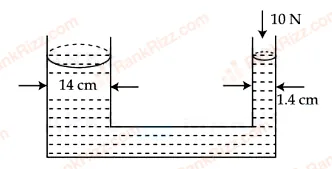
page4_img1


A hydraulic press containing water has two arms with diameters as mentioned in the figure. A force of 1010 N is applied on the surface of water in the thinner arm. The force required to be applied on the surface of water in the thicker arm to maintain equilibrium of water is ______ N.

JEE MAIN 2024 · 06 APR S1Surface tension and surface energyTRANSCRIBED

A big drop is formed by coalescing 1000 small droplets of water. The ratio of surface energy of 1000 droplets to that of energy of big drop is 10x\frac{10}{x}. The value of xx is __________

JEE MAIN 2024 · 08 APR S1Excess pressure in drops and bubblesTRANSCRIBED

A liquid column of height 0.04 cm0.04 \text{ cm} balances excess pressure of a soap bubble of certain radius. If density of liquid is 8×10³ kg m−38 \times 10^3 \text{ kg m}^{-3} and surface tension of soap solution is 0.28 Nm−10.28 \text{ Nm}^{-1}, then diameter of the soap bubble is ______ cm. (if g=10 m s−2g = 10 \text{ m s}^{-2})

JEE MAIN 2024 · 08 APR S2Stokes' law and terminal velocityTRANSCRIBED

Small water droplets of radius 0.01 mm are formed in the upper atmosphere and falling with a terminal velocity of 10 cm/s. Due to condensation, if 8 such droplets are coalesced and formed a larger drop, the new terminal velocity will be _____ cm/s.

JEE MAIN 2024 · 04 APR S1Surface tension and surface energyTRANSCRIBED

A soap bubble is blown to a diameter of 7 cm. 36960 erg of work is done in blowing it further. If surface tension of soap solution is 40 dyne/cm then the new radius is ______ cm. (Take π=227\pi = \frac{22}{7})

JEE MAIN 2023 · 29 JAN S1Surface tension and surface energyTRANSCRIBED

Surface tension of a soap bubble is 2.0×10−22.0 \times 10^{-2} N m−1^{-1}. Work done to increase the radius of soap bubble from 3.53.5 cm to 77 cm will be: [Take π=227\pi = \frac{22}{7}]

  1. A

    0.72×10−40.72 \times 10^{-4} J

  2. B

    5.76×10−45.76 \times 10^{-4} J

  3. C

    18.48×10−418.48 \times 10^{-4} J

  4. D

    9.24×10−49.24 \times 10^{-4} J

JEE MAIN 2023 · 11 APR S2Stokes' law and terminal velocityTRANSCRIBED

Eight equal drops of water are falling through air with a steady speed of 10 cm s−1^{-1}. If the drops coalesce, the new velocity is:-

  1. A

    16 cm s−1^{-1}

  2. B

    40 cm s−1^{-1}

  3. C

    5 cm s−1^{-1}

  4. D

    10 cm s−1^{-1}

JEE MAIN 2023 · 31 JAN S1Surface tension and surface energyTRANSCRIBED

If 1000 droplets of water of surface tension 0.07 N m−1^{-1}, having same radius 1 mm each, combine to form a single drop. In the process the released surface energy is- (Take π=227\pi = \dfrac{22}{7})

  1. A

    7.92×10−67.92 \times 10^{-6} J

  2. B

    7.92×10−47.92 \times 10^{-4} J

  3. C

    9.68×10−49.68 \times 10^{-4} J

  4. D

    8.8×10−58.8 \times 10^{-5} J

JEE MAIN 2023 · 29 JAN S2Speed of efflux and applications of Bernoulli's theoremTRANSCRIBED

A fully loaded boeing aircraft has a mass of 5.4×1055.4 \times 10^5 kg. Its total wing area is 500500 m2^2. It is in level flight with a speed of 10801080 km h−1^{-1}. If the density of air ρ\rho is 1.21.2 kg m−3^{-3}, the fractional increase in the speed of the air on the upper surface of the wing relative to the lower surface in percentage will be (g=10g = 10 m s−2^{-2})

  1. A

    1616

  2. B

    66

  3. C

    88

  4. D

    1010

JEE MAIN 2023 · 13 APR S2Stokes' law and terminal velocityTRANSCRIBED

Given below are two statements: one is labelled as Assertion A and the other is labelled as Reason R
Assertion A : A spherical body of radius (5±0.1)(5 \pm 0.1) mm having a particular density is falling through a liquid of constant density. The percentage error in the calculation of its terminal velocity is 4%.
Reason R : The terminal velocity of the spherical body falling through the liquid is inversely proportional to its radius. In the light of the above statements, choose the correct answer from the options given below

  1. A

    Both A and R are true and R is the correct explanation of A

  2. B

    Both A and R are true but R is NOT the correct explanation of A

  3. C

    A is true but R is false

  4. D

    A is false but R is true

JEE MAIN 2023 · 08 APR S2Fluid pressure, Pascal's law and accelerated/rotating liquidsTRANSCRIBED

A hydraulic automobile lift is designed to lift vehicles of mass 5000 kg. The area of cross section of the cylinder carrying load is 250 cm2^2. The maximum pressure the smaller piston would have to bear is [Assume g=10g = 10 m s−2^{-2}]

  1. A

    20×10620 \times 10^6 Pa

  2. B

    2×1052 \times 10^5 Pa

  3. C

    200×106200 \times 10^6 Pa

  4. D

    2×1062 \times 10^6 Pa

JEE MAIN 2023 · 06 APR S2Fluid pressure, Pascal's law and accelerated/rotating liquidsTRANSCRIBED

Given below are two statements: one is labelled as Assertion A and the other is labelled as Reason R
Assertion A: When you squeeze one end of a tube to get toothpaste out from the other end, Pascal's principle is observed.
Reason R: A change in the pressure applied to an enclosed incompressible fluid is transmitted undiminished to every portion of the fluid and to the walls of its container.

  1. A

    Both A and R are correct but R is NOT the correct explanation of A

  2. B

    A is not correct but R is correct

  3. C

    A is correct but R is not correct

  4. D

    Both A and R is correct and R is the correct explanation of A

JEE MAIN 2023 · 01 FEB S1Surface tension and surface energyTRANSCRIBED

A mercury drop of radius 10−310^{-3} m is broken into 125 equal size droplets. Surface tension of mercury is 0.45 N m−1^{-1}. The gain in surface energy is:

  1. A

    2.26×10−52.26 \times 10^{-5} J

  2. B

    28×10−528 \times 10^{-5} J

  3. C

    17.5×10−517.5 \times 10^{-5} J

  4. D

    5×10−55 \times 10^{-5} J

JEE MAIN 2023 · 10 APR S1Fluid pressure, Pascal's law and accelerated/rotating liquidsTRANSCRIBED

Given below are two statements:
Statement I: Pressure in a reservoir of water is same at all points at the same level of water.
Statement II: The pressure applied to enclosed water is transmitted in all directions equally.
In the light of the above statements, choose the correct answer from the options given below:

  1. A

    Both Statement I and Statement II are false

  2. B

    Statement I is true but Statement II is false

  3. C

    Statement I is false but Statement II is true

  4. D

    Both Statement I and Statement II are true

JEE MAIN 2023 · 06 APR S1Stokes' law and terminal velocityTRANSCRIBED

A small ball of mass MM and density ρ\rho is dropped in a viscous liquid of density ρ0\rho_0. After some time, the ball falls with a constant velocity. What is the viscous force on the ball?

  1. A

    F=Mg(1+ρ0ρ)F = Mg\left(1 + \dfrac{\rho_0}{\rho}\right)

  2. B

    F=Mg(1+ρρ0)F = Mg\left(1 + \dfrac{\rho}{\rho_0}\right)

  3. C

    F=Mg(1−ρ0ρ)F = Mg\left(1 - \dfrac{\rho_0}{\rho}\right)

  4. D

    F=Mg(1±ρρ0)F = Mg(1 \pm \rho\rho_0)

JEE MAIN 2023 · 30 JAN S1Angle of contact and capillary riseTRANSCRIBED

The height of liquid column raised in a capillary tube of certain radius when dipped in liquid AA vertically is, 55 cm. If the tube is dipped in a similar manner in another liquid BB of surface tension and density double the values of liquid AA, the height of liquid column raised in liquid B would be ______ m.

  1. A

    0.200.20

  2. B

    0.50.5

  3. C

    0.050.05

  4. D

    0.100.10

JEE MAIN 2023 · 13 APR S1Equation of continuity and Bernoulli's theoremTRANSCRIBED

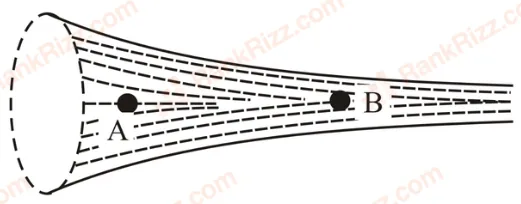
The figure shows a liquid of a given density flowing steadily in a horizontal tube of a varying cross-section. Cross-sectional area at A is 1.51.5 cm2^2, and that at B is 2525 mm2^2, if the speed of liquid at B is 6060 cm s−1^{-1} then (PA−PB)(P_A - P_B) is
(Given PAP_A and PBP_B are liquid pressures at A and B points. Density ρ=1000\rho = 1000 kg m−3^{-3}. A and B are on the axis of tube)

Figure for JEE Main 2023 Physics question on Equation of continuity and Bernoulli's theorem
  1. A

    135 Pa135 \ Pa

  2. B

    27 Pa27 \ Pa

  3. C

    175 Pa175 \ Pa

  4. D

    36 Pa36 \ Pa