RankRizz

Mechanical Properties of Fluids — JEE Main Previous Year Questions

Every Mechanical Properties of Fluids question JEE Main has set from 2004–2026, grouped by the idea it tests rather than the order of the syllabus. 193 questions across 9 distinct ideas. Free to read, answer key on every one.

Questions

193

Distinct ideas

9

Share of marks

4.2%

Difficulty

MEDIUM

The ideas inside Mechanical Properties of Fluids

A chapter is not one subject — it is a handful of procedures the examiner reuses. These are the ones Mechanical Properties of Fluids questions actually test.

Every Mechanical Properties of Fluids question

161–180 OF 193 · NEWEST FIRST

JEE MAIN 2014 · 06 APR OFFLINEFluid pressure, Pascal's law and accelerated/rotating liquidsTRANSCRIBED

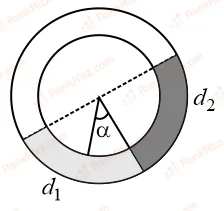
There is a circular tube in a vertical plane. Two liquids which do not mix and of densities d1d_1 and d2d_2 are filled in the tube. Each liquid subtends 90° angle at centre. Radius joining their interface makes an angle α\alpha with vertical. Ratio d1d2\frac{d_1}{d_2} is:

Figure for JEE Main 2014 Physics question on Fluid pressure, Pascal's law and accelerated/rotating liquids
  1. A

    1+sin⁡α1−sin⁡α\frac{1+\sin\alpha}{1-\sin\alpha}

  2. B

    1+cos⁡α1−cos⁡α\frac{1+\cos\alpha}{1-\cos\alpha}

  3. C

    1+tan⁡α1−tan⁡α\frac{1+\tan\alpha}{1-\tan\alpha}

  4. D

    1+sin⁡α1−cos⁡α\frac{1+\sin\alpha}{1-\cos\alpha}

JEE MAIN 2014 · 09 APR ONLINEAngle of contact and capillary riseTRANSCRIBED

A capillary tube is immersed vertically in water and the height of the water column is xx. When this arrangement is taken into a mine of depth d, the height of the water column is yy. If R is the radius of earth, the ratio xy\frac{x}{y} is:

  1. A

    (R−dR+d)\left(\frac{R-d}{R+d}\right)

  2. B

    (R+dR−d)\left(\frac{R+d}{R-d}\right)

  3. C

    (1−2dR)\left(1 - \frac{2d}{R}\right)

  4. D

    (1−dR)\left(1 - \frac{d}{R}\right)

JEE MAIN 2014 · 19 APR ONLINEViscosity, Poiseuille's equation and Reynolds numberTRANSCRIBED

The velocity of water in a river is 18 km h−1^{-1} near the surface. If the river is 5 m deep, find the shearing stress between the horizontal layers of water. The coefficient of viscosity of water = 10−210^{-2} poise.

  1. A

    10−410^{-4} N m−2^{-2}

  2. B

    10−310^{-3} N m−2^{-2}

  3. C

    10−210^{-2} N m−2^{-2}

  4. D

    10−110^{-1} N m−2^{-2}

JEE MAIN 2014 · 06 APR OFFLINEExcess pressure in drops and bubblesTRANSCRIBED

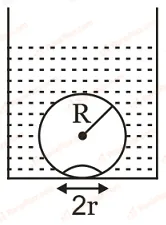
On heating water, bubbles being formed at the bottom of the vessel detach and rise. Take the bubbles to be spheres of radius R and making a circular contact of radius r with the bottom of the vessel. If r≪Rr \ll R, and the surface tension of water is T, value of r just before bubbles detach is: (density of water is ρw\rho_w)

Figure for JEE Main 2014 Physics question on Excess pressure in drops and bubbles
  1. A

    R22ρwg3TR^2\sqrt{\frac{2\rho_w g}{3T}}

  2. B

    R2ρwg6TR^2\sqrt{\frac{\rho_w g}{6T}}

  3. C

    R2ρwgTR^2\sqrt{\frac{\rho_w g}{T}}

  4. D

    R23ρwgTR^2\sqrt{\frac{3\rho_w g}{T}}

JEE MAIN 2014 · 11 APR ONLINESpeed of efflux and applications of Bernoulli's theoremTRANSCRIBED

A tank with a small hole at the bottom has been filled with water and kerosene (specific gravity 0.8). The height of water is 3 m and that of kerosene is 2 m. When the hole is opened, the velocity of fluid coming out from it is nearly: (take g = 10 ms−2^{-2} and density of water = 10310^3 kg m−3^{-3})

  1. A

    10.7 ms−1^{-1}

  2. B

    9.6 ms−1^{-1}

  3. C

    8.5 ms−1^{-1}

  4. D

    7.6 ms−1^{-1}

JEE MAIN 2014 · 12 APR ONLINESpeed of efflux and applications of Bernoulli's theoremTRANSCRIBED

A cylindrical vessel of cross-section A contains water to a height h. There is a hole in the bottom of radius 'a'. The time in which it will be emptied is:

  1. A

    2Aπa2hg\frac{2A}{\pi a^2}\sqrt{\frac{h}{g}}

  2. B

    2Aπa2hg\frac{\sqrt{2}A}{\pi a^2}\sqrt{\frac{h}{g}}

  3. C

    22Aπa2hg\frac{2\sqrt{2}A}{\pi a^2}\sqrt{\frac{h}{g}}

  4. D

    A2πa2hg\frac{A}{\sqrt{2}\pi a^2}\sqrt{\frac{h}{g}}

JEE MAIN 2014 · 19 APR ONLINESurface tension and surface energyTRANSCRIBED

A large number of liquid drops each of radius r coalesce to form a single drop of the radius R. The energy released in the process is converted into kinetic energy of the big drop so formed. The speed of the big drop is (given surface tension of the liquid T, density ρ\rho)

  1. A

    2Tρ(1r−1R)\sqrt{\frac{2T}{\rho}\left(\frac{1}{r} - \frac{1}{R}\right)}

  2. B

    6Tρ(1r−1R)\sqrt{\frac{6T}{\rho}\left(\frac{1}{r} - \frac{1}{R}\right)}

  3. C

    4Tρ(1r−1R)\sqrt{\frac{4T}{\rho}\left(\frac{1}{r} - \frac{1}{R}\right)}

  4. D

    Tρ(1r−1R)\sqrt{\frac{T}{\rho}\left(\frac{1}{r} - \frac{1}{R}\right)}

JEE MAIN 2014 · 06 APR OFFLINEFluid pressure, Pascal's law and accelerated/rotating liquidsTRANSCRIBED

An open glass tube is immersed in mercury in such a way that a length of 8 cm extends above the mercury level. The open end of the tube is then closed and sealed and the tube is raised vertically up by additional 46 cm. What will be length of the air column above mercury in the tube now? (Atmospheric pressure = 76 cm of Hg)

  1. A

    16 cm

  2. B

    22 cm

  3. C

    38 cm

  4. D

    6 cm

JEE MAIN 2014 · 11 APR ONLINEExcess pressure in drops and bubblesTRANSCRIBED

An air bubble of radius 0.1 cm is in a liquid having surface tension 0.06 N/m and density 10310^3 kg/m3^3. The pressure inside the bubble is 1100 Nm−2^{-2} greater than the atmospheric pressure. At what depth is the bubble below the surface of the liquid? (g=9.8g = 9.8 ms−2^{-2})

  1. A

    0.1 m

  2. B

    0.15 m

  3. C

    0.20 m

  4. D

    0.25 m

JEE MAIN 2014 · 12 APR ONLINEExcess pressure in drops and bubblesTRANSCRIBED

Two soap bubbles coalesce to form a single bubble. If V is the subsequent change in volume of contained air and S change in total surface area, T is the surface tension and P atmospheric pressure, then which of the following relation is correct?

  1. A

    4PV + 3ST = 0

  2. B

    3PV + 4ST = 0

  3. C

    2PV + 3ST = 0

  4. D

    3PV + 2ST = 0

JEE MAIN 2014 · 19 APR ONLINESpeed of efflux and applications of Bernoulli's theoremTRANSCRIBED

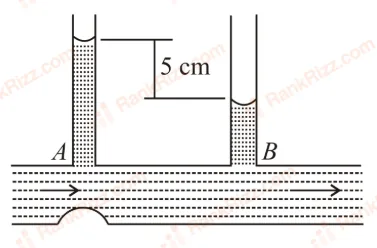
In the diagram shown, the difference in the two tubes of the manometer is 5 cm, the cross-section of the tube at A and B is 6 mm2^2 and 10 mm2^2 respectively. The rate at which water flows through the tube is (g = 10 m s−2^{-2})

Figure for JEE Main 2014 Physics question on Speed of efflux and applications of Bernoulli's theorem
  1. A

    7.5 cc s−1^{-1}

  2. B

    12.5 cc s−1^{-1}

  3. C

    8.0 cc s−1^{-1}

  4. D

    10.0 cc s−1^{-1}

JEE MAIN 2013 · 07 APR ONLINEArchimedes' principle and floatationTRANSCRIBED

A uniform cylinder of length L and mass M having cross-sectional area A is suspended, with its length vertical, from a fixed point by a massless spring, such that it is half submerged in a liquid of density σ\sigma at equilibrium position. The extension x0x_0 of the spring when it is in equilibrium is :

  1. A

    Mgk(1−LAσ2M)\frac{Mg}{k}\left(1 - \frac{LA\sigma}{2M}\right)

  2. B

    Mgk(1+LAσM)\frac{Mg}{k}\left(1 + \frac{LA\sigma}{M}\right)

  3. C

    Mgk\frac{Mg}{k}

  4. D

    Mgk(1−LAσM)\frac{Mg}{k}\left(1 - \frac{LA\sigma}{M}\right)

JEE MAIN 2013 · 25 APR ONLINEStokes' law and terminal velocityTRANSCRIBED

In an experiment, a small steel ball falls through a liquid at a constant speed of 10 cm/s. If the steel ball is pulled upward with a force equal to twice its effective weight, how fast will it move upward?

  1. A

    5 cm/s

  2. B

    Zero

  3. C

    10 cm/s

  4. D

    20 cm/s

JEE MAIN 2013 · 07 APR ONLINESurface tension and surface energyTRANSCRIBED

Assume that a drop of a liquid evaporates by a decrease in its surface energy so that its temperature remains unchanged. The minimum radius of the drop for this to be possible is. (The surface tension is T, the density of the liquid is ρ\rho and L is its latent heat of vaporisation.)

  1. A

    TρL\frac{T}{\rho L}

  2. B

    2TρL\frac{2T}{\rho L}

  3. C

    ρLT\frac{\rho L}{T}

  4. D

    TρL\sqrt{\frac{T}{\rho L}}

JEE MAIN 2013 · 09 APR ONLINEAngle of contact and capillary riseTRANSCRIBED

This question has Statement-1 and Statement-2. Of the four choices given after the Statements, choose the one that best describes the two Statements.
Statement-1: A capillary is dipped in a liquid and liquid rises to a height h in it. As the temperature of the liquid is raised, the height h increases (if the density of the liquid and the angle of contact remain the same).
Statement-2: Surface tension of a liquid decreases with the rise in its temperature.

  1. A

    Statement-1 is true, Statement-2 is true; Statement-2 is not the correct explanation for Statement-1.

  2. B

    Statement-1 is false, Statement-2 is true.

  3. C

    Statement-1 is true, Statement-2 is false.

  4. D

    Statement-1 is true, Statement-2 is true; Statement-2 is the correct explanation for Statement-1.

JEE MAIN 2013 · 22 APR ONLINESpeed of efflux and applications of Bernoulli's theoremTRANSCRIBED

Air of density 1.2 kg m−3^{-3} is blowing across the horizontal wings of an aeroplane in such a way that its speeds above and below the wings are 150 ms−1^{-1} and 100 ms−1^{-1}, respectively. The pressure difference between the upper and lower sides of the wings, is :

  1. A

    60 Nm−2^{-2}

  2. B

    180 Nm−2^{-2}

  3. C

    7500 Nm−2^{-2}

  4. D

    12500 Nm−2^{-2}

JEE MAIN 2013 · 23 APR ONLINEAngle of contact and capillary riseTRANSCRIBED

Wax is coated on the inner wall of a capillary tube and the tube is then dipped in water. Then, compared to the unwaxed capillary, the angle of contact θ\theta and the height hh upto which water rises change. These changes are :

  1. A

    θ\theta increases and hh also increases

  2. B

    θ\theta decreases and hh also decreases

  3. C

    θ\theta increases and hh decreases

  4. D

    θ\theta decreases and hh increases

JEE MAIN 2012Surface tension and surface energyTRANSCRIBED

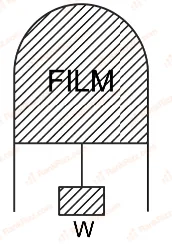
A thin liquid film formed between a U-shaped wire and a light slider supports a weight of 1.5×10−21.5 \times 10^{-2} N (see figure). The length of the slider is 3030 cm and its weight negligible. The surface tension of the liquid film is

Figure for JEE Main 2012 Physics question on Surface tension and surface energy
  1. A

    0.0125 Nm−10.0125\ Nm^{-1}

  2. B

    0.1 Nm−10.1\ Nm^{-1}

  3. C

    0.05 Nm−10.05\ Nm^{-1}

  4. D

    0.025 Nm−10.025\ Nm^{-1}

JEE MAIN 2012Speed of efflux and applications of Bernoulli's theoremTRANSCRIBED

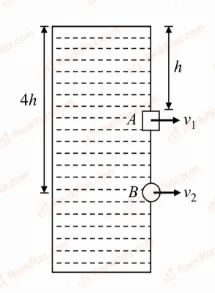
A square hole of side length ℓ\ell is made at a depth of hh and a circular hole of radius rr is made at a depth of 4h4h from the surface of water in a water tank kept on a horizontal surface. If ℓ<<h,r<<h\ell << h, r << h and the rate of water flow from the holes is the same, then rr is equal to

Figure for JEE Main 2012 Physics question on Speed of efflux and applications of Bernoulli's theorem
  1. A

    ℓ2π\dfrac{\ell}{\sqrt{2\pi}}

  2. B

    ℓ3π\dfrac{\ell}{\sqrt{3\pi}}

  3. C

    ℓ3π\dfrac{\ell}{3\pi}

  4. D

    ℓ2π\dfrac{\ell}{2\pi}

JEE MAIN 2012Stokes' law and terminal velocityTRANSCRIBED

The terminal velocity of a small sphere of radius aa in a viscous liquid is proportional to

  1. A

    a2a^2

  2. B

    a3a^3

  3. C

    aa

  4. D

    a−1a^{-1}